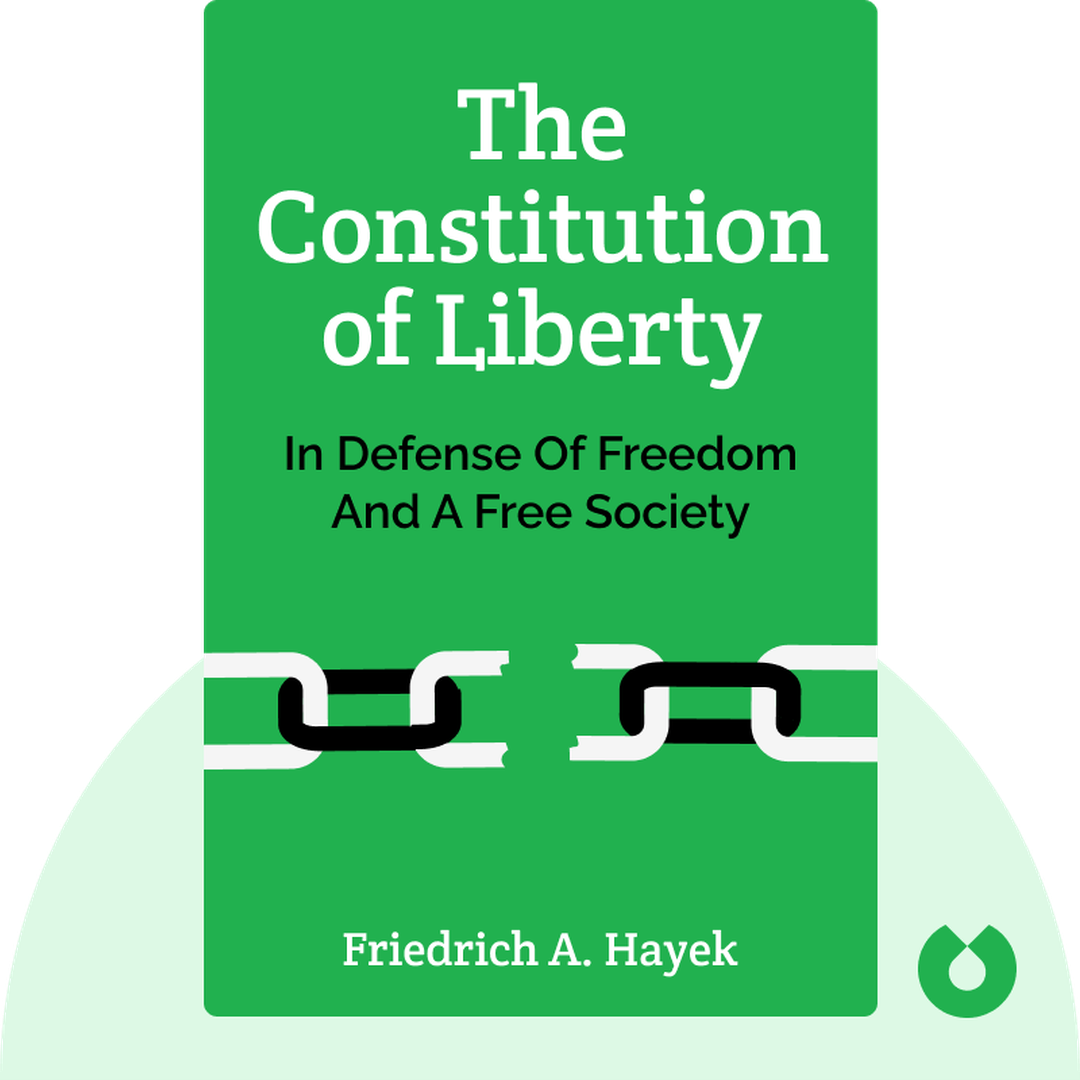
The Constitution of Liberty
Start ListeningDownload Try free on iPhoneScan to start in 5 seconds
Categories:
If You're Curious About These Questions...
You should listen to this audiobook
- What’s the secret to why social progress actually thrives under individual freedom rather than expert government planning?
- Have you ever wondered why the "rule of law" is the most essential ingredient for a truly free and prosperous society?
- Did you know that some of the greatest threats to our liberty can come from well-meaning attempts to centrally organize society?
Listen to The Constitution of Liberty — Cinematic Audio Edition
Loading player...
Key Takeaways from The Constitution of Liberty
- Understand why true individual liberty is defined as 'freedom from' external coercion, giving you the power to make choices without outside forces dictating your path.
- Discover how personal responsibility is the true cost of freedom, and why the fear of being held accountable often tempts societies to trade liberty for economic security.
- Learn why classical liberalism advocates for equality before the law rather than economic equality, recognizing that forced wealth redistribution fundamentally restricts personal freedom.
- Grasp the crucial difference between democracy and liberty, and understand how democratically elected governments can still restrict freedom if not guided by shared liberal values.
- Explore why organic social progress depends on the unpredictable trial and error of free individuals rather than the conscious, top-down design of central planners.
Learning Tools
Reinforce what you learned from The Constitution of Liberty
Mind Map
The Constitution of Liberty
Core Principles of Freedom+
Social Progress and Evolution+
The Rule of Law+
The Threat of Socialism+
Free Markets vs. Government Interference+
Quiz — Test Your Understanding
Question 1 of 10
What is Friedrich A. Hayek's primary definition of individual liberty in a free society?
Question 2 of 10
How does classical liberalism view the concepts of legal and economic equality?
Question 3 of 10
According to the text, what is the primary difference between the French and British traditions regarding social progress?
Question 4 of 10
What characterizes the ideal form of laws in a free society, according to Hayek?
Question 5 of 10
What critical mistake did the British parliamentary system make that the American Constitution attempted to fix?
Question 6 of 10
What is identified as the fundamental flaw of socialist policies that aim to distribute resources based on what people 'deserve'?
Question 7 of 10
Why does the author argue that the government should steer clear of progressive taxation?
Question 8 of 10
What is Hayek's stance on social security and welfare insurance?
Question 9 of 10
According to the text, what was an unintended long-term consequence of pro-union legislation and coercion in 1960s America?
Question 10 of 10
How does rent control typically affect the housing market, based on the provided text?
The Constitution of Liberty — Full Chapter Overview
- 1Recommendation
- 2Individual freedom is the foundation of a free society.
- 3Liberty, equality, and democracy are linked—but not the same.
- 4Social progress relies on individual liberty.
- 5A free society should be governed by the rule of law.
- 6Socialist doctrine endangers individual liberty.
- 7Government should avoid progressive taxation.
- 8Government can provide some social security, but people should ultimately support themselves.
- 9Government interference should remain minimal.
- 10Final summary
The Constitution of Liberty Summary & Overview
The Constitution of Liberty (1960) is a classic of economic philosophy. As one of the seminal texts of modern liberalism, it reminds us of the values of individual freedom, limited government, and universal principles of law. First published in the 1960s, it contends that social progress depends on the free market rather than on socialist planning. This work remains relevant in an age where socialist ideas are gaining new popularity.
Who Should Listen to The Constitution of Liberty?
- Students of twentieth-century history, politics, and economy
- Progressives and conservatives curious about liberalism
- Anyone interested in economic philosophy
Books Similar to The Constitution of Liberty
Readers who enjoyed this also liked these titles.