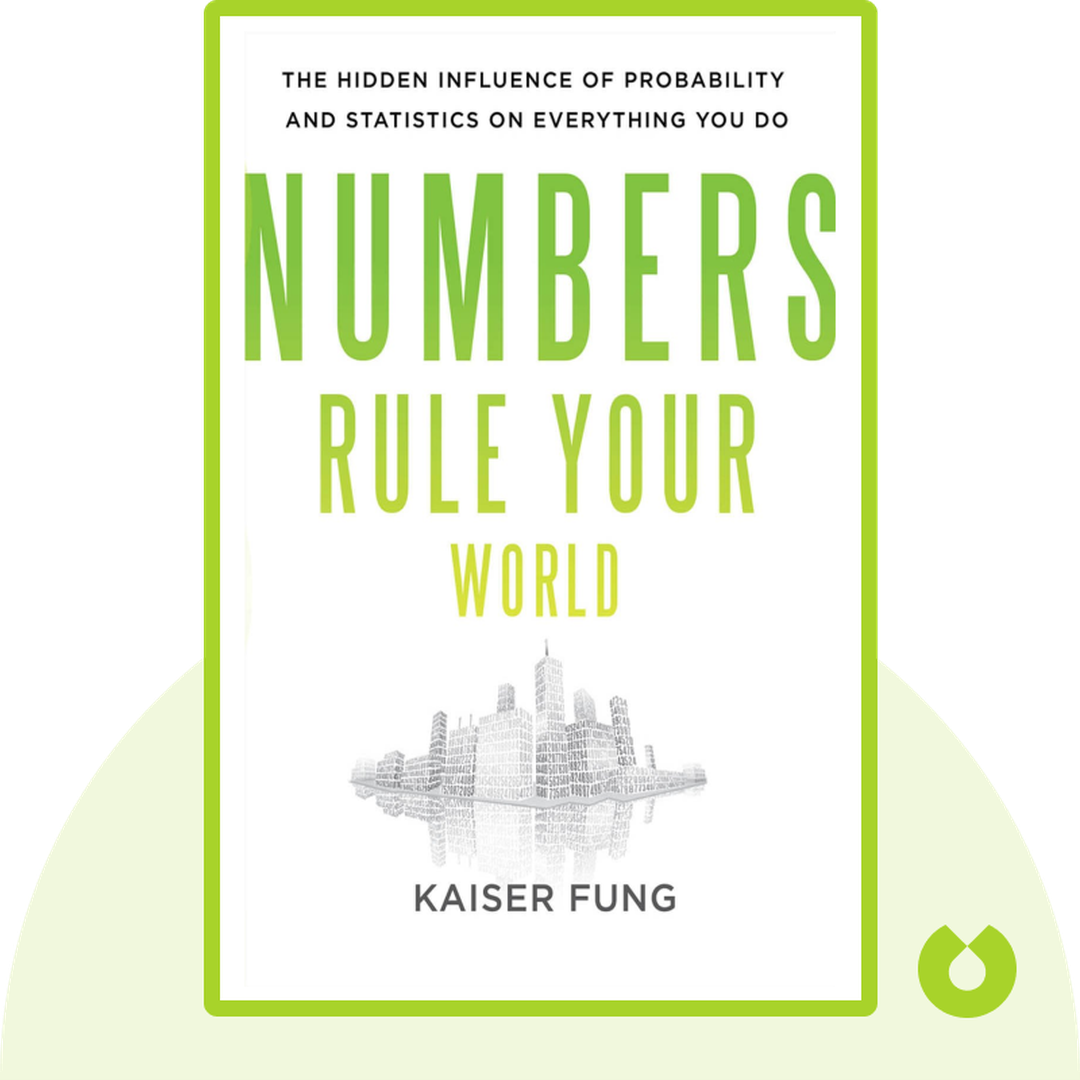
Numbers Rule Your World
Start ListeningDownload Try free on iPhoneScan to start in 5 seconds
Categories:
If You're Curious About These Questions...
You should listen to this audiobook
- Have you ever wondered why the world’s most complex systems, from highway traffic to insurance rates, are governed by just five hidden statistical rules?
- What if you could harness the power of statistical reasoning to predict outcomes and make smarter decisions in both your career and personal life?
- Are you curious about how concepts like 'variability' and 'grouping' actually shape your daily reality—and how you can use that knowledge to gain a competitive edge?
Listen to Numbers Rule Your World — Free Audiobook
Loading player...
Key Takeaways from Numbers Rule Your World
- Uncover the invisible but powerful world of statistical thinking, and discover the core principles experts use to make sound decisions that improve our daily lives.
- Discover why variations from the average dictate everyday frustrations like traffic jams, and how managing these fluctuations is more effective than simply adding capacity.
- Learn how experts apply causation to pinpoint the exact source of disease outbreaks, while relying on correlation to instantly predict financial responsibility.
- Understand how factoring in demographic and environmental group differences is absolutely essential for ensuring fairness in standardized testing and insurance policies.
- Grasp the inevitable trade-offs in statistical decision-making by exploring the delicate balance between false positives and false negatives in drug screenings.
Learning Tools
Reinforce what you learned from Numbers Rule Your World
Mind Map
Numbers Rule Your World
Variations Over Averages+
Causation & Correlation+
Group Differences+
Error Trade-offs+
Questioning Patterns+
Quiz — Test Your Understanding
Question 1 of 6
Why do long lines form at amusement parks like Disney World even if the park can accurately predict the average daily attendance?
Question 2 of 6
How do epidemiologists and credit modelers utilize statistical reasoning differently, according to the text?
Question 3 of 6
To ensure standardized tests like the SAT are fair, how do statisticians properly account for group differences?
Question 4 of 6
In the context of athletic drug testing, what is the inevitable trade-off of trying to minimize 'false positives' (wrongly accusing innocent athletes)?
Question 5 of 6
What did statistical thinking reveal about the four EgyptAir jetliner crashes that occurred in the same location between 1996 and 1999?
Question 6 of 6
How did statisticians uncover fraud in the Ontario Provincial Lottery?
Numbers Rule Your World — Full Chapter Overview
- 1Recommendation
- 2Statisticians say deviations from the mean often matter more than the mean itself does.
- 3Statistics operate by revealing causation and correlation.
- 4Statistics account for group differences to help ensure equality.
- 5Decisions using statistics often confront a trade-off between two kinds of errors.
- 6Statistical thinking teaches us to challenge patterns.
Numbers Rule Your World Summary & Overview
Numbers Rule Your World (2010) is a guide to statistical reasoning and how you can use concrete statistical information productively to understand as well as improve your world. These blinks walk the reader through the five key principles of statistics and how they can be applied to improve decision making in various contexts.
Who Should Listen to Numbers Rule Your World?
- People interested in statistics and how they apply to everyday life
- Anyone keen to reap the benefits of statistical thinking
Books Similar to Numbers Rule Your World
Readers who enjoyed this also liked these titles.