If You're Curious About These Questions...
You should listen to this audiobook
- Did you know that the rise of super-intelligent AI might be our planet’s best hope for surviving the climate crisis?
- Have you ever wondered what happens to humanity when we are no longer the most intelligent beings on Earth, but merely the precursors to a new form of life?
- Are you curious about the extraordinary theory that suggests humanity’s true purpose is to help the cosmos finally understand itself?
Listen to Novacene — Cinematic Audio Edition
Loading player...
Key Takeaways from Novacene
- Discover why the current geological age of humanity, the Anthropocene, is rapidly ending to make way for the 'Novacene,' a new era defined by autonomous, self-replicating AI.
- Learn how an artificial intelligence takeover will likely be a peaceful, mutually beneficial event that helps humanity combat climate change, rather than a dystopian nightmare.
- Understand the Gaia hypothesis, which reveals how Earth functions as a single, self-regulating system where organic life and the biosphere mutually adapt to one another.
- Explore the concept of non-linear causation in nature to truly grasp how ecosystems, like rainforests, simultaneously rely on and actively create their own sustaining climates.
- Find out why Earth is more vulnerable to global warming today than it was 55 million years ago, largely due to increased solar radiation pushing us out of the traditional 'habitable zone'.
Learning Tools
Reinforce what you learned from Novacene
Mind Map
Novacene
The Epoch Transition+
Gaia Hypothesis+
The Heat Threat & AI Alliance+
Critique of Environmentalism+
Evolutionary Acceleration+
Superiority of Electronic Life+
Cosmic Purpose+
Quiz — Test Your Understanding
Question 1 of 7
According to James Lovelock, how should humanity view the impending takeover of Earth by Artificial Intelligence?
Question 2 of 7
What defines the 'Novacene', the new geological age that Lovelock argues we are currently entering?
Question 3 of 7
Why has the scientific community historically resisted the Gaia hypothesis?
Question 4 of 7
Why does Lovelock believe that superintelligent AI will choose to preserve organic human life rather than destroy it?
Question 5 of 7
How does Lovelock critique the modern environmentalist movement?
Question 6 of 7
What is one of the primary reasons Lovelock argues electronic life will be vastly superior to organic human life?
Question 7 of 7
According to Lovelock's interpretation of the Anthropic Cosmological Principle, what is the ultimate purpose of the cosmos?
Novacene — Full Chapter Overview
- 1Recommendation
- 2The Anthropocene is drawing to a close, and a new epoch is set to begin.
- 3The Gaia hypothesis holds Earth to be a single, self-regulating system.
- 4The gravest threat to life’s continued existence on Earth is excessive heat today.
- 5Modern environmentalism remains overly human-centric, even in its misanthropic condemnations of the Anthropocene.
- 6Human innovation continues evolution’s trajectory toward increasingly intelligent forms of life.
- 7The emerging electronic form of life will surpass human life, vastly superior to us in almost every way.
- 8Humanity has long served as the conduit through which the cosmos understands itself, but indeed that role will soon be superseded.
Novacene Summary & Overview
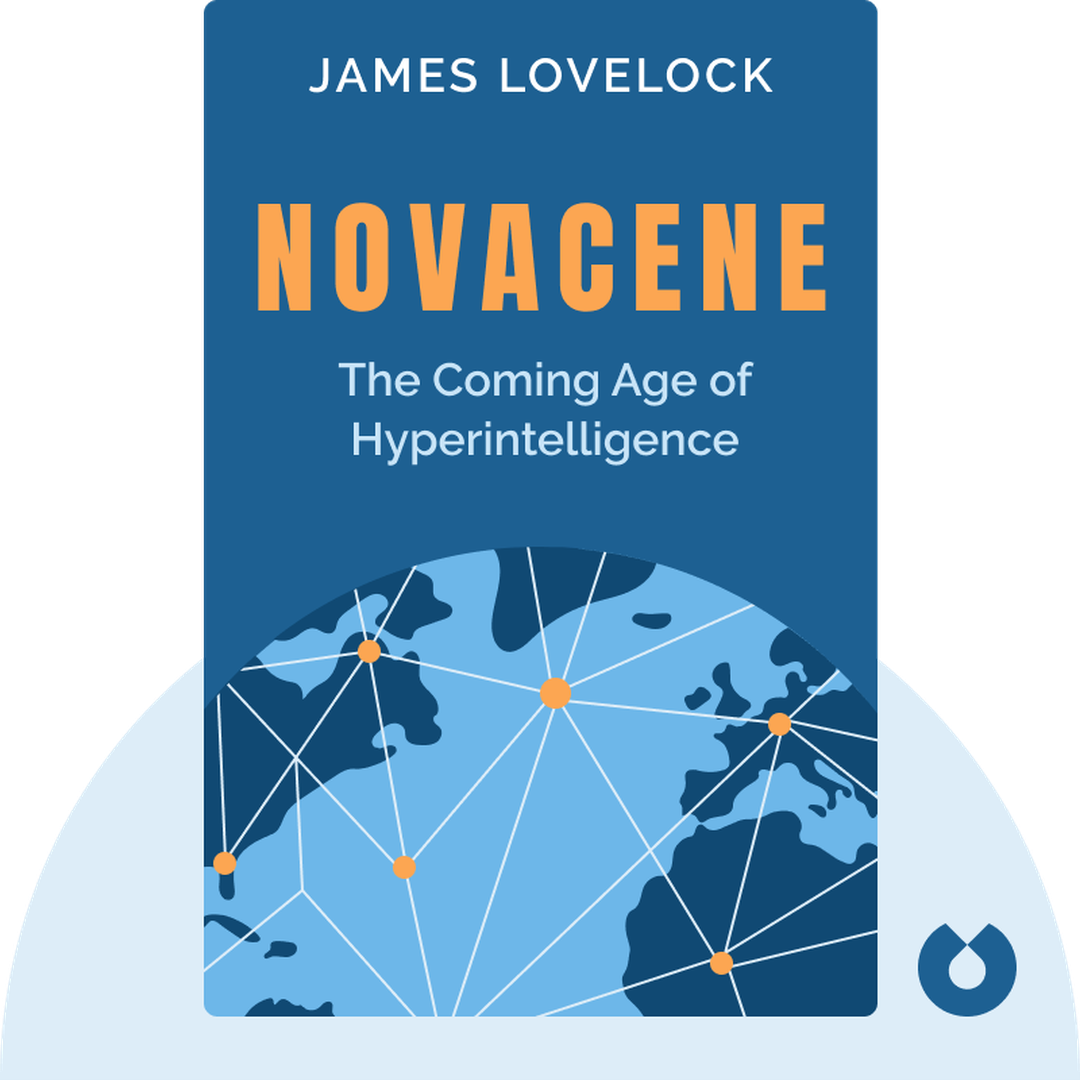
Novacene (2019) presents a startling vision of a near-future Earth in which climate change is threatening our existence and artificial intelligence technology has acquired life. The emergence of this new life-form, which will vastly surpass humanity in its intelligence, will mark the beginning of a new age in the history of Earth – an epoch the author calls the Novacene. Extremely ambitious in scope, Novacene shines a spotlight on our particular moment in history and articulates an extraordinary theory about the purpose of the Cosmos and our place in it.
Who Should Listen to Novacene?
- Environmentalists who fear for the future of the planet
- Luddites who want to put the brakes on technological innovation
- Curious minds ready for a theory about humanity’s purpose in the cosmos
Books Similar to Novacene
Readers who enjoyed this also liked these titles.