If You're Curious About These Questions...
You should listen to this audiobook
- Did you know that there’s a hidden flaw in human judgment that is just as damaging as bias, yet almost everyone completely ignores it?
- Have you ever wondered why a doctor’s diagnosis or a judge’s sentence can drastically change depending on the time of day or even the weather?
- What if you could master a few simple strategies to strip away the invisible "noise" that clouds your decisions and makes your judgments more accurate?
Listen to Noise — Free Audiobook
Loading player...
Key Takeaways from Noise
- Discover how seemingly irrelevant factors, like the weather or a recent sports loss, can drastically alter professional judgments and lead to unpredictable 'occasion noise'.
- Understand the crucial difference between bias and noise, and how recognizing systematic cognitive errors can help expose widespread inconsistencies within an entire system.
- Learn how individual biases compound to create devastating 'system noise,' leading to wildly varying decisions in high-stakes environments like immigration courts.
- Find out why human experts often fail at predicting the future because our brains are easily led astray by the emotional reward of a conclusion that simply 'feels right'.
- See why simple mathematical formulas and basic algorithms consistently outperform highly trained human professionals when making critical predictive decisions like granting bail.
Learning Tools
Reinforce what you learned from Noise
Mind Map
Noise
Understanding Noise+
Psychological Blindspots+
Measuring the Problem+
Reducing Noise+
Quiz — Test Your Understanding
Question 1 of 8
According to the text, what is 'occasion noise'?
Question 2 of 8
How does the book distinguish between 'noise' and 'bias' using the analogy of a shooting arcade?
Question 3 of 8
Why do rudimentary algorithms often outperform human experts in making predictions, such as setting bail?
Question 4 of 8
Why is 'noise' often ignored or unnoticed by people compared to 'bias'?
Question 5 of 8
Which of the following is a crucial caveat for the 'wisdom-of-crowds' effect to successfully reduce noise?
Question 6 of 8
What is the primary purpose of conducting a 'noise audit' in an institution?
Question 7 of 8
What does the concept of taking the 'outside view' in decision hygiene entail?
Question 8 of 8
Why did the noise reduction achieved by the Sentencing Reform Act ultimately fail to stick in the long run?
Noise — Full Chapter Overview
- 1Recommendation
- 2Unrelated, unpredictable factors can seriously affect human judgment.
- 3Noise and bias are different, although bias can create noise.
- 4Our predictions are easily swayed by what feels right.
- 5We overlook noise because it doesn’t make a compelling story.
- 6We can reduce noise by averaging several independent judgments on the same question.
- 7To combat noise, you first have to reveal it with a noise audit.
- 8Decision hygiene can reduce noise—and like everyday hygiene, it depends on discipline and prevention.
- 9For noise reduction to last, judges need to be on board.
- 10Final summary
Noise Summary & Overview
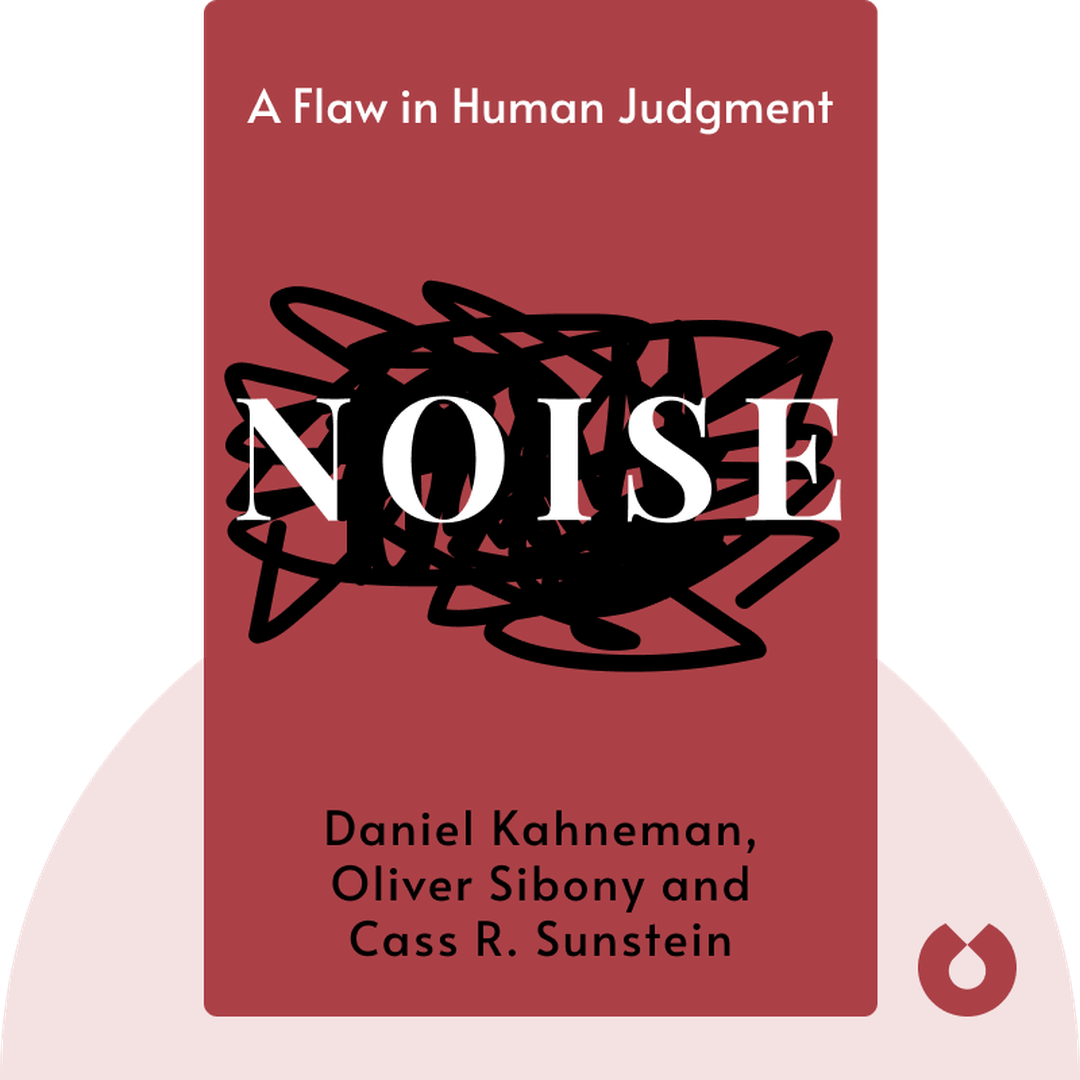
Noise (2021) is an exploration into the chaotic and costly role that randomness plays in human judgment. By uncovering the mechanisms behind how our minds and societies work, the authors show how noise – unwanted variability in decisions – is both inescapable and elusive. We can, however, with a few solid strategies, make our judgments less noisy and our world fairer.
Who Should Listen to Noise?
- Behavioral economists, psychologists, CEOs, and students
- Anyone interested in how we make judgments and how those judgments shape society
- Anyone who cares about accuracy and fairness
Books Similar to Noise
Readers who enjoyed this also liked these titles.