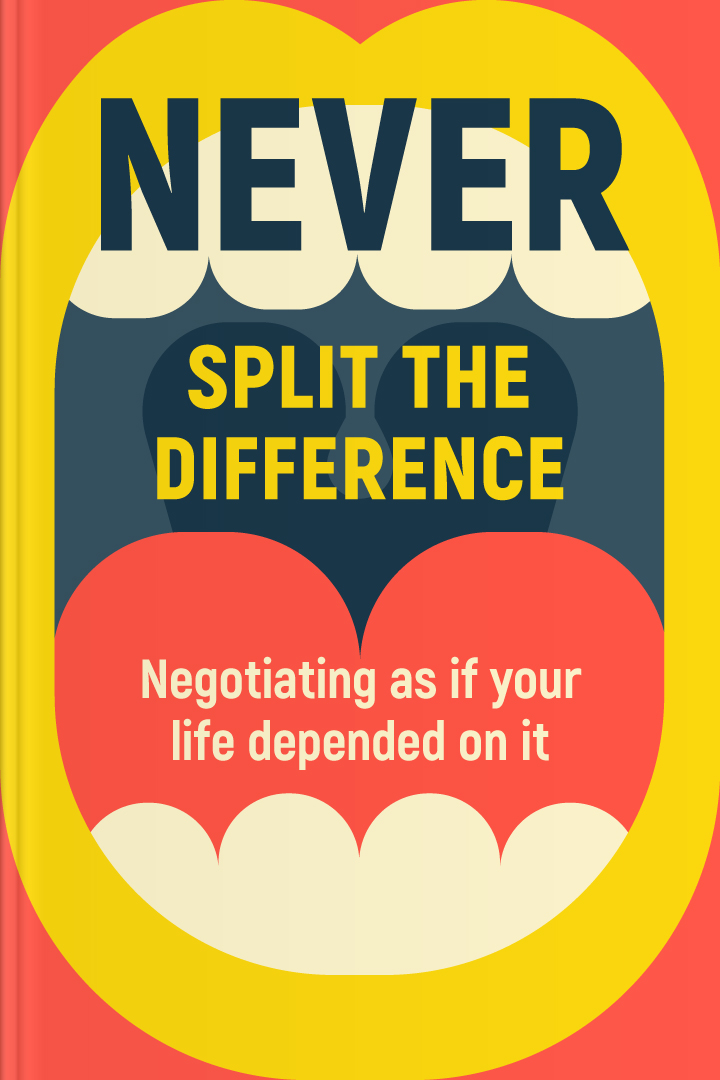
Never Split the Difference
Start ListeningDownload Try free on iPhoneScan to start in 5 seconds
Categories:
If You're Curious About These Questions...
You should listen to this audiobook
- Did you know that the secret to winning any negotiation isn't logic or compromise, but a counterintuitive psychological technique used by FBI hostage negotiators?
- Have you ever wondered why pushing for a 'yes' might actually be ruining your deal, and why the most powerful word in a conversation is actually 'no'?
- What if you could use a specific set of 'calibrated questions' to get exactly what you want while making the other person feel like they’re the one in control?
Listen to Never Split the Difference — Cinematic Audio Edition
Loading player...
Key Takeaways from Never Split the Difference
- Understand why people act instinctively and irrationally in everyday negotiations, and discover how to use this knowledge of human nature to your advantage.
- Learn how the simple technique of 'mirroring'—repeating another person’s words—builds instant trust, comforts your counterpart, and encourages them to disclose more information.
- Master the deliberate use of your voice by alternating between an easygoing, playful tone for collaboration and a calm 'late-night FM DJ' voice to safely assert authority.
- Discover how 'tactical empathy' combines emotional intelligence with strategic thinking to help you uncover your counterpart's true feelings and influence their actions.
- Find out how to use 'labeling' to recognize and verbalize the other person's underlying emotions, effectively diffusing negative feelings and keeping the negotiation moving forward.
Learning Tools
Reinforce what you learned from Never Split the Difference
Mind Map
Never Split the Difference
Core Philosophy+
Active Listening+
Tactical Empathy+
The Power of 'No'+
Avoid Compromise+
Black Swans+
Quiz — Test Your Understanding
Question 1 of 8
According to the book, what is a fundamental flaw in traditional negotiation theory?
Question 2 of 8
What is the primary goal of using the 'mirroring' technique in a negotiation?
Question 3 of 8
The book describes 'tactical empathy'. How does this differ from regular empathy?
Question 4 of 8
When using the 'labeling' technique, why is it recommended to start phrases with 'It sounds like...' or 'It seems like...'?
Question 5 of 8
Why does the author argue that hearing the word 'No' can be a positive step in a negotiation?
Question 6 of 8
What is the author's main argument against 'splitting the difference'?
Question 7 of 8
In negotiation, what is a 'black swan'?
Question 8 of 8
How does 'negative leverage' work, according to the book?
Never Split the Difference — Full Chapter Overview
- 1Recommendation
- 2Negotiation is part of daily life—and there’s far more to it than logic and intellect.
- 3Use active listening in daily interactions to strengthen and build trust.
- 4Emotions and empathy are tools you can employ to build trust.
- 5Simply say no!
- 6Do not compromise, don’t yield, and never, ever split the difference.
- 7Spot the black swan, and turn it to your advantage.
Never Split the Difference Summary & Overview
Never Split the Difference (2016) is your guide to getting what you want. Drawing on FBI strategies, it offers hands-on advice for how to negotiate your way to success – whether it’s in the office, the home, or a hostage standoff.
Who Should Listen to Never Split the Difference?
- Leaders and managers
- Workers in the market for a job or a raise
- Anyone with a spouse, partner, or friend
Books Similar to Never Split the Difference
Readers who enjoyed this also liked these titles.