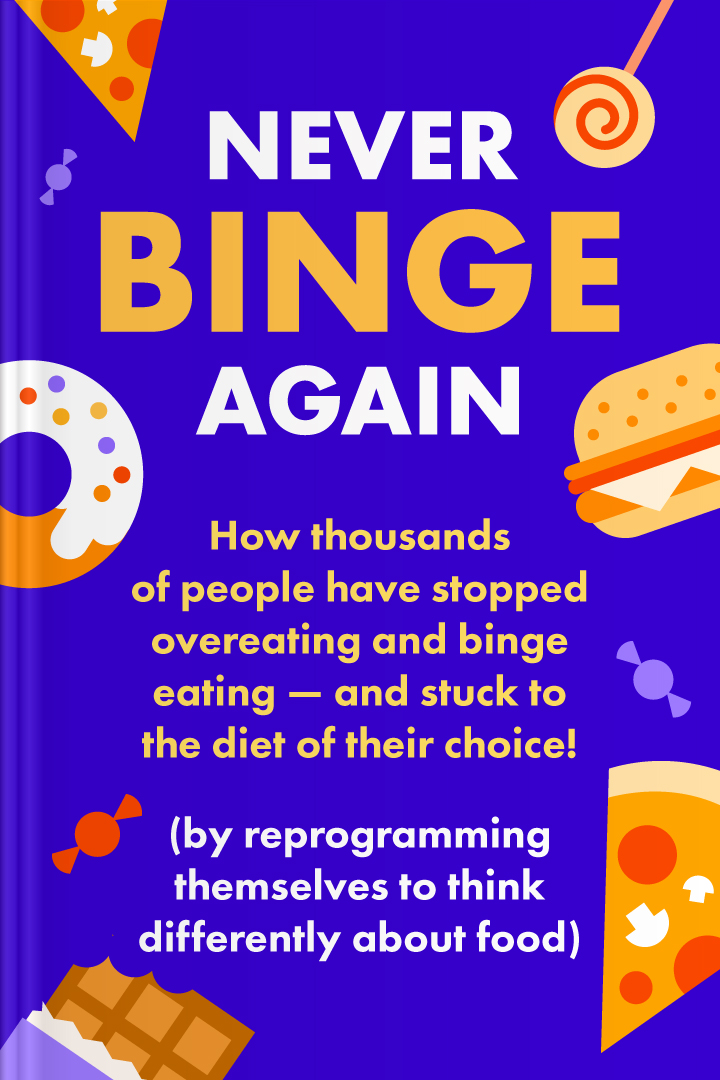
Never Binge Again audiobook cover - This warm, practical guide reframes binge eating as a battle you can learn to win—by creating a clear food plan, separating cravings from identity, and returning to progress quickly and kindly whenever you slip.

Never Binge Again

This warm, practical guide reframes binge eating as a battle you can learn to win—by creating a clear food plan, separating cravings from identity, and returning to progress quickly and kindly whenever you slip.

Glenn Livingstone, PhD

4.3 / 5(4 ratings)
Start ListeningDownloadQR code that opens AudiobookHub on the App StoreTry free on iPhoneScan to start in 5 seconds

If You're Curious About These Questions...

You should listen to this audiobook

Listen to Never Binge Again — Free Audiobook

Loading player...

Key Takeaways from Never Binge Again

Learning Tools

Reinforce what you learned from Never Binge Again

Mind Map

Never Binge Again
Foundations of Food Addiction+
Designing a Clear Food Plan+
Handling Discomfort & Setbacks+
Maintaining & Adjusting the Plan+
Reclaiming Choice & Power+
Using Guilt as Information+
A Steady Path to Freedom+

Quiz — Test Your Understanding

Question 1 of 10
What is the primary purpose of discipline and healthy structure when dealing with food addiction?
  • A. To serve as a rigid moral test of your character.
  • B. To act as a protective boundary that keeps your health safe.
  • C. To punish yourself for past dietary mistakes.
  • D. To create a fast track for rapid weight loss.
Question 2 of 10
Why is overcoming a binge eating addiction described as particularly complex compared to overcoming addictions to drugs or alcohol?
  • A. Because food addiction is purely physical and lacks psychological elements.
  • B. Because healthy food is generally more expensive than addictive substances.
  • C. Because eating is a necessary part of daily life and cannot be completely avoided.
  • D. Because there are no trained healthcare professionals for food addiction.
Question 3 of 10
In the book's framework, what does the 'pig' represent?
  • A. The impulsive, survival-driven voice that pushes for immediate comfort through food.
  • B. A supportive internal guide that helps regulate portion control.
  • C. The food industry's deceptive marketing strategies.
  • D. Your true underlying identity that needs to be starved.
Question 4 of 10
What are the four categories recommended for structuring a clear food plan?
  • A. Morning, Noon, Evening, and Night rules.
  • B. Good, Bad, Neutral, and Occasional foods.
  • C. Proteins, Fats, Carbohydrates, and Sugars.
  • D. Nevers, Always, Unrestricteds, and Conditionals.
Question 5 of 10
How does the book suggest you view emotional or physical discomfort when starting a new food plan?
  • A. It is a warning sign that the diet is too strict and should be abandoned.
  • B. It proves that your inner 'pig' is permanently taking over.
  • C. It is a normal response indicating that a habit is changing, not an emergency.
  • D. It means your body is going into starvation mode and needs immediate calories.
Question 6 of 10
If a 'Conditional' rule in your food plan repeatedly leads to a loss of control, what action is recommended?
  • A. Move it into the 'Never' category to eliminate the loophole.
  • B. Punish yourself by fasting for the rest of the day.
  • C. Keep it as a Conditional but use willpower to try harder next time.
  • D. Change it to an 'Unrestricted' food so it loses its psychological appeal.
Question 7 of 10
Why does Dr. Livingstone express concern over the common recovery practice of 'counting days'?
  • A. Because it guarantees a relapse when milestone days are reached.
  • B. Because it keeps a person psychologically locked in 'battle mode' as an addict.
  • C. Because tracking days requires too much mathematical effort and distracts from cooking.
  • D. Because it causes individuals to ignore their 'Always' and 'Unrestricted' habits.
Question 8 of 10
Which of the following is identified as a common mistake or rationalization that can quietly derail progress?
  • A. Taking a 'little break' from the diet because you start seeing early results.
  • B. Writing your food plan down and placing it somewhere visible.
  • C. Separating your cravings from your true identity.
  • D. Keeping your new food philosophy private to avoid defensive reactions.
Question 9 of 10
How should guilt and shame be utilized during the recovery process?
  • A. They should be completely ignored since they are always destructive to self-esteem.
  • B. They should be maintained as a daily form of self-punishment to deter future binges.
  • C. They should be viewed as internal alarms or moral pointers, but not held onto for too long.
  • D. They are the primary emotions that fuel the inner 'pig' and guarantee permanent failure.
Question 10 of 10
What pacing does the book recommend when introducing changes to your diet and lifestyle?
  • A. A rapid, extreme overhaul to shock the body into immediate submission.
  • B. Following a 30-day strict sprint to reset metabolism as fast as possible.
  • C. A slow and careful pace, because rushing increases the risk of relapse.
  • D. Allowing the inner 'pig' to dictate the speed of habit changes.

Never Binge Again — Full Chapter Overview

Never Binge Again Summary & Overview

This summary explores a compassionate, structured approach to overcoming binge eating and food addiction. It highlights why quick fixes so often fail, and how steady, thoughtful planning can help a person reclaim a sense of choice around food—without relying on constant willpower alone.

Across seven chapters, the narration walks through building a personal food plan, anticipating discomfort and cravings, staying grounded in responsibility rather than shame, and knowing when to adjust a plan for true improvement—not as a sneaky path back to old habits. The overall tone is steady and encouraging: progress matters, and persistence can be learned.

Who Should Listen to Never Binge Again?

  • People who feel stuck in cycles of bingeing, emotional eating, or losing control around specific foods and want a clearer, calmer framework.
  • Listeners who have tried strict diets or “quick fixes” and want a more sustainable plan built on personal responsibility and self-respect.
  • Anyone who wants supportive language and practical steps for recovering after setbacks without spiraling into guilt, shame, or giving up.

About the Author: Glenn Livingstone, PhD

Glenn Livingstone, PhD is presented here as a trained professional whose methods are described as research-informed and tested with many individuals. His work emphasizes practical structure, personal responsibility, and strategies for separating cravings from one’s identity.

🎧
Listen in the AppOffline playback & background play
Get App