If You're Curious About These Questions...
You should listen to this audiobook
- Did you know that the Apollo moon landing holds the secret to solving today’s most complex global crises, from climate change to healthcare?
- Have you ever wondered why modern capitalism often fails to deliver big breakthroughs, and what it would take to reignite a sense of purpose in our economy?
- What if we could stop treating government as a mere 'fixer' of market failures and instead transform it into a bold engine for societal innovation?
Listen to Mission Economy — Free Audiobook
Loading player...
Key Takeaways from Mission Economy
- Discover why we must tackle today's socioeconomic crises with a 1960s 'moonshot' mentality, prioritizing ambitious missions over strict budgetary constraints.
- Understand how the financialization of modern business prioritizes shareholder value over societal needs, driving both widening inequality and the climate crisis.
- Learn how governments actually drive major innovation by taking massive early-stage risks, contrary to the myth that only the private sector innovates.
- Find out how setting a singular, ambitious mission generates powerful technological spillover effects, yielding unexpected everyday innovations like modern software and home insulation.
- Master the leadership strategies behind the Apollo program by seeing how a culture of experimentation and risk-taking can attract top talent to solve complex challenges.
Learning Tools
Reinforce what you learned from Mission Economy
Mind Map
Mission Economy
The Mission Concept+
Flaws in Current Capitalism+
Lessons from Apollo 11+
Modern Earth-Bound Missions+
Rethinking Public Value+
Fairness and Collective Effort+
Quiz — Test Your Understanding
Question 1 of 7
Why does the author use the 1969 Apollo moon mission as a model for modern problem-solving?
Question 2 of 7
According to the text, what is a major flaw in the current financial and business sector?
Question 3 of 7
How does the author challenge the modern economic orthodoxy regarding the role of government?
Question 4 of 7
What characterized the Apollo mission's approach to budgeting and outsourcing?
Question 5 of 7
How should modern environmental missions, like the Green New Deal, differ from the Apollo mission?
Question 6 of 7
What is the author's view on national budgets and public finance?
Question 7 of 7
How does the author suggest society should address modern economic inequality?
Mission Economy — Full Chapter Overview
- 1Recommendation
- 2We need to reshape our political economy with a vision as bold as the 1960s moon mission.
- 3We need visionary change, but governments are too hesitant to drive it.
- 4The US government’s Apollo program shows how much a mission can achieve.
- 5Among the many missions we could choose today, many focus on the environment.
- 6We need a mission to rethink the political economy and its view of public value.
- 7We need to transform the political economy together, and do it fairly.
- 8Final summary
Mission Economy Summary & Overview
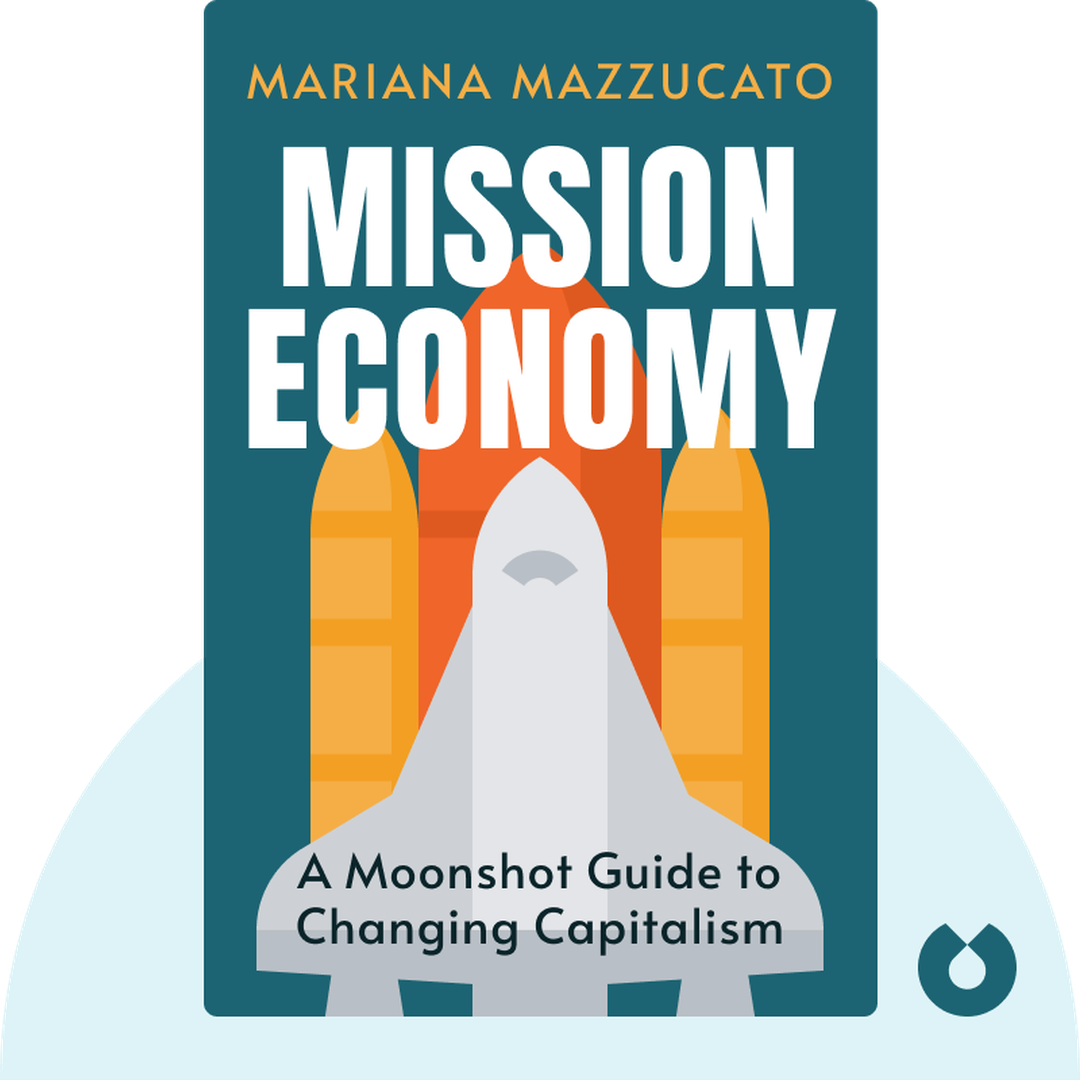
Mission Economy (2021) explains how we can rethink our approaches toward government and capitalism through the concept of missions – huge, ambitious projects that inspire people across society to think big. These blinks show how we can change the world by taking inspiration from one of the most famous missions of all: the moon landing.
Who Should Listen to Mission Economy?
- Visionary thinkers who want to transform society
- Economists and politics fans in search of bold new ideas
- Critics of capitalism who want to see change
Books Similar to Mission Economy
Readers who enjoyed this also liked these titles.