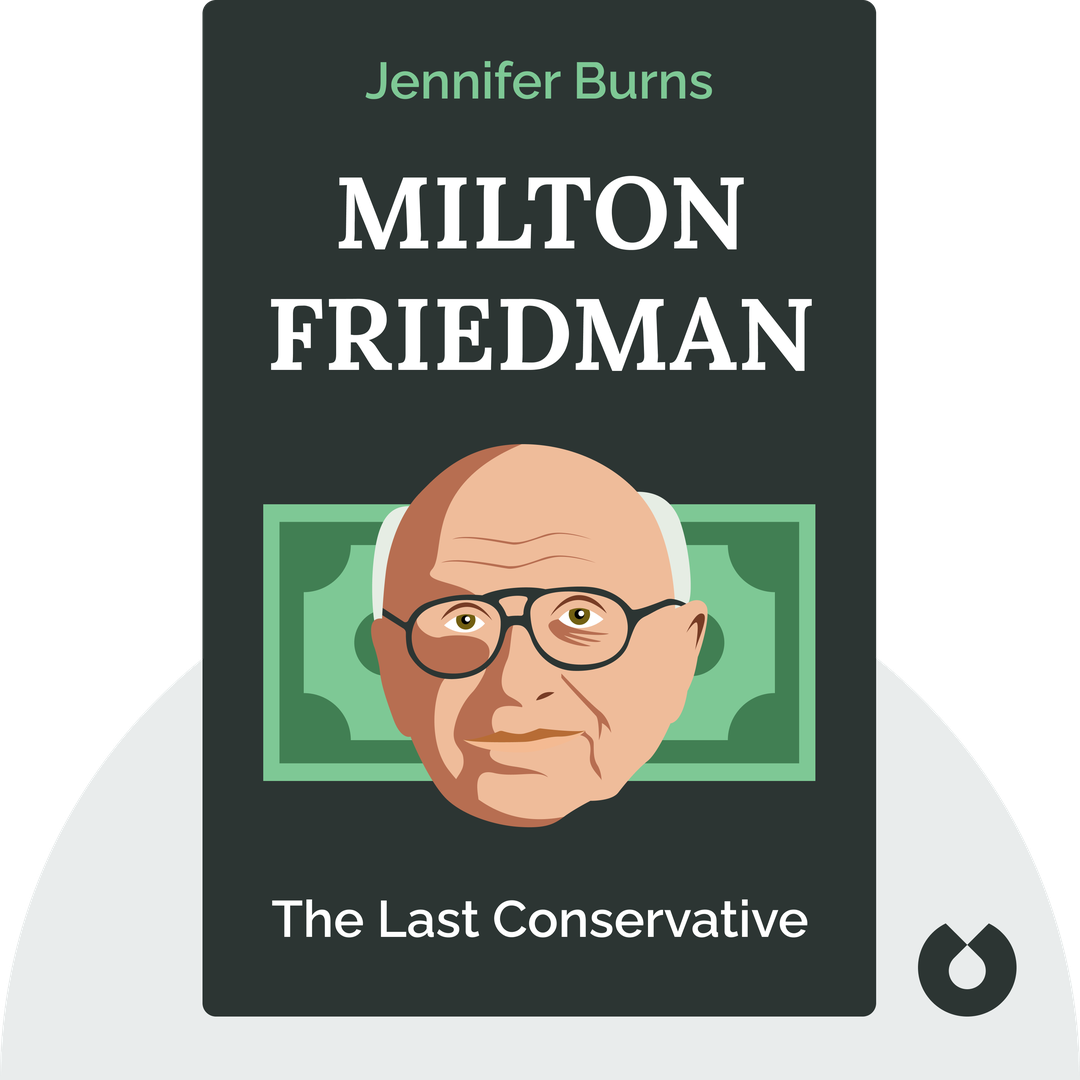
If You're Curious About These Questions...
You should listen to this audiobook
- Did you know that many of the economic policies we take for granted today actually began as a radical challenge to the status quo?
- Have you ever wondered how a single economist managed to reshape the entire landscape of American politics and modern conservatism?
- Are you curious about the hidden history behind the rise of neoliberalism and the man who became its most powerful voice?
Listen to Milton Friedman — Free Audiobook
Loading player...
Key Takeaways from Milton Friedman
- Discover how Milton Friedman, the son of working-class immigrants, evolved into a polarizing economic icon whose ideas on free markets and limited government shaped twentieth-century thought.
- Understand the foundational differences between the University of Chicago's free-market 'price theory' and the government-driven economic planning that dominated the New Deal era.
- Learn why Friedman's controversial doctoral thesis sparked intense backlash by aggressively applying free-market theory to accuse the American Medical Association of artificially inflating doctors' incomes.
- Find out how Friedman's brilliant statistical innovation during World War II, known as sequential analysis, optimized military munitions testing and created a lasting impact on postwar statistics.
- Explore how Friedman and his allies formed a powerful academic counter-establishment at the University of Chicago, ultimately developing the monetarist approach that displaced Keynesian economics in the 1970s.
Learning Tools
Reinforce what you learned from Milton Friedman
Mind Map
Milton Friedman
Early Life & Education+
Early Career & Conflicts+
Building the Chicago School+
Core Economic Theories+
Global Legacy+
Quiz — Test Your Understanding
Question 1 of 6
What was the primary focus of the University of Chicago's economics department when Milton Friedman first arrived for graduate studies in 1932?
Question 2 of 6
Why did Friedman's doctoral research cause years of dispute with his superiors at the National Bureau of Economic Research (NBER)?
Question 3 of 6
Upon returning to the University of Chicago, Friedman helped nurture new intellectual movements. Which of the following was a key focus of these movements?
Question 4 of 6
As Friedman developed his unique vision of liberalism, what core value did he prioritize to differentiate his philosophy from both New Deal liberals and right-wing reactionaries?
Question 5 of 6
In their 1963 study "A Monetary History of the United States," what did Friedman and Anna Schwartz conclude was the primary cause of the Great Depression's severity?
Question 6 of 6
How were Friedman's monetarist theories practically applied by the US government to combat stagflation in the late 1970s and early 1980s?
Milton Friedman — Full Chapter Overview
- 1Recommendation
- 2Friedman’s early life
- 3Columbia, Washington, and beyond
- 4The return to Chicago
- 5Friedman’s lasting legacy
- 6Final summary
Milton Friedman Summary & Overview
Milton Friedman (2023) provides a nuanced biography of the influential free-market economist. Tracing Friedman's groundbreaking work across diverse policy areas, it explores his instrumental role in the rise of modern American conservatism and free market ideology.
Who Should Listen to Milton Friedman?
- Those looking to understand the roots of modern neoliberalism
- Students of public policy and political history
- Anyone interested in impactful, paradigm-shifting thinkers
Books Similar to Milton Friedman
Readers who enjoyed this also liked these titles.