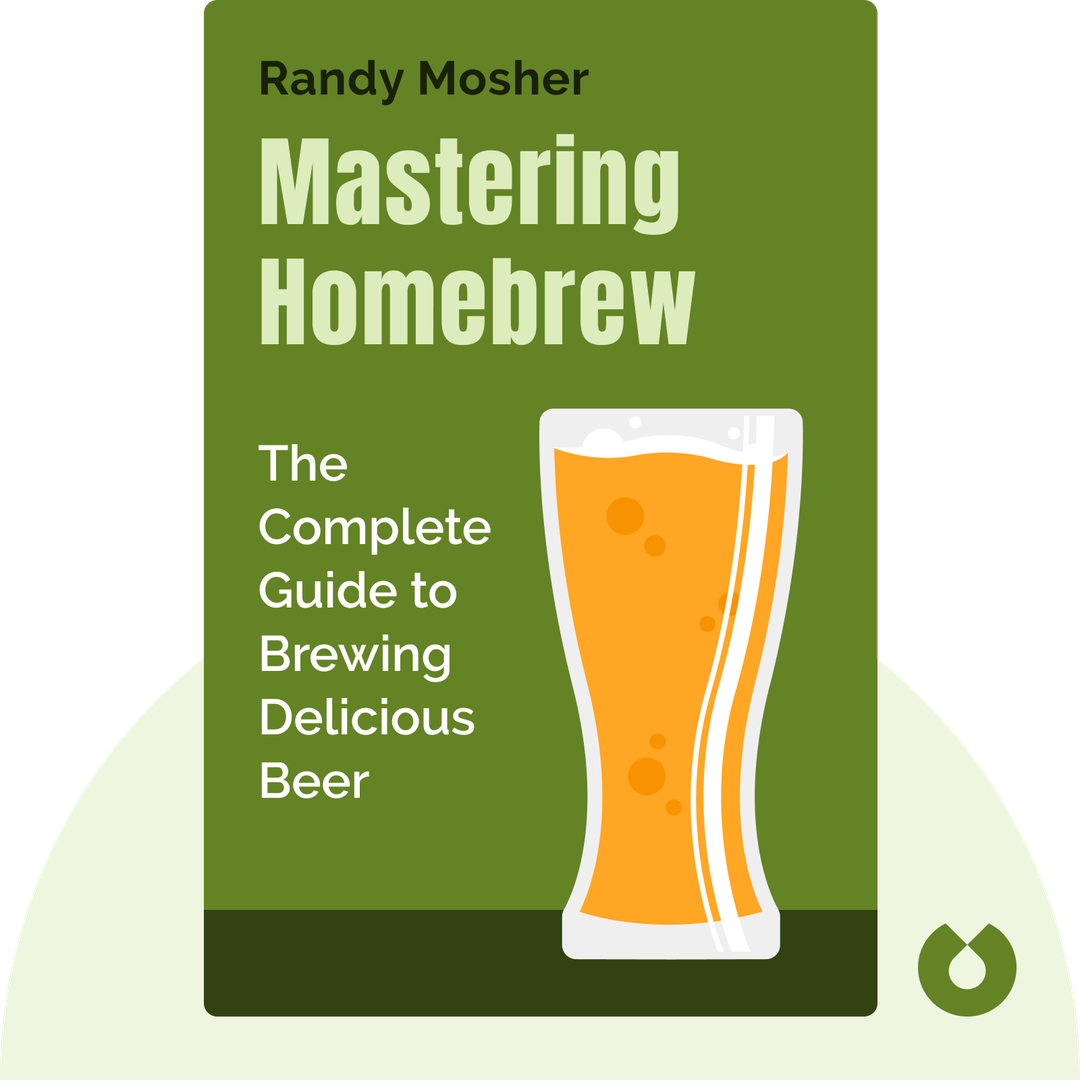
If You're Curious About These Questions...
You should listen to this audiobook
- Have you ever wondered how a handful of basic ingredients can be transformed into an infinite variety of world-class beer styles?
- What’s the secret to avoiding the common pitfalls that ruin a batch and ensuring your homebrew tastes like a professional craft beer?
- Did you know that mastering the subtle science of fermentation is the key to unlocking flavors you can't find in any store-bought bottle?
Listen to Mastering Homebrew — Free Audiobook
Loading player...
Key Takeaways from Mastering Homebrew
- Discover how brewing blends the strict science of chemistry and biology with artistic intuition, allowing you to experiment and craft a truly unique beer.
- Learn to evaluate beer like a pro by understanding quantifiable metrics like gravity, alcohol content, and Bitterness Units.
- Master the art of tasting by taking a deep whiff and holding a sip on your tongue to identify complex flavors, balance, and mouthfeel.
- Understand the distinct roles of core ingredients, using malted barley to provide essential fermentable sugars and hops to introduce unique spices and aromas.
- Find out why water is a crucial, often-overlooked ingredient, and how its specific mineral content fundamentally shapes the final flavor profile of your brew.
Learning Tools
Reinforce what you learned from Mastering Homebrew
Mind Map
Mastering Homebrew
Science & Art+
Evaluating Beer+
Essential Ingredients+
Equipment & Sanitation+
The Brewing Process+
Yeast Cultivation+
Customization & Styles+
Quiz — Test Your Understanding
Question 1 of 8
What does the 'gravity' of a beer measure?
Question 2 of 8
Why is barley traditionally considered an ideal grain for brewing beer?
Question 3 of 8
Why does the author recommend homebrewers use distilled or filtered water instead of tap water?
Question 4 of 8
What happens during the 'secondary fermentation' or 'conditioning' stage of brewing?
Question 5 of 8
What is the primary purpose of a 'wort chiller' in a homebrewing setup?
Question 6 of 8
What is the correct brewing term for the process of adding yeast to the wort?
Question 7 of 8
According to the book's final advice, what is the most common reason that a homebrew fails?
Question 8 of 8
How does the text describe the traditional characteristics of a British brown ale?
Mastering Homebrew — Full Chapter Overview
- 1Recommendation
- 2Brewing beer is both scientific and artistic.
- 3Beer can be scientifically measured or simply enjoyed for its qualities.
- 4Great beer begins with choosing the right ingredients.
- 5Brew your first beer with a simple, no-frills recipe.
- 6Begin with basic brewing tools and upgrade as needed.
- 7Improve your beer by cultivating happy, healthy yeast.
- 8Experiment with flavors and methods to create a unique homebrew.
- 9The world is filled with distinctive beers waiting to be discovered and enjoyed.
- 10Final summary
Mastering Homebrew Summary & Overview
Mastering Homebrew (2015) is an accessible guide to the art of making beer. This practical handbook gives a step-by-step overview of the whole process from brewing to bottling.
Who Should Listen to Mastering Homebrew?
- Budding brewers looking to make their first batch
- Seasoned drinkers seeking to deepen their beer knowledge
- Anyone curious about making beer at home
Books Similar to Mastering Homebrew
Readers who enjoyed this also liked these titles.