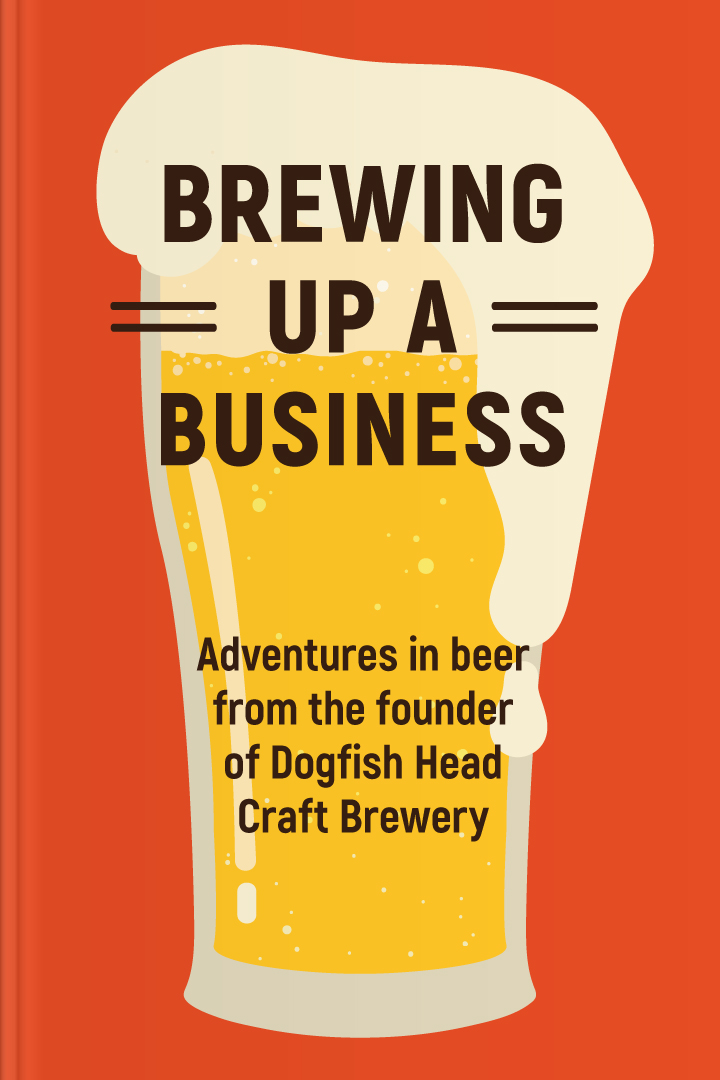
Brewing Up a Business audiobook cover - This warm, practical narrative follows Sam Calagione’s unlikely path—from rebellious misfit to respected founder—offering gentle encouragement for anyone building something meaningful, even with limited resources, doubt from others, or a past that doesn’t fit the usual success story.

Brewing Up a Business

This warm, practical narrative follows Sam Calagione’s unlikely path—from rebellious misfit to respected founder—offering gentle encouragement for anyone building something meaningful, even with limited resources, doubt from others, or a past that doesn’t fit the usual success story.

Sam Calagione

4.3 / 5(4 ratings)
Start ListeningDownloadQR code that opens AudiobookHub on the App StoreTry free on iPhoneScan to start in 5 seconds

If You're Curious About These Questions...

You should listen to this audiobook

Listen to Brewing Up a Business — Free Audiobook

Loading player...

Key Takeaways from Brewing Up a Business

Learning Tools

Reinforce what you learned from Brewing Up a Business

Mind Map

Brewing Up A Business
When a Past Doesn’t Predict a Future+
The Underdog Advantage+
Building a Sustainable Life+
Research as Protection+
Finding & Serving Your Niche+
Marketing on a Budget+
Brewing Something Worth Keeping+

Quiz — Test Your Understanding

Question 1 of 9
According to the book, what is more important than a person's past mistakes for achieving future success?
  • A. The ability to forget the past and focus only on the present.
  • B. Securing financial backing to erase the consequences of past errors.
  • C. The inner decision to pursue personal goals and believe in one's capacity for growth.
  • D. Having a rebellious nature that can be channeled into business.
Question 2 of 9
How does the book suggest an 'underdog' business can turn its disadvantages into an advantage?
  • A. By ignoring the competition and focusing solely on internal operations.
  • B. By using limited resources as a reason to seek a buyout from a larger company.
  • C. By publicly criticizing the 'top dogs' to gain attention.
  • D. By using constraints and pressure as fuel for innovation and creating distinct solutions.
Question 3 of 9
What is the book's perspective on accepting help while building a business?
  • A. Accepting help is a sign of weakness and shows a lack of capability.
  • B. Help should only be accepted from official mentors or paid collaborators.
  • C. Accepting support makes a person more effective and is a part of becoming stronger.
  • D. Help is rarely useful because no one else can understand your unique vision.
Question 4 of 9
How does the book advise a business to handle negative feedback?
  • A. Ignore it, especially if it seems unfounded, to maintain confidence.
  • B. View it as 'good medicine' that can reveal blind spots and strengthen the company.
  • C. Respond publicly to every piece of negative feedback to control the narrative.
  • D. Treat it as a personal attack and a sign that the business model is failing.
Question 5 of 9
Why is research and market awareness described as a 'kind of protection' for a new business?
  • A. It guarantees that the business will always be more profitable than competitors.
  • B. It allows a business to perfectly predict future market trends.
  • C. It protects the owner's ego by preventing any form of failure.
  • D. It helps a business avoid preventable mistakes related to laws, regulations, and market viability.
Question 6 of 9
What advice does the book give for dealing with business limitations, such as an inability to produce at a large scale?
  • A. Halt all operations until proper, large-scale equipment can be afforded.
  • B. Work with the limitation and use it to foster creativity and experimentation.
  • C. Switch to a completely different industry where scale is not a factor.
  • D. Acknowledge the limitation as a permanent barrier to success.
Question 7 of 9
What is a key principle for effective marketing on a budget, as outlined in the book?
  • A. Speaking in a unique and consistent voice that makes your brand distinct.
  • B. Spending the majority of the budget on billboards and print ads.
  • C. Constantly changing the brand's voice to appeal to different demographics.
  • D. Focusing marketing efforts on talking down the products of competitors.
Question 8 of 9
The book uses the metaphor of 'brewing' a business. What does this metaphor primarily emphasize?
  • A. That entrepreneurship is a quick and explosive process.
  • B. That the final result of a business is unpredictable and mostly based on luck.
  • C. That a business is a process where the outcome is shaped by the quality of effort and ingredients put in over time.
  • D. That a business should only be started if one has a passion for beer or brewing.
Question 9 of 9
What practical advice does the final chapter offer for moments when inspiration runs dry?
  • A. To work harder and push through the lack of inspiration with sheer force.
  • B. To take a long vacation until inspiration naturally returns.
  • C. To do something slightly out of the ordinary, like taking a new route or reading a different kind of book.
  • D. To copy the routine of a more successful person in your field.

Brewing Up a Business — Full Chapter Overview

Brewing Up a Business Summary & Overview

This audio summary explores a set of grounded business and life lessons through the lens of Sam Calagione’s early setbacks and his determination to innovate. It gently challenges the idea that a person’s background, reputation, or “underdog” status decides their future, and instead highlights how creativity, self-belief, and thoughtful strategy can steadily shape a different outcome.

Across seven chapters, the narration moves from personal identity and confidence, into practical themes like research, market awareness, niche-building, and approachable marketing. Along the way, it emphasizes balance, learning, and resilience—offering a calm, supportive voice for anyone trying to build a business without losing themselves in the process.

Who Should Listen to Brewing Up a Business?

  • People who feel underestimated—because of their background, past mistakes, or limited resources—and want a more hopeful, practical frame for success.
  • Early-stage entrepreneurs and creatives who want approachable guidance on niche, product-market fit, research, and marketing voice.
  • Builders who want to grow without burning out, and who value work–life balance, self-discovery, and healthy support systems.

About the Author: Sam Calagione

Sam Calagione is an entrepreneur known for founding Dogfish Head Craft Brewery. In this summary’s source material, he is presented as someone who channeled youthful rebelliousness into creativity, persistence, and unconventional business strategy—sharing lessons on innovation, resilience, and learning through both mistakes and experimentation.

🎧
Listen in the AppOffline playback & background play
Get App