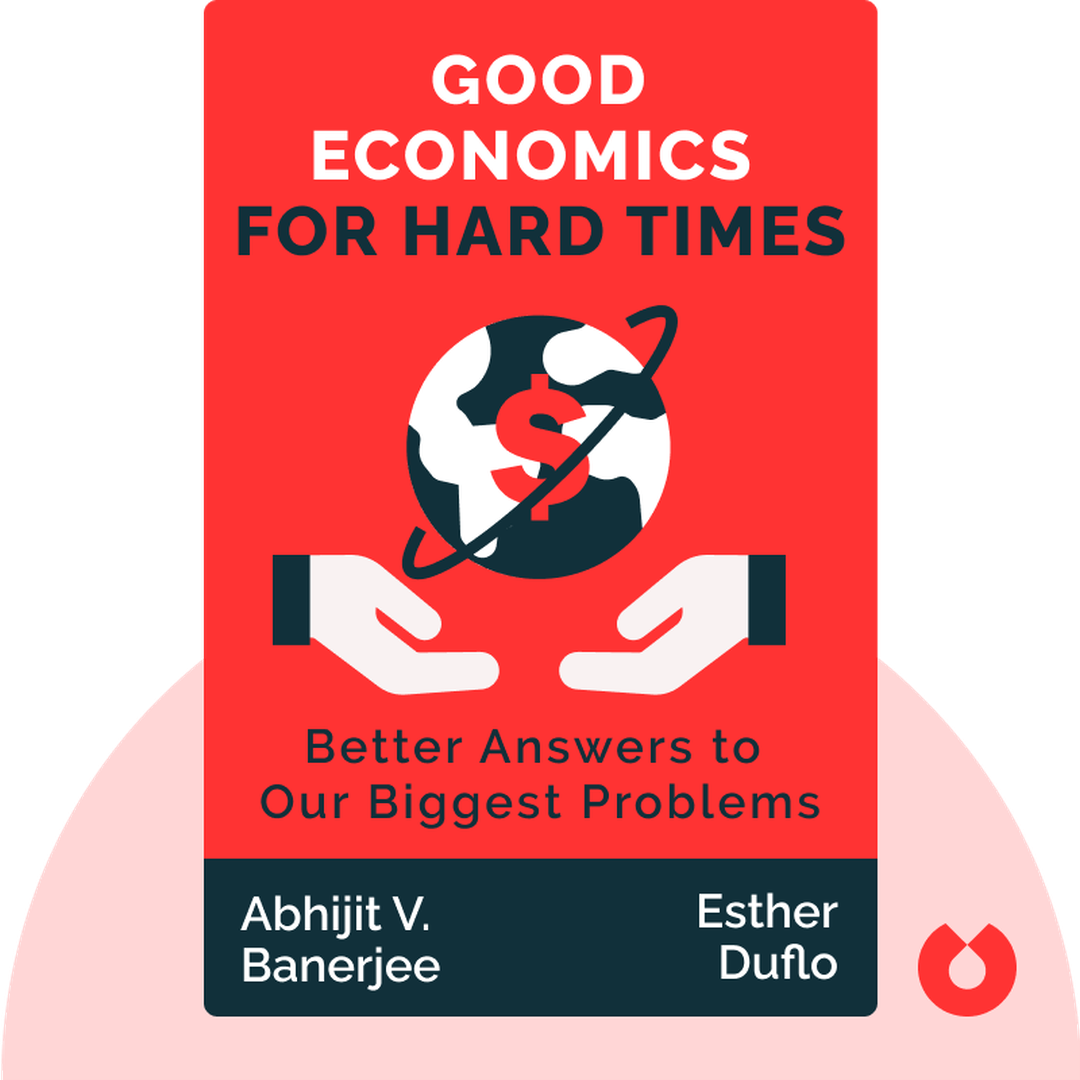
Good Economics for Hard Times
Start ListeningDownload Try free on iPhoneScan to start in 5 seconds
Categories:
If You're Curious About These Questions...
You should listen to this audiobook
- Have you ever wondered why the most common fears about immigration and trade are often based on economic myths rather than reality?
- What if you could find a way to solve the climate crisis without placing an unfair burden on the world's poorest populations?
- Are you curious about how the 'dismal science' of economics can actually provide a roadmap for healing social divides and tackling rising inequality?
Listen to Good Economics for Hard Times — Cinematic Audio Edition
Loading player...
Key Takeaways from Good Economics for Hard Times
- Discover how applying good economics in plain language can help bridge the deep political divides surrounding trade, inequality, and immigration.
- Understand why the collapse of law and order, rather than mere economic poverty or wage differences, is the true primary driving force behind international migration.
- Find out why it often takes extreme external events like natural disasters or war to overcome human inertia, ultimately pushing displaced populations toward greater economic prosperity.
- Uncover the counterintuitive reality that large-scale, low-skilled immigration does not reduce job opportunities or lower wages for native residents.
- Learn how migrant workers actually boost local economies by increasing the demand for everyday goods, creating additional jobs, and delaying the need for automated labor.
Learning Tools
Reinforce what you learned from Good Economics for Hard Times
Mind Map
Good Economics for Hard Times
The Role of Economists+
Immigration Reality+
Global Trade Flaws+
Climate Change & Inequality+
AI and Automation+
Wealth Inequality+
Taxation Solutions+
Poverty and Dignity+
Political Polarization+
Quiz — Test Your Understanding
Question 1 of 10
According to the book, what is a crucial step economists must take to regain the public's trust?
Question 2 of 10
Why does the simple economic model of supply and demand fail to accurately predict immigration patterns?
Question 3 of 10
How do immigrants typically affect the local job market for native workers?
Question 4 of 10
What is a major flaw in the traditional economic argument advocating for free international trade?
Question 5 of 10
What was the unintended consequence of the US imposing heavy protectionist tariffs on Chinese steel and aluminum?
Question 6 of 10
How do the authors respond to the argument that fighting climate change is a luxury the poor cannot afford?
Question 7 of 10
According to the text, which types of jobs are currently LEAST likely to be taken over by AI and robots?
Question 8 of 10
What do economists point to as a primary cause for the massive spike in economic inequality starting around 1980?
Question 9 of 10
What did data from experiments in 119 developing countries reveal about giving direct financial aid (cash) to the very poor?
Question 10 of 10
According to the authors, what is an effective way to combat the political polarization and prejudice amplified by social media echo chambers?
Good Economics for Hard Times — Full Chapter Overview
- 1Recommendation
- 2Economists can help solve the world’s gravest problems – but first they must earn our trust.
- 3Politicians mislead voters with false claims about immigration.
- 4Immigration boosts local economies and creates new opportunities for native workers.
- 5Goods move freely through global trade agreements, but people and money do not.
- 6Trade agreements can hurt local workers, but protectionist tariffs aren’t the answer.
- 7The fight against climate change is inseparable from the fight against economic inequality.
- 8AI is advancing enough to take over more complex human tasks, hurting the job market.
- 9Economic inequality existed long before intelligent robots.
- 10Smart taxation can help reduce economic inequality.
- 11There’s no universal solution to poverty, but protecting the dignity of the poor is essential.
- 12To repair the polarization and prejudice weakening democracy, we must listen to one another.
- 13Final summary
Good Economics for Hard Times Summary & Overview
Good Economics for Hard Times (2019) unflinchingly examines some of the most seemingly intractable problems we’re confronting today. Abhijit V. Banerjee and Esther Duflo argue that economics can provide new perspectives on how to solve climate change without hurting the poor, and also tackle social problems caused by rising inequality, global trade, and fear of immigration.
Who Should Listen to Good Economics for Hard Times?
- People who want to regain their faith in the usefulness of economics
- Environmentalists who want a new perspective on how to save the planet
- Workers who are worried about how immigration and trade will affect their jobs
Books Similar to Good Economics for Hard Times
Readers who enjoyed this also liked these titles.