If You're Curious About These Questions...
You should listen to this audiobook
- Did you know that the financial system, once designed to fuel real-world innovation, has evolved into a force that might actually be draining the economy?
- Have you ever wondered why some of the world’s biggest corporations are acting more like high-stakes banks than the innovators they claim to be?
- Are you curious about how hidden shifts in banking regulations from decades ago are still dictating the safety of your mortgage and the growth of your pension today?
Listen to Makers and Takers — Free Audiobook
Loading player...
Key Takeaways from Makers and Takers
- Discover how rampant credit and mounting debt were used to mask severe income inequality leading up to both the Great Depression and the 2008 Great Recession.
- Understand how decades of political deregulation and the invention of products like the credit card slowly eroded the protective boundary between commercial and investment banking.
- Learn why prioritizing short-term shareholder profits over long-term company value can be deadly, as seen in a cost-cutting culture at General Motors that led to 124 fatalities.
- See how Wall Street's profit-driven mindset forces vital industries, such as pharmaceuticals, to abandon life-saving research in favor of stock buybacks and shareholder payouts.
- Find out how modern shareholder activists extract massive wealth from major corporations like Apple, draining billions of dollars away from the development of innovative new technologies.
Learning Tools
Reinforce what you learned from Makers and Takers
Mind Map
Makers and Takers
Historical Parallels (1929 vs 2008)+
The Deregulation Journey+
The Shareholder Value Disease+
Blurring of Banks and Corporations+
Exploitation of the Middle Class+
Political Capture+
Fixing the System+
Quiz — Test Your Understanding
Question 1 of 8
What role did consumer credit play in the years leading up to both the Great Depression and the 2008 Great Recession?
Question 2 of 8
How did the introduction of the negotiable certificate of deposit (CD) in the late 1940s impact the banking industry?
Question 3 of 8
According to the book, what was the underlying cause of General Motors' failure to fix a deadly ignition switch glitch?
Question 4 of 8
Who primarily funds the fundamental research and development for major technological innovations, such as the internet, GPS, and touchscreens?
Question 5 of 8
How did Goldman Sachs exploit the aluminum market to increase its profits?
Question 6 of 8
Why has the percentage of Americans who own a home been in decline since 2004, despite a rise in home sales post-2008?
Question 7 of 8
What evidence does the author provide to demonstrate the deeply entrenched relationship between government and the financial sector?
Question 8 of 8
What is one of the author's key recommendations for reforming the financial system?
Makers and Takers — Full Chapter Overview
- 1Recommendation
- 2Like the Great Depression, the Great Recession was also caused by a flawed financial system.
- 3In the decades following the Great Depression, financial regulations were relaxed again to satisfy demand for credit.
- 4Companies prioritize short-term profits over long-term growth or customer solutions.
- 5Shareholders may not finance big companies’ innovations, but they still reap the rewards.
- 6Banks are no longer the only force in finance—and they don’t limit themselves to finance either.
- 7Profitable rental-home schemes and mismanaged retirement funds let banks profit at ordinary citizens’ expense.
- 8After 2008, bank-politician ties weakened efforts to reform the financial system.
- 9Cutting debt and promoting financial transparency could help repair the financial system.
- 10Final summary
Makers and Takers Summary & Overview
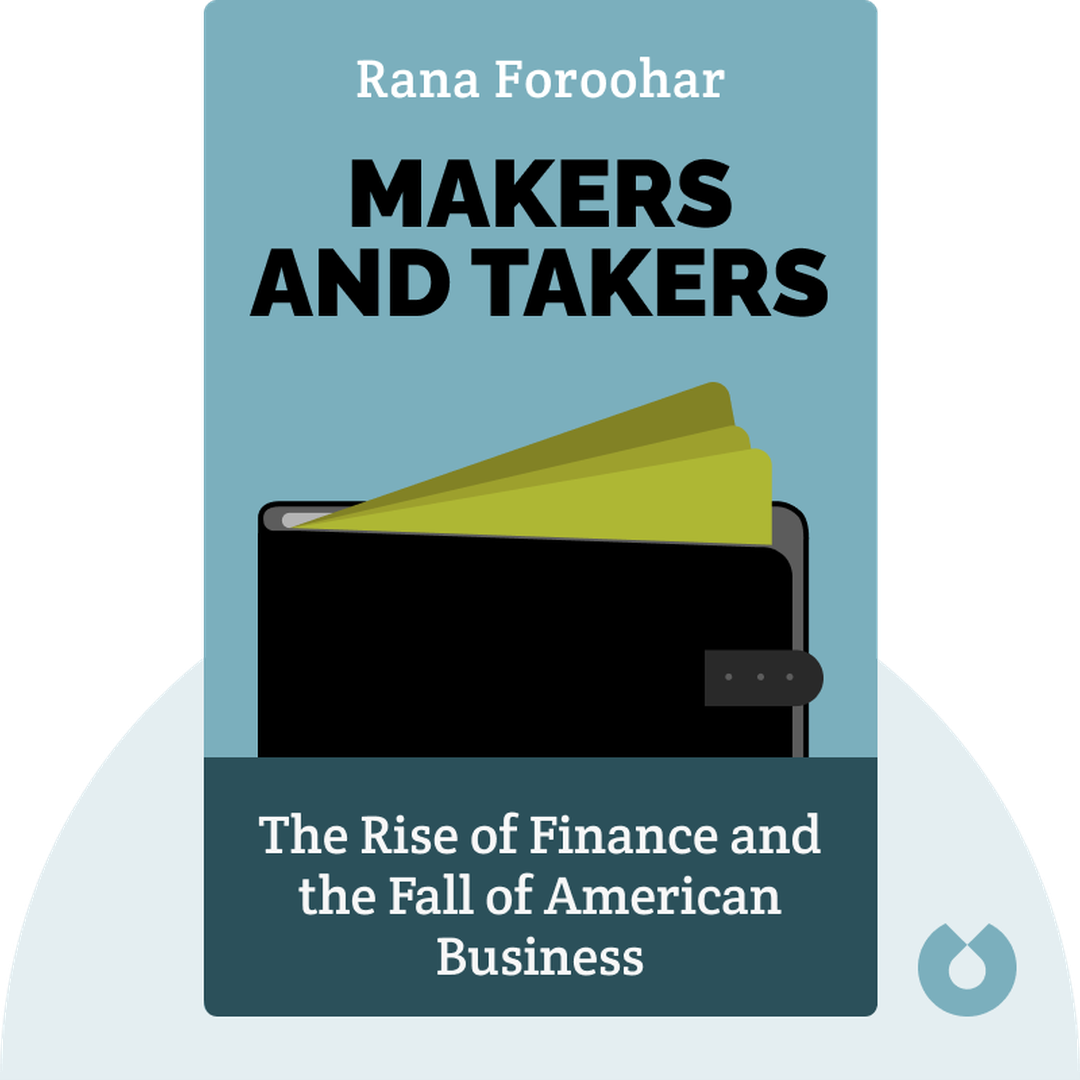
Makers and Takers (2016) investigates the role of finance in the 2008 crisis and subsequent recession. From the Great Depression onward, these blinks trace the history of loose regulation and blurred boundaries between commercial and investment banking, while highlighting the role of banks, businesses and politicians in the crisis. They also suggest actions the powerful can take to kickstart reform.
Who Should Listen to Makers and Takers?
- Readers curious about the historical background of the 2008 crisis
- Students of economics and finance
- Young couples, families and professionals considering their prospects for mortgages and pensions
Books Similar to Makers and Takers
Readers who enjoyed this also liked these titles.