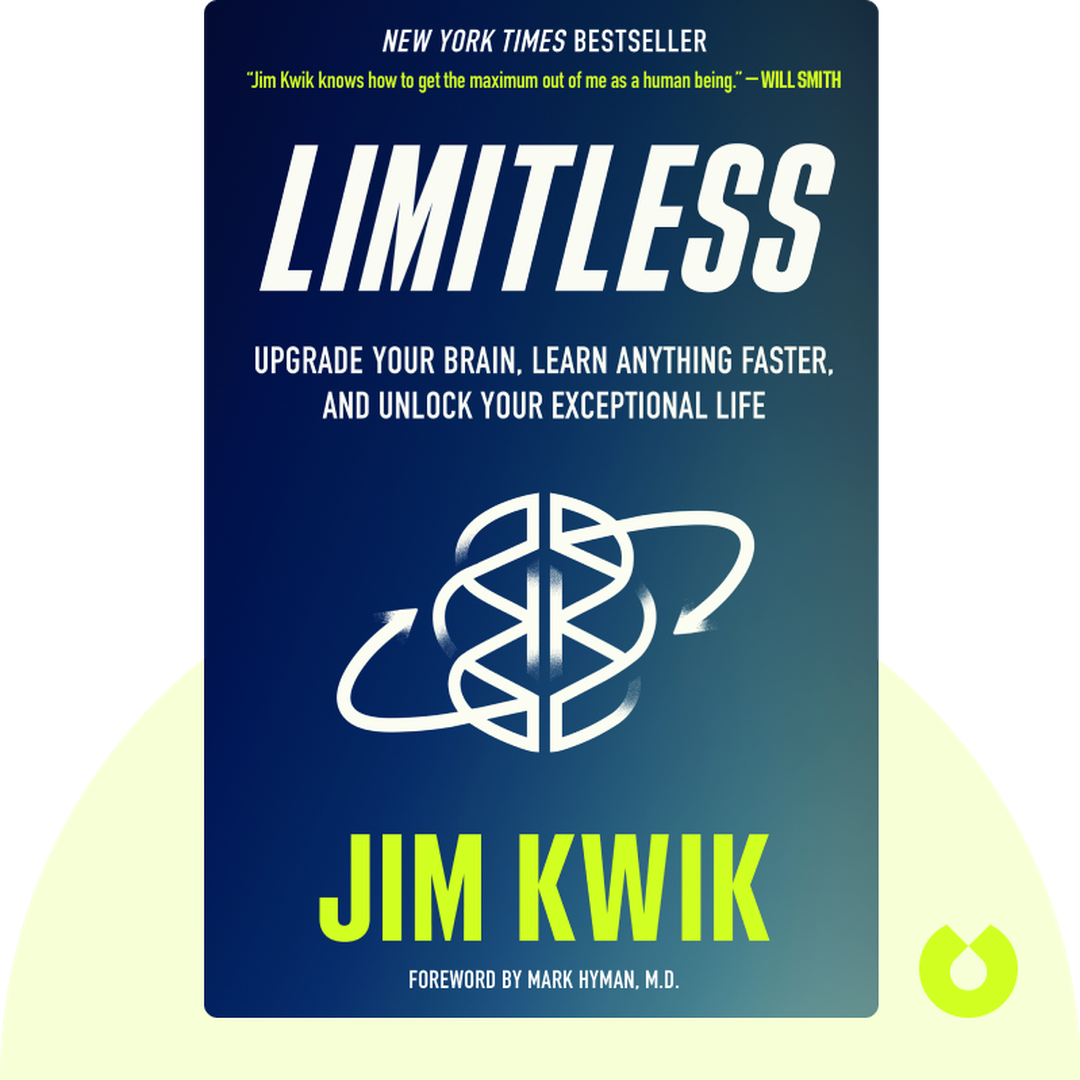
If You're Curious About These Questions...
You should listen to this audiobook
- What if you could unlock the full potential of your brain and achieve anything you set your mind to?
- Are you curious about the secret to learning faster, remembering more, and making better decisions?
- Have you ever wondered why some people seem to be able to learn and adapt at an incredible pace, while others struggle to keep up?
Listen to Limitless — Free Audiobook
Loading player...
Key Takeaways from Limitless
- Discover how to protect your focus from the four modern digital threats: digital deluge, digital distraction, digital dementia, and digital deduction.
- Understand the concept of 'healthy selfishness' and why prioritizing your brain's care is the essential first step to reducing stress and showing up for others.
- Learn how to overcome limiting labels by recognizing that a struggle to learn is usually caused by ineffective methods, not a lack of inherent potential.
- Harness your brain's extraordinary ability to adapt and stay 'young' by continuously challenging yourself to build and sustain new neural connections.
- Find out why your gut acts as a surprising 'boss' that directly influences your daily mood, behavior, and overall cognitive performance.
Learning Tools
Reinforce what you learned from Limitless
Mind Map
Limitless
Mindset+
Motivation+
Methods+
Digital Environment+
Quiz — Test Your Understanding
Question 1 of 12
According to the book, what is a major negative consequence of relying too heavily on digital technology to look up facts?
Question 2 of 12
What does the author refer to when he uses the acronym 'LIE'?
Question 3 of 12
How does the author suggest transforming your internal dialogue to foster a limitless mindset?
Question 4 of 12
According to the author, what is the primary difference between passion and purpose?
Question 5 of 12
Based on a Stanford University study mentioned in the text, how can you effectively increase your motivation to achieve a goal?
Question 6 of 12
How does regular aerobic exercise specifically benefit the brain, according to the text?
Question 7 of 12
What psychological toll does procrastination take on the brain?
Question 8 of 12
Why does the author recommend listening to Baroque music, like Bach, while studying?
Question 9 of 12
Which technique involves assigning key talking points to different objects in a familiar room to help memorize a presentation?
Question 10 of 12
What is 'subvocalization' in the context of reading?
Question 11 of 12
What does 'exponential thinking' involve, as opposed to linear thinking?
Question 12 of 12
According to the actionable advice in the summary, what is the purpose of creating a 'not-to-do list'?
Limitless — Full Chapter Overview
- 1Recommendation
- 2Technology makes life easier, but it may be holding back our learning abilities.
- 3We all have the power to reshape our brains.
- 4Clear your mind of negative thoughts and replace them with positive ones.
- 5Motivate yourself to change your behavior by defining who you are and your purpose.
- 6Fuel your brain with enough sleep, healthy food, and regular exercise.
- 7Boost productivity by entering a flow state and harnessing small steps.
- 8Make the most of your study time.
- 9Visualization techniques can improve your memory and concentration.
- 10Reading is essential to learning, and you can improve at it.
- 11Improve problem-solving by trying new and different ways of thinking.
- 12Final summary
Limitless Summary & Overview
Limitless (2020) is an empowering how-to guide for making full use of your brain’s incredible capabilities. It goes out to anyone who’s ever felt too dumb, too slow, or too unskilled to succeed. Learn how to unlimit your brain – and gain the power to achieve anything at all.
Who Should Listen to Limitless?
- Lifelong learners and people with big aspirations
- Self-criticizers who fear that they just can’t learn as fast as everyone else
- Businesspeople, students, and employees who want to fit learning into their busy schedules
Books Similar to Limitless
Readers who enjoyed this also liked these titles.