If You're Curious About These Questions...
You should listen to this audiobook
- Have you ever wondered why your mind holds onto small stresses and daily frustrations long after they’ve passed?
- What if you could clear out the mental clutter that blocks your happiness and finally find peace in the middle of a chaotic day?
- What’s the secret to practicing mindfulness and self-love even when you feel like you're way too busy to slow down?
Listen to Let That Sh*t Go — Free Audiobook
Loading player...
Key Takeaways from Let That Sh*t Go
- Discover how to use your logical 'observer mind' to eavesdrop on and silence your negative 'chatty mind.' This simple mindfulness technique helps you declutter unnecessary thoughts and find immediate mental clarity.
- Transform your internal dialogue by speaking to yourself with the exact same kindness you would show a young child. Letting go of toxic self-talk allows you to reconnect with your true self and confidently handle life's challenges.
- Understand how to separate your authentic desires from the things society tells you that you 'should' do. Ignoring these outside pressures removes the irritating mental 'rock in your shoe' so you can pursue what truly fulfills you.
- Master the art of acceptance by writing down your stressors and immediately crossing off the ones completely out of your control. This actionable exercise stops toxic worry loops and redirects your energy to problems you can actually solve.
- Learn how to wield the ultimate 'F word'—forgiveness—to successfully dump your heaviest emotional baggage. Releasing the deep-seated mental clutter tied up in other people's actions provides a powerful purge for lasting peace.
Learning Tools
Reinforce what you learned from Let That Sh*t Go
Mind Map
Let That Sh*t Go
Mind Decluttering Basics+
Self-Love & Authenticity+
Acceptance & Perspective+
Forgiveness+
Daily Application+
Quiz — Test Your Understanding
Question 1 of 6
According to the book, what is the relationship between the 'observer mind' and the 'chatty mind'?
Question 2 of 6
Why do the authors reference Dr. Masaru Emoto’s experiment with water molecules?
Question 3 of 6
In the context of authenticity, what does the metaphor of 'a rock in your shoe' refer to?
Question 4 of 6
When practicing acceptance by writing down five stressful things, what is the recommended next step?
Question 5 of 6
Which of the following best describes the book's approach to forgiving others?
Question 6 of 6
How can applying mindfulness and authenticity improve your experience with social media?
Let That Sh*t Go — Full Chapter Overview
- 1Recommendation
- 2Self-love and authenticity can help you release negative self-talk and discover your purpose.
- 3You can let go of a long list of shit by practicing acceptance and gaining perspective.
- 4Learn to forgive others and yourself so you can unload emotional shit.
- 5Now you can apply mindfulness to everything you do.
- 6Final Summary
Let That Sh*t Go Summary & Overview
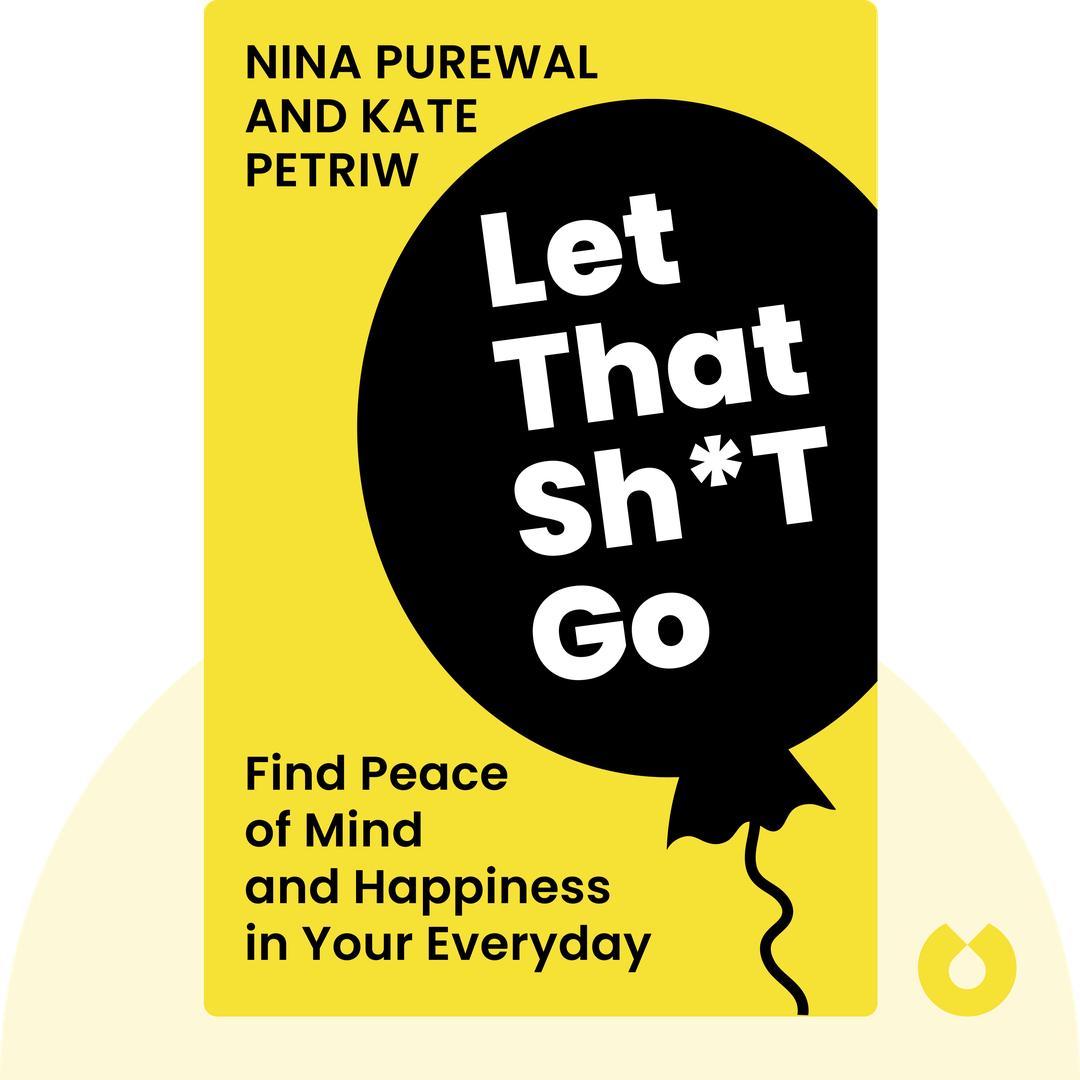
Let That Sh*t Go: Find Peace of Mind and Happiness in Your Everyday (2018) offers a trove of tools and tips to declutter your mind of all the crap that gets in the way of inner peace and joyful living. Its approach to mindfulness helps you to connect to what’s going on in your head and then use that awareness to build self love, authenticity, acceptance, perspective, and forgiveness.
Who Should Listen to Let That Sh*t Go?
- People interested in what mindfulness is and how to practice it
- Busy people who feel too stressed or overwhelmed to enjoy life
- Anyone who wants to improve their daily happiness
Books Similar to Let That Sh*t Go
Readers who enjoyed this also liked these titles.