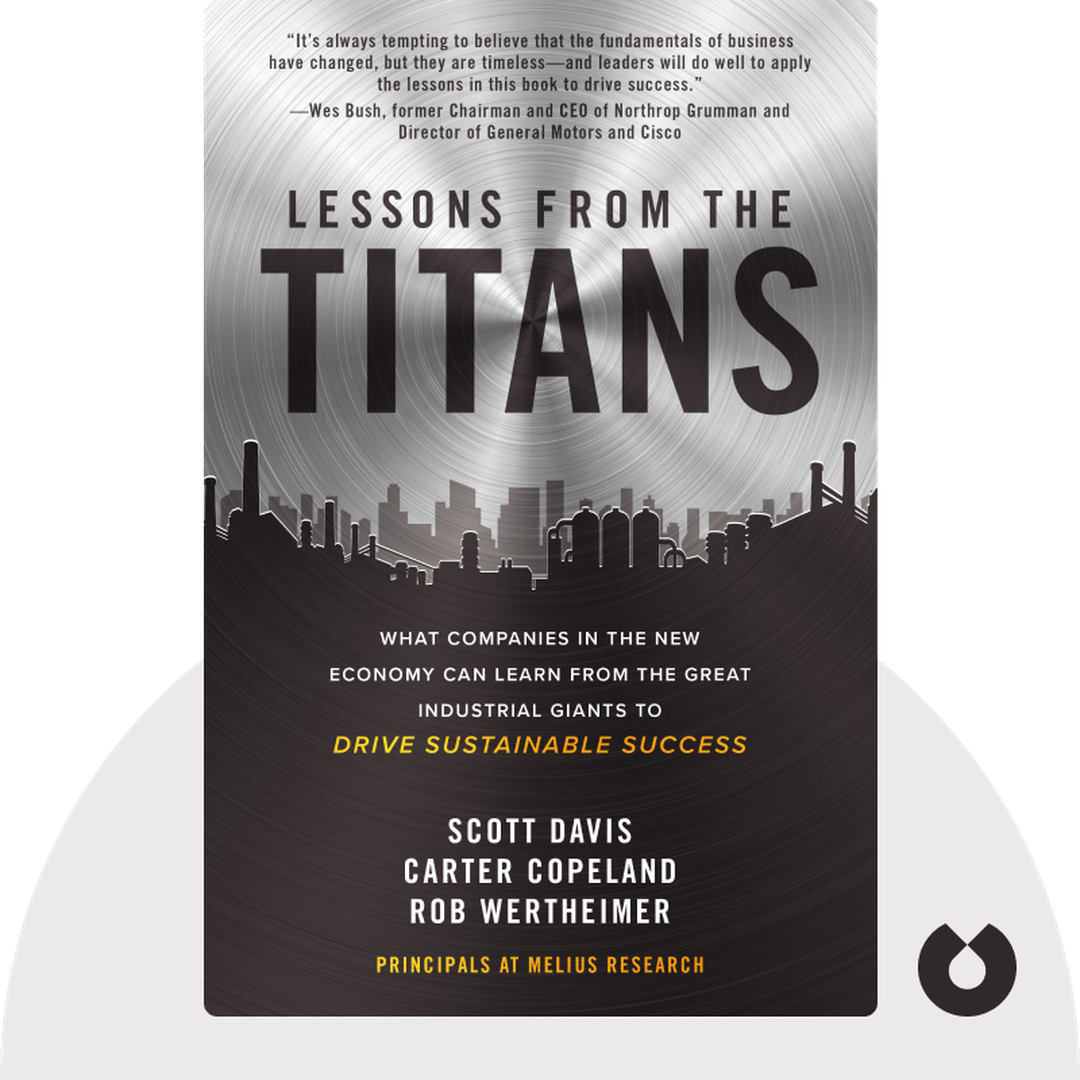
Lessons from the Titans
Start ListeningDownload Try free on iPhoneScan to start in 5 seconds
Categories:
If You're Curious About These Questions...
You should listen to this audiobook
- Have you ever wondered why legendary industrial giants like GE faced sudden downfalls while others, like Honeywell, managed to thrive?
- What if you could predict which of today’s corporate titans will dominate the next decade and which are quietly on the brink of disaster?
- Are you curious about the specific strategic missteps that turned some of the world's most powerful companies into cautionary tales?
Listen to Lessons from the Titans — Free Audiobook
Loading player...
Key Takeaways from Lessons from the Titans
- Discover why the downfall of giant industrial companies is usually caused by an arrogant management culture rather than sudden technological disruption.
- Learn how Jack Welch strategically acquired RCA to secure the NBC network for free, using the surplus cash to fund highly profitable, long-term industrial projects.
- Understand the dangers of creative accounting by exploring how General Electric used its unregulated financial branch to artificially smooth earnings and mask extreme financial volatility.
- Uncover how a corporate culture of hubris and intimidation deterred internal criticism and silenced external analysts, ultimately blinding GE to its impending collapse.
- Find out why disciplined cost management and a humble corporate culture are the true foundational metrics that allow legacy companies to survive and thrive over time.
Learning Tools
Reinforce what you learned from Lessons from the Titans
Mind Map
Lessons from the Titans
General Electric (Rise & Fall)+
Boeing (Risk & Hubris)+
Honeywell (The Turnaround)+
United Rentals (Systemic Integration)+
Core Principles for Success+
Quiz — Test Your Understanding
Question 1 of 9
According to the book, what is the most common culprit behind the failure of giant industrial companies?
Question 2 of 9
How did Jack Welch effectively acquire the TV network NBC for General Electric 'for free'?
Question 3 of 9
What hidden role did GE Capital play in General Electric's financial reporting during the 1980s and 1990s?
Question 4 of 9
What was a defining characteristic of General Electric's corporate culture under Jeffrey Immelt that contributed to its decline?
Question 5 of 9
What underlying management decision contributed to the disastrous rollout of Boeing's 737 MAX?
Question 6 of 9
When Dave Cote took over Honeywell, how did he approach cost-cutting and manufacturing?
Question 7 of 9
How did Mike Kneeland encourage regional cooperation and stop branch managers from hoarding equipment at United Rentals?
Question 8 of 9
What Japanese business philosophy did United Rentals extensively use to establish a culture of continuous improvement?
Question 9 of 9
According to the book's final advice on employee performance, where does the most impactful long-term success come from?
Lessons from the Titans — Full Chapter Overview
- 1Recommendation
- 2Jack Welch’s RCA deal helped GE become an industry leader.
- 3GE Capital’s success was not built to last.
- 4Jeffrey Immelt reinforced a culture that discouraged criticism and favored big ideas over practical investments.
- 5Boeing’s attempts to reduce risk and improve profitability had mixed results.
- 6Dave Cote revived Honeywell by cutting costs, creating new products, and expanding into new markets.
- 7Mike Kneeland turned United Rentals around with reforms, continuous improvement practices, and regional cooperation.
- 8The most successful companies control costs and risks, increase cash flow, and deploy capital effectively.
- 9Final summary
Lessons from the Titans Summary & Overview
Lessons from the Titans (2020) tells the stories of ten industrial companies in the United States. From General Electric to Boeing, Honeywell to United Rentals, it looks at which strategic decisions led to success and which disastrous missteps created new obstacles. By analyzing the past performance of such legendary businesses, it offers greater insight into which companies today will stick around – and which won’t.
Who Should Listen to Lessons from the Titans?
- Business gurus fascinated by economic shifts
- Entrepreneurs looking to future-proof their companies
- Economists curious about market shifts
Books Similar to Lessons from the Titans
Readers who enjoyed this also liked these titles.