If You're Curious About These Questions...
You should listen to this audiobook
- Why does watching a movie about a shark attack or seeing news about a plane crash completely override our statistical knowledge of real-world dangers?
- Why do physical and monetary rewards often decrease human performance, and what alternative actually motivates people to do better?
- How does the simple act of publicly announcing a decision trap us in a cycle of irrational behavior and prevent us from changing our minds?
Listen to Irrationality — Free Audiobook
Loading player...
Key Takeaways from Irrationality
- Irrationality isn't just making an accidental mistake; it is the deliberate act of ignoring available knowledge and facts when forming conclusions.
- We frequently fall victim to the availability error, where highly emotional or recent information drastically skews our perception of reality and risk.
- Contrary to popular belief, tangible rewards can actually discourage performance, whereas targeted feedback that fosters self-improvement yields much better results.
- Our overconfidence and reliance on intuition often lead us to see false cause-and-effect relationships, making data-driven analysis far superior to gut feelings.
- You can actively combat your own irrationality by applying basic statistics, paying close attention to how questions are framed, and physically writing out pros and cons to prevent cognitive overload.
Learning Tools
Reinforce what you learned from Irrationality
Mind Map
Irrationality
Defining Irrationality+
Individual & Organizational Traps+
Information & Memory Biases+
Social Pressures & Conformity+
Motivation & Choice+
Emotions & Belief Preservation+
Statistical & Causal Blind Spots+
Tools for Rationality+
Quiz — Test Your Understanding
Question 1 of 10
According to the text, how does irrationality differ from making a false assumption based on insufficient knowledge (such as believing all swans are white)?
Question 2 of 10
How do organizational structures often promote irrational behavior, according to the book?
Question 3 of 10
Why do many people mistakenly believe they are more likely to die in a plane crash than from a stroke?
Question 4 of 10
What is the 'boomerang effect' in the context of publicly announced decisions?
Question 5 of 10
Based on the college newspaper experiment, what is the effect of physical rewards on performance?
Question 6 of 10
How did taking away the freedom to choose affect children in the toy experiment?
Question 7 of 10
The historical belief that turmeric cured jaundice because both the herb and the disease are yellow is an example of:
Question 8 of 10
What does the author suggest job interviewers use instead of their intuition to judge a candidate's abilities?
Question 9 of 10
According to the law of large numbers, why would a smaller hospital be more likely than a larger hospital to have days where 60% of the babies born are boys?
Question 10 of 10
What simple, practical strategy does the book recommend to avoid information overload when making complex decisions?
Irrationality — Full Chapter Overview
- 1Recommendation
- 2Irrationality is more common than we think, and it comes from ignoring knowledge.
- 3Irrationality affects both individuals and organizations.
- 4When and how we get information strongly influences our irrationality.
- 5Following social expectations and publicly declaring decisions can lead to irrational behavior.
- 6Rewards can be irrational, and lack of choice can trigger irrational behavior.
- 7Rejecting information to protect beliefs, along with our emotions, can make us act irrationally.
- 8Irrationality keeps us from accurately judging correlations and cause-and-effect relationships.
- 9Overconfidence and intuition can lead to irrational decisions.
- 10Understanding statistics helps improve rationality.
- 11Avoid irrationality by noticing how questions are worded and listing pros and cons before deciding.
- 12Final summary
Irrationality Summary & Overview
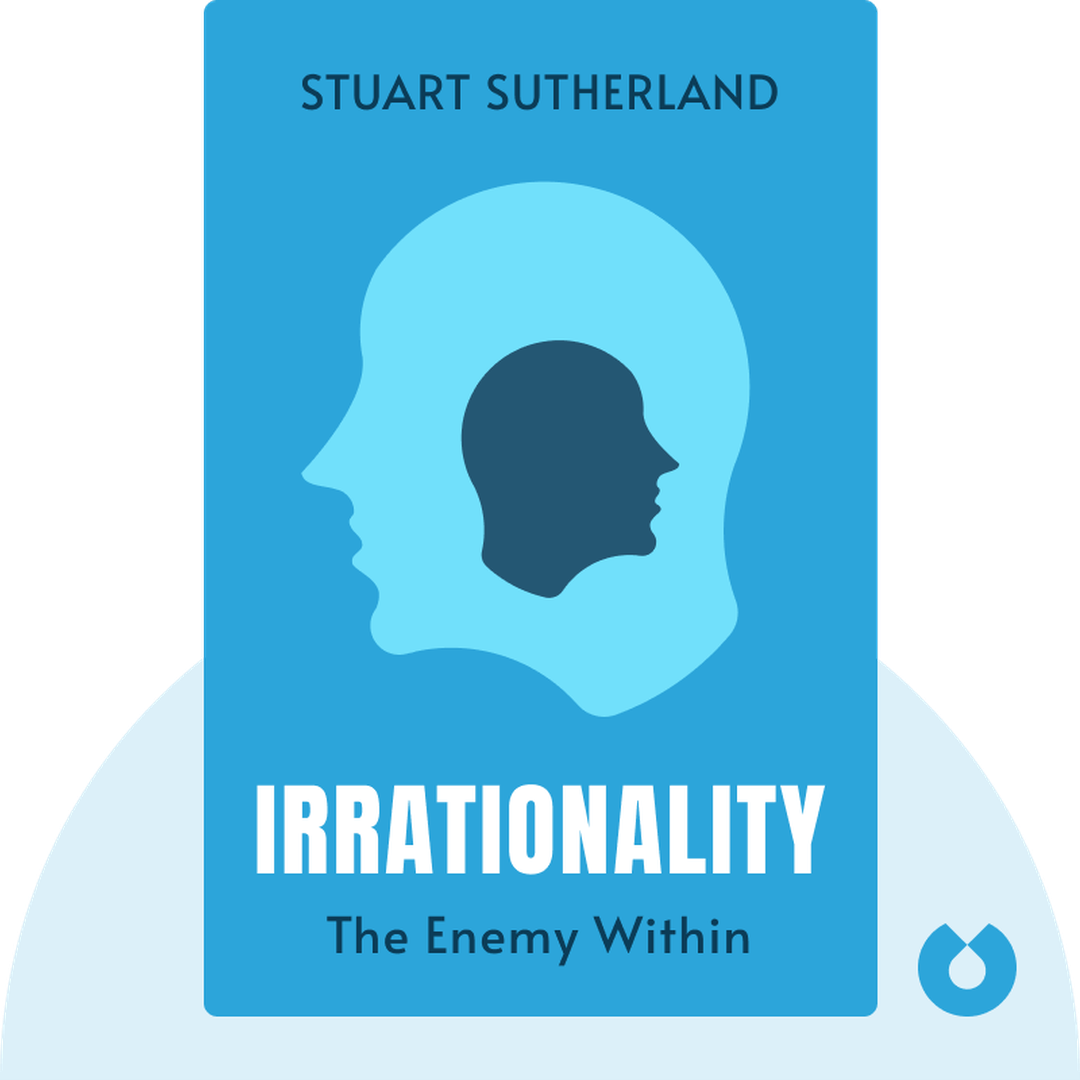
Irrationality (1991) is a guide to illogical decisions, unreasonable actions and irrational behavior as a whole. These blinks reveal how people tend to be more irrational than rational, examines several reasons why and offers solutions as to how we can become a little more logical in our decision making.
Who Should Listen to Irrationality?
- People who think of themselves as entirely rational beings
- Anyone who struggles to make decisions, especially rational ones
Books Similar to Irrationality
Readers who enjoyed this also liked these titles.