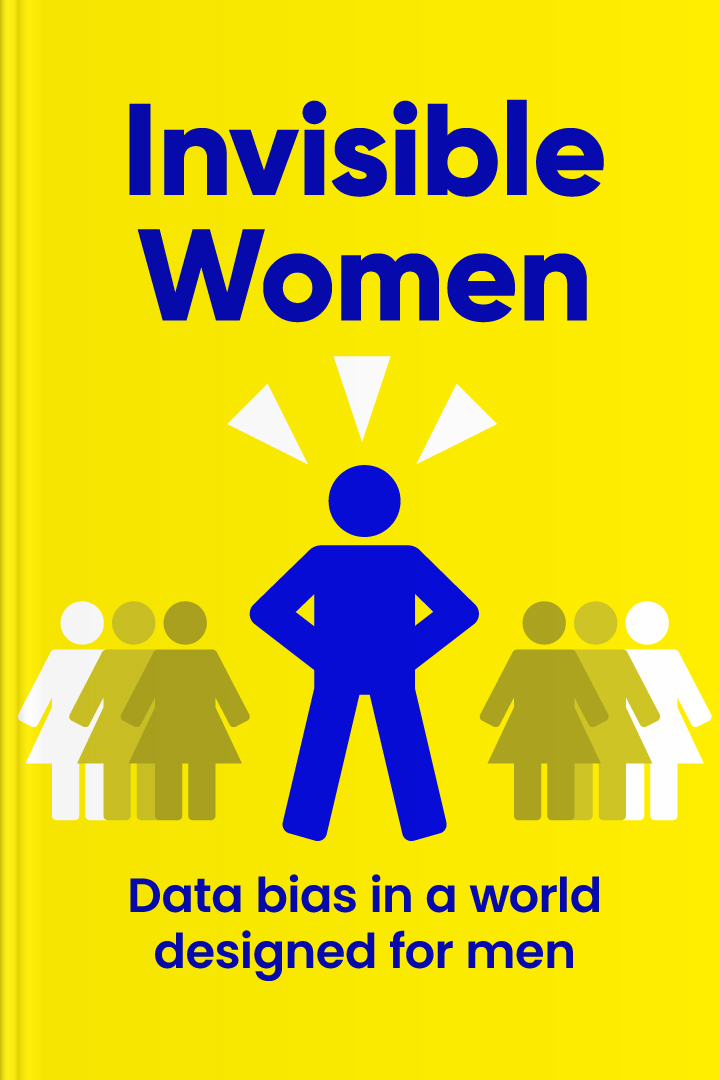
Invisible Women audiobook cover - This warm, eye-opening journey shows how missing data about women quietly shapes everything from healthcare and workplace policies to city streets—while also revealing how better information, better design, and fairer representation can make life safer and more workable for everyone.

Invisible Women

This warm, eye-opening journey shows how missing data about women quietly shapes everything from healthcare and workplace policies to city streets—while also revealing how better information, better design, and fairer representation can make life safer and more workable for everyone.

Caroline Criado Perez

4.3 / 5(4 ratings)
Start ListeningDownloadQR code that opens AudiobookHub on the App StoreTry free on iPhoneScan to start in 5 seconds

If You're Curious About These Questions...

You should listen to this audiobook

Listen to Invisible Women — Free Audiobook

Loading player...

Key Takeaways from Invisible Women

Learning Tools

Reinforce what you learned from Invisible Women

Mind Map

Invisible Women
The Male Default+
Infrastructure & Planning+
Product Design+
Health & Safety+
Economics & GDP+
Politics & Leadership+

Quiz — Test Your Understanding

Question 1 of 10
What is the 'gender data gap' as described in the book?
  • A. The difference in wages between men and women in data science and tech fields.
  • B. The tendency to overlook women's needs and experiences in the data that underpins decision-making.
  • C. The historical lack of female authors and researchers in scientific literature.
  • D. The phenomenon where women consume less digital data on average than men.
Question 2 of 10
How did the Karlskoga council's initial snow-clearing schedule inadvertently favor men over women?
  • A. It prioritized clearing roads for full-time commuters over sidewalks used by pedestrians and carers.
  • B. It allocated more funds to neighborhoods with higher male populations.
  • C. It scheduled clearing during times when women were typically dropping children off at school.
  • D. It focused heavily on corporate office parks while ignoring residential areas.
Question 3 of 10
Why do public planning regulations that allocate equal floor space for men's and women's bathrooms fail to meet women's needs?
  • A. Women's bathrooms require significantly more expensive plumbing fixtures than men's.
  • B. Men are statistically more likely to use public bathrooms than women.
  • C. Equal space does not account for women needing more time, space for children, and menstruation needs.
  • D. Female bathrooms are usually placed in less accessible, unsafe areas of a building.
Question 4 of 10
How does the gender data gap in public transport financially penalize women?
  • A. Women are legally charged higher base fares for monthly public transit passes.
  • B. Transport systems prioritize non-commuter travel, which is inherently more expensive.
  • C. Women are more likely to be fined for traveling during peak commuter hours.
  • D. Women often 'trip-chain' (make multiple short trips), paying more when tickets are priced by journey rather than distance.
Question 5 of 10
What prevents many average female pianists from reaching their full potential, according to a 2015 study?
  • A. A lack of early childhood music education programs aimed at young girls.
  • B. The design of the standard piano keyboard, which is optimized for the average male handspan.
  • C. Historical biases in the classical music industry that refuse to publish female composers.
  • D. The acoustic differences in how male and female ears perceive standard keyboard octaves.
Question 6 of 10
Who is 'reference man' in the context of scientific and health studies?
  • A. A theoretical model representing the average measurements of both men and women globally.
  • B. A specific crash test dummy required by EU law for all vehicle safety tests.
  • C. A Caucasian male, aged 25 to 30, weighing 70 kg, historically used to represent everyone.
  • D. A standard metric used to determine equal pay and labor output in corporate environments.
Question 7 of 10
Why are women 47 percent more likely than men to be seriously injured in car crashes?
  • A. Women tend to drive smaller, less structurally sound vehicles.
  • B. Car safety tests rely on crash test dummies based on standard male dimensions and anatomy.
  • C. Women generally sit further back from the steering wheel, reducing airbag effectiveness.
  • D. Seatbelts are manufactured using materials that are legally required to yield to female body weight.
Question 8 of 10
According to a 2017 EU study, what is a primary reason women are routinely excluded from medical trials?
  • A. Women are statistically less likely to volunteer for experimental medical treatments.
  • B. Medical review boards consider testing on women of childbearing age to be an ethical violation.
  • C. The diseases being tested predominantly affect only male populations.
  • D. Women's bodies are viewed as too 'complex' and 'costly' to study due to changeable hormones.
Question 9 of 10
What is the primary reason the global Gross Domestic Product (GDP) fails to accurately reflect women's economic contributions?
  • A. Women are more likely to work in informal economies that governments cannot track.
  • B. Unpaid domestic, childcare, and eldercare work, primarily performed by women, is excluded from GDP calculations.
  • C. The gender wage gap means women's paid labor is valued at a lower rate than men's in official statistics.
  • D. Tax systems disproportionately hide the wealth accumulated by female-owned businesses.
Question 10 of 10
What happens when female politicians gain power, according to historical data from OECD countries and India?
  • A. They are more likely to enact policies and invest in infrastructure that address women's needs.
  • B. They tend to adopt the exact same policy priorities as their male predecessors to ensure electability.
  • C. They primarily focus on foreign policy and national defense to combat stereotypes of female weakness.
  • D. They struggle to pass legislation because they are consistently blocked by male-dominated local councils.

Invisible Women — Full Chapter Overview

Invisible Women Summary & Overview

In this summary of Invisible Women, the focus is simple and powerful: when women are missing from data, women are missing from decisions. And when decisions are made using “default” assumptions that actually reflect male lives, the results can range from small daily frustrations to serious harm—especially in health, safety, work, and public space.

Across eight chapters, the story moves from a clear explanation of the gender data gap to real-world consequences in design, transport, unpaid labor, medicine, science, technology, and politics. Along the way, it offers something steady and hopeful: when societies collect better data, include more diverse voices, and act on what they learn, outcomes improve—not only for women, but for communities as a whole.

Who Should Listen to Invisible Women?

  • Listeners who want to understand how “neutral” policies and products can unintentionally exclude women—and what can be done about it.
  • Designers, managers, educators, healthcare workers, and policymakers who want practical insight into how data shapes decisions.
  • Anyone curious about fairness, evidence, and how small changes in measurement and representation can create big changes in daily life.

About the Author: Caroline Criado Perez

Caroline Criado Perez is a writer and advocate known for highlighting how gaps in data and representation affect women’s lives. Her work brings attention to the ways public systems, research practices, and everyday design choices can unintentionally privilege male experiences—and how better evidence can support more equal outcomes.

🎧
Listen in the AppOffline playback & background play
Get App