If You're Curious About These Questions...
You should listen to this audiobook
- Did you know that the very capitalist system often blamed for global inequality might actually be the most powerful tool we have for saving the world?
- Have you ever wondered how the world’s most successful ethical investors manage to generate significant profits while simultaneously solving major social problems?
- What if you could move beyond the 'greed is good' mentality and discover the secret to making money that actually makes a difference?
Listen to Investing With Impact — Free Audiobook
Loading player...
Key Takeaways from Investing With Impact
- Discover why the capitalist system is not inherently evil, and understand how the 2008 financial crisis was actually driven by human greed rather than a broken market.
- Learn how private companies leverage their efficiency and large budgets to drive healthcare, educational, and environmental changes far more effectively than debt-burdened governments.
- Understand the transformative power of millennials, a growing workforce demographic that prioritizes societal improvement and corporate philanthropy over the traditional, money-driven American Dream.
- Find out how impact investing tools, such as social impact bonds, empower private investors to profitably fund crucial public programs and solve real-world community issues.
- Master the concept of investing for dual outcomes by exploring how frameworks like the E6 investment model can generate high financial returns while simultaneously benefiting humanity.
Learning Tools
Reinforce what you learned from Investing With Impact
Mind Map
Investing With Impact
Capitalism as a Neutral Tool+
Corporate Efficiency vs. Government+
The Millennial Influence+
Mechanics of Impact Investing+
The 6E Investment Model+
Quiz — Test Your Understanding
Question 1 of 6
According to the author, what was the primary cause of the 2008 financial crisis?
Question 2 of 6
Why does the book argue that companies are often more effective than governments at instigating social change?
Question 3 of 6
How do the career values of millennials differ from those of the baby-boomer generation, as described in the text?
Question 4 of 6
How do 'social impact bonds' function within the realm of impact investing?
Question 5 of 6
In the 6E investment model, what does the 'Empowerment' criterion specifically evaluate?
Question 6 of 6
Which of the following is NOT one of the criteria included in the 6E investment model?
Investing With Impact — Full Chapter Overview
- 1Recommendation
- 2Capitalism isn’t inherently evil; people are what can make it harmful.
- 3Companies can be more effective than governments at driving social change.
- 4Millennials have the values needed to get capitalism back on track.
- 5Impact investing channels profits toward benefits for society.
- 6The 6E investment model helps ensure a company serves society’s best interests.
- 7Final summary
Investing With Impact Summary & Overview
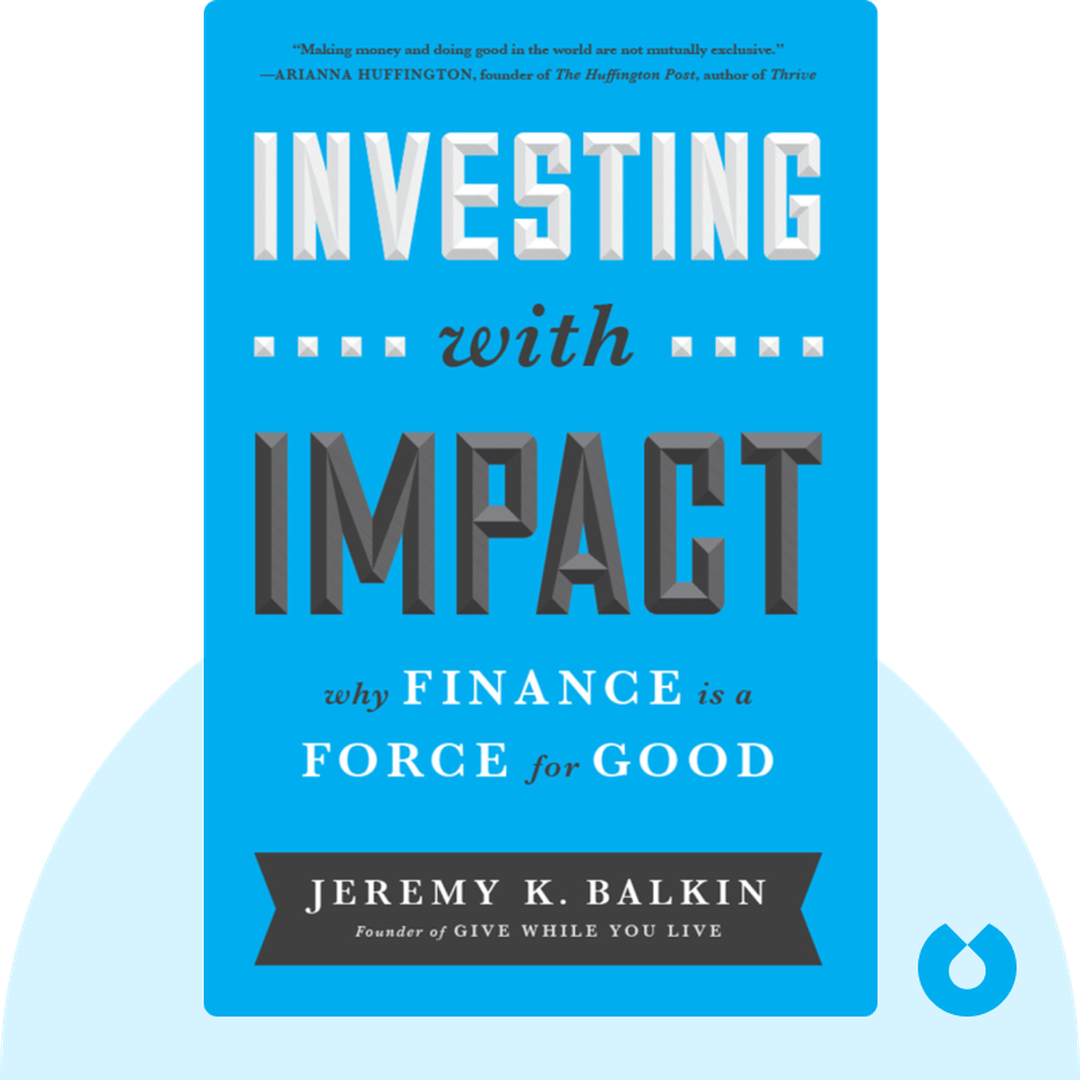
Investing With Impact (2015) explores how people have harnessed the power of capitalism to do good and improve society at large. As a number of ethical and philanthropic investors have shown, finance needn’t be a system of pure greed. Find out why the frequently demonized capitalist system may well be the secret to saving the world.
Who Should Listen to Investing With Impact?
- Investors and entrepreneurs seeking to improve the world
- People looking for answers after the 2008 financial crisis
- Bankers who want to make money ethically
Books Similar to Investing With Impact
Readers who enjoyed this also liked these titles.