Theme Song
If You're Curious About These Questions...
You should listen to this audiobook
- Have you ever wondered why some geniuses revolutionize their fields in their early twenties, while others don't reach their creative peak until much later in life?
- Are you curious about whether you are a 'conceptual' innovator who relies on bold new ideas or an 'experimental' one who succeeds through gradual refinement over time?
- What if you could predict the timing of your greatest professional breakthroughs by identifying the specific style of creativity that matches your personality?
Listen to Innovators — Free Audiobook
Loading player...
Key Takeaways from Innovators
- Understand the fundamental difference between conceptual innovators who achieve rapid, early breakthroughs and experimental creators who reach greatness later through patient refinement.
- Discover how experimental artists like Paul Cézanne and Jackson Pollock found massive success later in life by extracting meaning directly through the physical act of creation.
- Learn why embracing your unique creative rhythm, whether through slow, meticulous revision like Robert Frost or precise, intellectual leaps like T.S. Eliot, can save you years of frustration.
- Explore how legendary architects like Frank Lloyd Wright and Frank Gehry designed their most iconic masterpieces in their 70s and 90s, proving that creative genius has no expiration date.
- Identify whether you thrive on bold, early visions or continuous, lifelong trial-and-error so you can align your process with your natural rhythm and unlock your highest creative potential.
Learning Tools
Reinforce what you learned from Innovators
Mind Map
Innovators
Core Innovation Types+
Painting+
Poetry+
Architecture+
Film+
Science & Business+
Collaboration & Environment+
Quiz — Test Your Understanding
Question 1 of 7
What is the primary difference between conceptual and experimental innovators according to the text?
Question 2 of 7
How does the career of Jackson Pollock illustrate the experimental approach to innovation?
Question 3 of 7
Why did critics initially misunderstand Robert Frost's poetry?
Question 4 of 7
Which architect serves as an example of a conceptual innovator who achieved a massive breakthrough at a young age?
Question 5 of 7
According to the text, what challenge did conceptual filmmakers like Orson Welles and Jean-Luc Godard face after their initial breakthroughs?
Question 6 of 7
How did Charles Darwin's approach to his theory of evolution contrast with Albert Einstein's approach to physics?
Question 7 of 7
What does the text suggest about the role of disagreement and tension in the creative process?
Innovators — Full Chapter Overview
- 1Recommendation
- 2Why Some Artists Peak Early While Others Improve Over Time
- 3The Hidden Patterns of Poetic Greatness
- 4How Creative Timing Shapes Great Architecture
- 5Mastering Film at Any Age
- 6The Creative Clock in Science and Entrepreneurship
- 7Creativity Flourishes Alone and in Groups
- 8Final summary
Innovators Summary & Overview
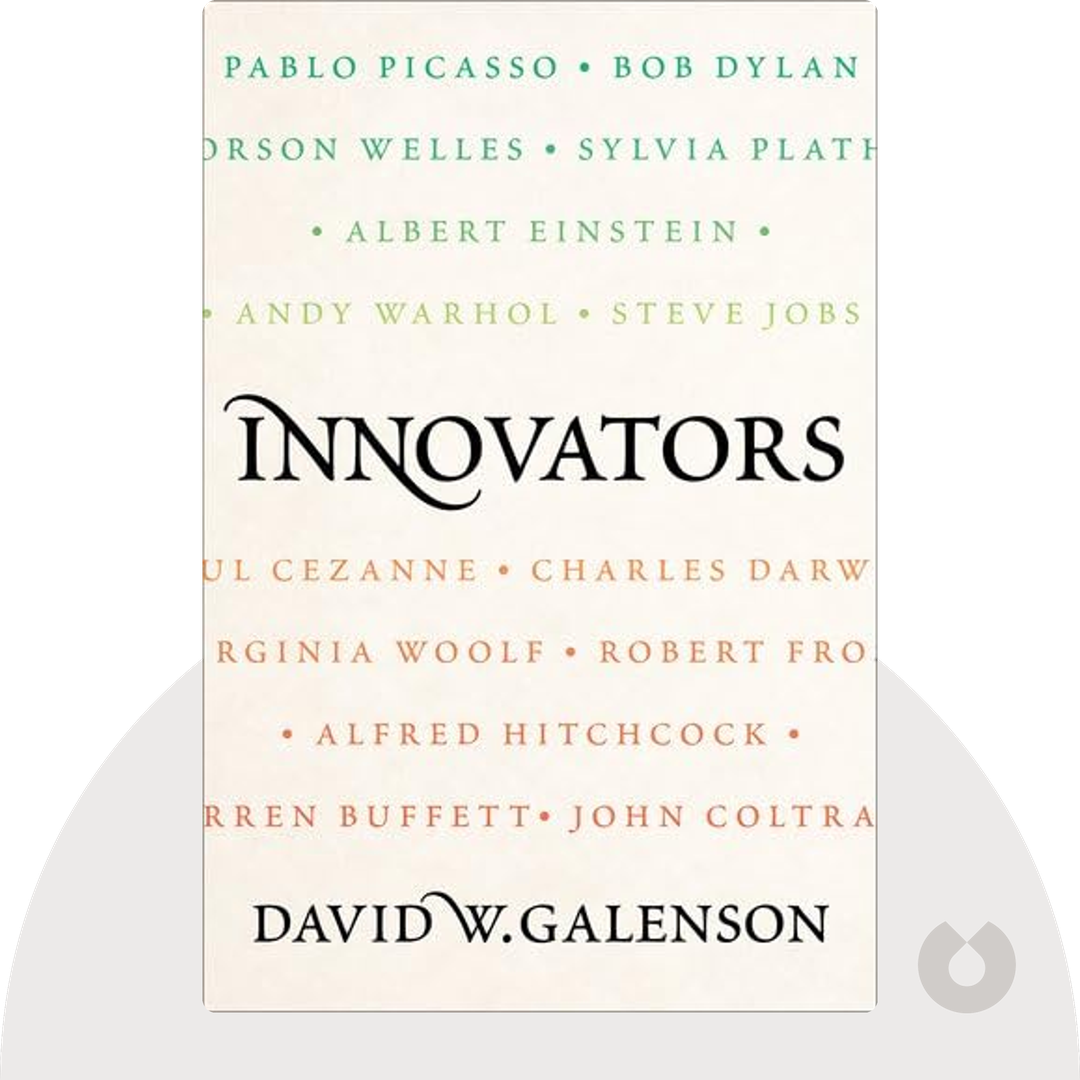
Innovators (2025) explores why some people make their greatest contributions early in life while others peak much later. It presents a groundbreaking theory of creativity, distinguishing between conceptual innovators who revolutionize fields with bold new ideas and experimental innovators who achieve success through gradual refinement over time. Drawing on extensive research, it analyzes patterns of innovation across art, science, business, and beyond.
Who Should Listen to Innovators?
- Ambitious young creatives seeking early breakthroughs
- Thoughtful professionals refining skills over time
- Anyone interested in how innovation works
Books Similar to Innovators
Readers who enjoyed this also liked these titles.