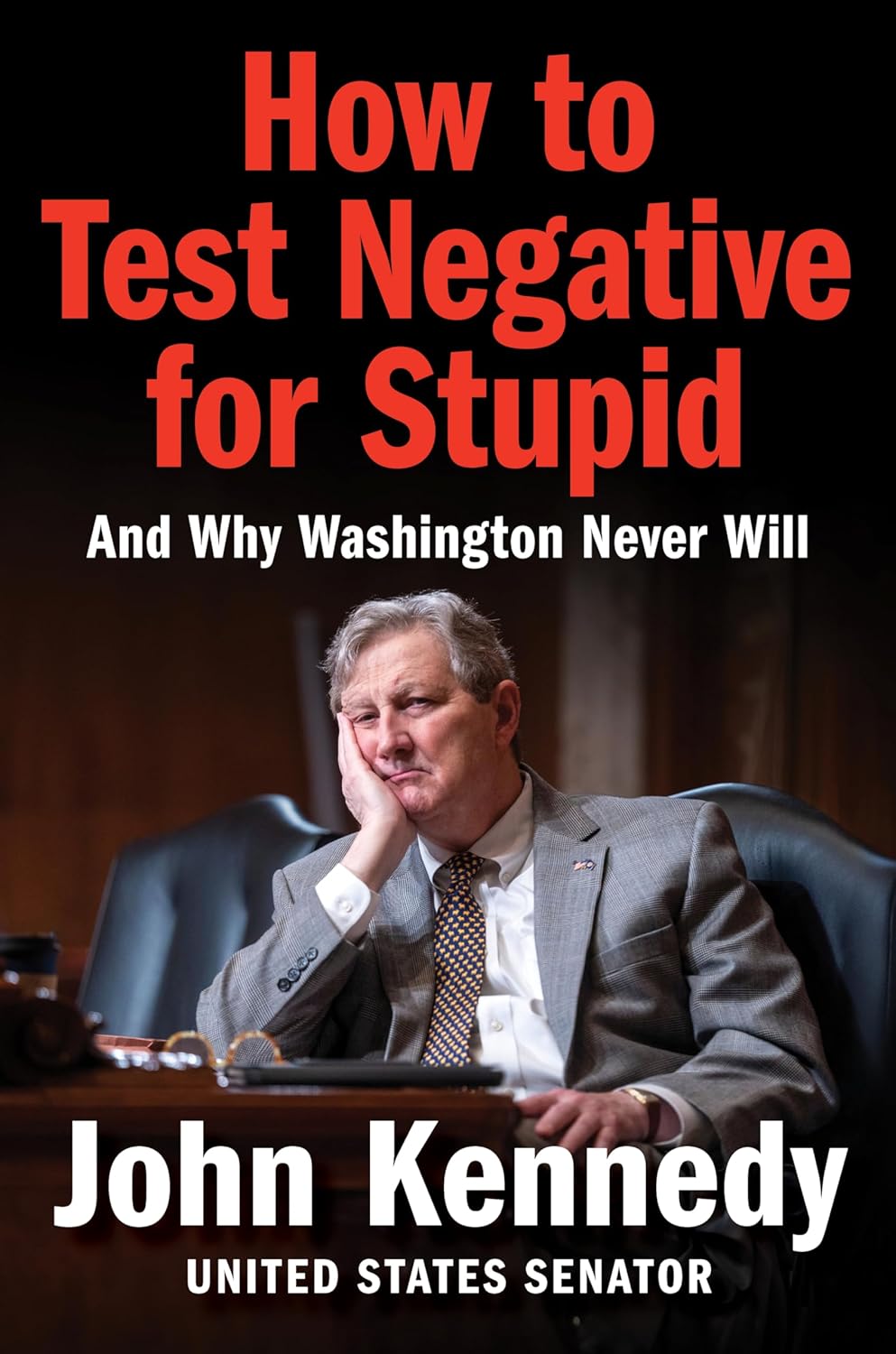
How to Test Negative for Stupid audiobook cover - A blunt-talking Louisiana senator traces how small-town lessons, hard political losses, and Washington absurdities shaped his habit of saying the quiet part out loud—and why he thinks candor, competence, and the rule of law are the only antidotes to national “stupid.”

How to Test Negative for Stupid

A blunt-talking Louisiana senator traces how small-town lessons, hard political losses, and Washington absurdities shaped his habit of saying the quiet part out loud—and why he thinks candor, competence, and the rule of law are the only antidotes to national “stupid.”

John Kennedy

4.2 / 5(5 ratings)
Start ListeningDownloadQR code that opens AudiobookHub on the App StoreTry free on iPhoneScan to start in 5 seconds

If You're Curious About These Questions...

You should listen to this audiobook

Listen to How to Test Negative for Stupid — Free Audiobook

Loading player...

Key Takeaways from How to Test Negative for Stupid

Learning Tools

Reinforce what you learned from How to Test Negative for Stupid

Mind Map

How To Test Negative For Stupid
Core Philosophy & Senate Realities+
Early Life & Formative Lessons+
Entering Louisiana Politics+
State Leadership & Crisis Management+
The Road to the U.S. Senate+
Accountability & The Rule of Law+

Quiz — Test Your Understanding

Question 1 of 10
In an early TV interview, what analogy did Senator Kennedy use to criticize the government for awarding a contract to a credit reporting company that had suffered a massive data breach?
  • A. Like asking an arsonist to become the new fire chief.
  • B. Like giving a celebrity known for trouble "the keys to the minibar."
  • C. Like letting a fox guard the henhouse.
  • D. Like hiring a bank robber to design the new security system.
Question 2 of 10
According to Kennedy's description of the 'Senate Bubble,' how does the filibuster typically function in the modern era?
  • A. It is used in every debate and requires senators to speak for days on end.
  • B. It has been largely abandoned, as leadership now prefers simple majority votes.
  • C. It is most often used as a threat to force negotiation, as leadership prefers making deals to causing gridlock.
  • D. It is a rule that only applies to judicial nominations, not regular legislation.
Question 3 of 10
What core principle did Kennedy form after a childhood confrontation with a school bully in Zachary?
  • A. That one should always 'turn the other cheek' to de-escalate a situation.
  • B. That showing weakness encourages more abuse, and sometimes you must stand up for yourself.
  • C. That all conflicts should be resolved through verbal negotiation rather than action.
  • D. That winning a fight earns you bragging rights and permanent respect.
Question 4 of 10
How does Kennedy portray his time studying at Oxford University?
  • A. As a period of intellectual ease where he felt superior to his peers.
  • B. As a socially vibrant time where he enjoyed the comforts of English university life.
  • C. As a humbling and demanding ordeal with cold rooms, merciless tutors, and massive reading lists.
  • D. As a disappointing experience that made him choose law school instead.
Question 5 of 10
What crucial lesson on integrity did Kennedy learn from Governor Buddy Roemer during a fight to reform higher education?
  • A. That it's acceptable to use staff as a 'spear-catcher' to deflect political attacks.
  • B. That winning a policy fight is not worth sacrificing one's integrity.
  • C. That all state legislators are transactional and expect favors for their votes.
  • D. That securing a policy victory is the most important goal, even if it requires lying.
Question 6 of 10
During his first campaign for attorney general, what ethical line did Kennedy refuse to cross, even though he believed it cost him the election?
  • A. He refused to accept a large, anonymous cash donation for his campaign.
  • B. He refused to spread a false but damaging rumor about an opponent.
  • C. He refused an offer from Edwin Edwards to be placed on a key 'sample ballot' in exchange for a cash payment.
  • D. He refused to make a promise to a powerful lobbyist in exchange for an endorsement.
Question 7 of 10
As Louisiana's Secretary of Revenue, what became Kennedy's 'favorite achievement'?
  • A. Firing insubordinate employees to establish a culture of accountability.
  • B. Successfully collecting back taxes from politically connected residents.
  • C. Creating an aggressive program that returned hundreds of millions of dollars in unclaimed property to citizens.
  • D. Correcting an error that routed a tax hotline to a phone-sex line.
Question 8 of 10
In response to Hurricane Katrina, what specific action did Kennedy take upon entering the New Orleans evacuation zone?
  • A. He organized private security to protect businesses from looters.
  • B. He set up an independent fund to bypass FEMA's control over rebuilding money.
  • C. He personally began collecting displaced dogs after discovering FEMA rules forbade them on evacuation buses.
  • D. He publicly criticized the governor for a slow and ineffective response.
Question 9 of 10
What was Kennedy's strategy for debating David Duke during the 2016 U.S. Senate 'jungle primary'?
  • A. To engage him in a detailed policy debate to expose his lack of knowledge.
  • B. To refer to him by his federal prisoner number to undermine his legitimacy.
  • C. To completely ignore his presence and refuse to acknowledge him.
  • D. To publicly praise the protestors outside who were denouncing Duke.
Question 10 of 10
How does Kennedy illustrate his principle of holding all judicial nominees to the same standard of competence?
  • A. By confirming that he only votes for nominees who share his exact political ideology.
  • B. By stating that his primary goal is to block all nominees from the opposing party.
  • C. By describing how he defers to the judgment of senior party leadership on all nominations.
  • D. By recounting how he challenged a Trump nominee whose lack of competence helped lead to the nomination's withdrawal.

How to Test Negative for Stupid — Full Chapter Overview

How to Test Negative for Stupid Summary & Overview

How to Test Negative for Stupid is a political memoir told in a fast, punchy, joke-laced voice by U.S. Senator John Kennedy of Louisiana. The book moves between two tracks: (1) how Kennedy became the kind of public official who talks plainly and (2) what he has seen inside state government, campaigns, and the U.S. Senate that convinces him bureaucracy, groupthink, and performative politics often replace real problem-solving.

Across stories ranging from substitute teaching to hurricane response to confirmation hearings, Kennedy argues that good government depends on accountability, transparency, and the willingness to challenge bad ideas publicly. Along the way, he describes Louisiana’s culture and his own education and career path, then uses Washington episodes to illustrate what he views as institutional dysfunction—especially around media incentives, Senate procedure, and politicization of federal agencies.

Who Should Listen to How to Test Negative for Stupid?

  • Listeners who enjoy candid political memoirs with heavy humor and inside-baseball stories from campaigns, state government, and the Senate.
  • Anyone curious how Senate procedure, hearings, and nominations work in practice, explained through real anecdotes.
  • Readers interested in Louisiana politics, Hurricane Katrina-era governance challenges, and the making of a “plain-spoken” political brand.

About the Author: John Kennedy

John Neely Kennedy is a United States senator from Louisiana, first elected in 2016 and reelected in 2022. Before the Senate, he served five terms as Louisiana state treasurer, was secretary of the Louisiana Department of Revenue, and worked in the administration of Governor Buddy Roemer. He practiced law, taught as an adjunct professor at LSU Law School (2002–2016), and has volunteered as a substitute teacher in Louisiana public schools. He studied at Vanderbilt University, the University of Virginia School of Law, and Oxford University (Magdalen College).

🎧
Listen in the AppOffline playback & background play
Get App