If You're Curious About These Questions...
You should listen to this audiobook
- Have you ever wondered what would happen to your company’s productivity if you completely replaced traditional managers with a system of self-organizing circles?
- What’s the secret behind how industry leaders like Zappos and Medium stay incredibly agile while eliminating the bottlenecks of corporate red tape?
- What if you could empower every person in your organization to act like a CEO of their own role, making decisions without the need for constant approval?
Listen to Holacracy — Free Audiobook
Loading player...
Key Takeaways from Holacracy
- Understand why the traditional predict-and-control management structure is obsolete in today's dynamic business world and how it stifles vital employee feedback.
- Discover how Holacracy avoids the chaos of a completely flat organization by using a constitution to clearly distribute authority and assign responsibility.
- Learn how to replace traditional, rigid departments with autonomous circles that work cooperatively to fulfill a shared, overarching company purpose.
- Explore how defining clear, purpose-driven roles empowers every employee to act as a human sensor who can autonomously identify and implement improvements.
- Find out how adopting a Holacratic approach can skyrocket your organization's productivity, increase employee motivation, and eliminate useless meetings.
Learning Tools
Reinforce what you learned from Holacracy
Mind Map
Holacracy
Traditional Management Flaws+
Core Principles+
Structural Elements+
Meeting Processes+
Dynamic Strategy+
Implementation+
Quiz — Test Your Understanding
Question 1 of 10
Why does the author argue that traditional 'predict-and-control' management structures are obsolete?
Question 2 of 10
How does Holacracy differ from both top-down hierarchies and completely flat organizational models?
Question 3 of 10
In a Holacratic organization, what replaces traditional corporate departments?
Question 4 of 10
According to Holacracy, which of the following is NOT one of the explicit components used to define a role?
Question 5 of 10
What is the primary function of a 'representative link' within a Holacratic organization?
Question 6 of 10
What is the main purpose of a governance meeting in a Holacracy?
Question 7 of 10
During the Integrative Decision-Making Process, what happens during the 'reaction round'?
Question 8 of 10
How do weekly 'tactical meetings' differ from governance meetings?
Question 9 of 10
How does a Holacratic organization approach long-term strategy in an unpredictable market?
Question 10 of 10
What actionable advice does the author give for implementing Holacracy in an organization?
Holacracy — Full Chapter Overview
- 1Recommendation
- 2In today’s rapidly changing world, traditional management structures are outdated.
- 3Holacracies distribute authority and responsibility across the organization.
- 4A Holacratic organization is built around a system of interdependent purposes.
- 5Clearly defined roles form the foundation of Holacratic organizations.
- 6Roles are organized into circles, which are connected through overlapping links.
- 7Circles refine their purposes and roles through governance meetings.
- 8Governance meetings follow a strict process for addressing proposals, tensions, and roadblocks.
- 9To boost operational efficiency, circles hold weekly tactical meetings and create concrete projects for each role.
- 10Holacracy-powered organizations use a dynamic strategy to respond to today’s fast-changing business landscape.
- 11Final summary
Holacracy Summary & Overview
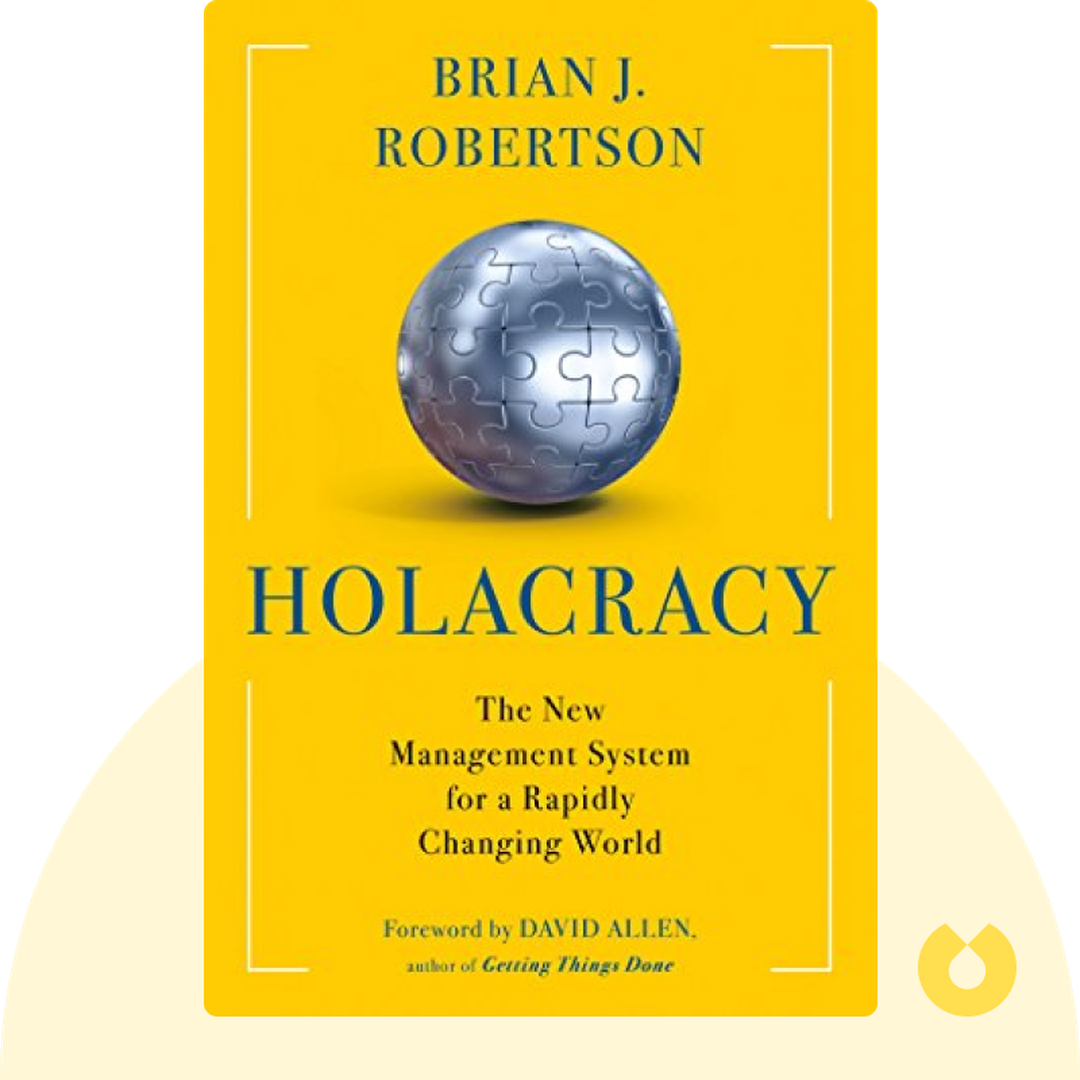
Holacracy (2015) describes a revolutionary new management system championed by some of today’s most forward-thinking companies, like Zappos and Medium. These blinks explain how authority and responsibility are defined and distributed within a Holacracy – and why this system leads to a more effective and dynamic organization.
Who Should Listen to Holacracy?
- Founders, CEOs, managers and HR professionals
- Employees who feel undervalued within a hierarchical organization
- Anyone who wishes their company were more flexible, dynamic and responsive
Books Similar to Holacracy
Readers who enjoyed this also liked these titles.