If You're Curious About These Questions...
You should listen to this audiobook
- Have you ever wondered how a single invisible force can simultaneously control the rhythmic rise of the tides and the formation of entire galaxies?
- Did you know that the history of gravity is filled with mind-bending conundrums that challenged the world’s greatest thinkers for centuries?
- Are you curious about the secret scientific breakthroughs that transformed gravity from a mysterious pull into the fundamental architect of our universe?
Listen to Gravity — Free Audiobook
Loading player...
Key Takeaways from Gravity
- Discover how early astronomers revolutionized science by shifting the study of the cosmos from ancient philosophical dogma to meticulous, evidence-based observation.
- Learn how Johannes Kepler used Tycho Brahe's unprecedented data to debunk the myth of perfect circular orbits and prove that planets actually travel in ellipses.
- Understand how Isaac Newton connected a falling apple to the orbiting moon, revealing that a single universal law of gravitation binds both terrestrial and celestial bodies.
- Find out why all objects accelerate at the exact same rate in a vacuum, as a heavier object's increased gravitational pull is perfectly counterbalanced by its greater inertia.
- Uncover the surprising reason why you feel physical weight, which happens not because of internal gravity, but because the ground physically resists your continuous downward fall.
Learning Tools
Reinforce what you learned from Gravity
Mind Map
Gravity
From Dogma to Data+
Newtonian Gravity+
Light & Special Relativity+
General Relativity+
Astrophysical Discoveries+
Core Philosophy+
Quiz — Test Your Understanding
Question 1 of 7
Why did Claudius Ptolemy introduce the concept of 'epicycles' into his cosmological model?
Question 2 of 7
What was Johannes Kepler's revolutionary breakthrough regarding planetary motion?
Question 3 of 7
How did Isaac Newton resolve the paradox that heavier objects don't fall faster than lighter objects, despite having a stronger gravitational pull?
Question 4 of 7
What was the significance of the 1882 experiment conducted by Albert Michelson and Edward Morley?
Question 5 of 7
According to Einstein's special theory of relativity, what happens to space and time as an object approaches the speed of light?
Question 6 of 7
How did Arthur Eddington provide critical early experimental verification for Einstein's general theory of relativity?
Question 7 of 7
What provided the 'smoking-gun' proof of gravitational waves discovered by Russell Hulse and Joseph Taylor in 1974?
Gravity — Full Chapter Overview
- 1Recommendation
- 2Our stars as ourselves
- 3How a theory was born
- 4What about light?
- 5The quantum leap
- 6Massive
- 7Final summary
Gravity Summary & Overview
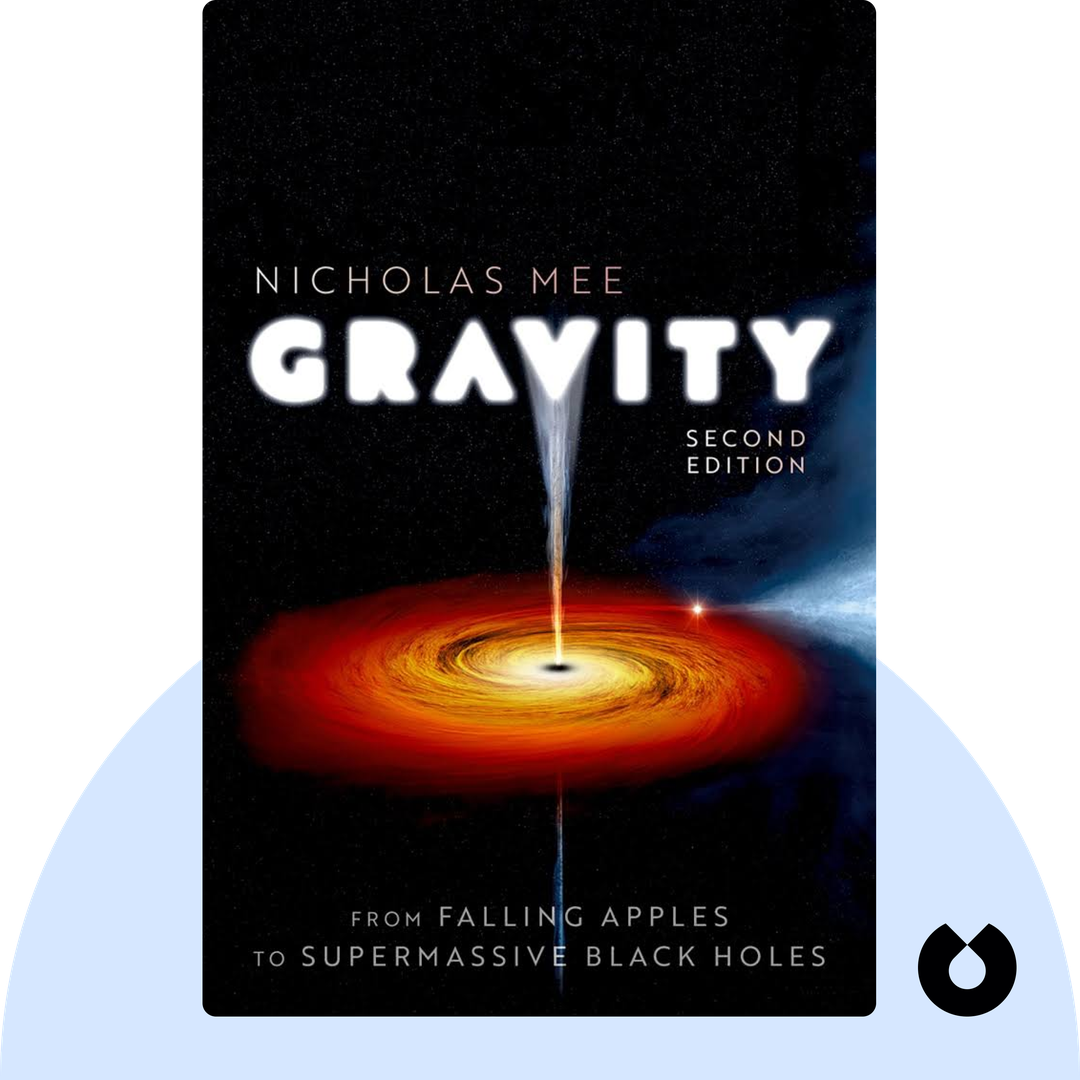
Gravity (2014) brings to life the history of human thought on one of the universe’s most fundamental forces. By guiding us through experiments, conundrums, and breakthroughs that changed science forever, it demonstrates how everything from galaxies to tides are formed and connected through this fascinating force.
Who Should Listen to Gravity?
- Those with an innate curiosity about the natural world
- Science fans craving stories about scientific advancement
- Anyone wanting to know more about the forces that govern our universe
Books Similar to Gravity
Readers who enjoyed this also liked these titles.