Theme Song
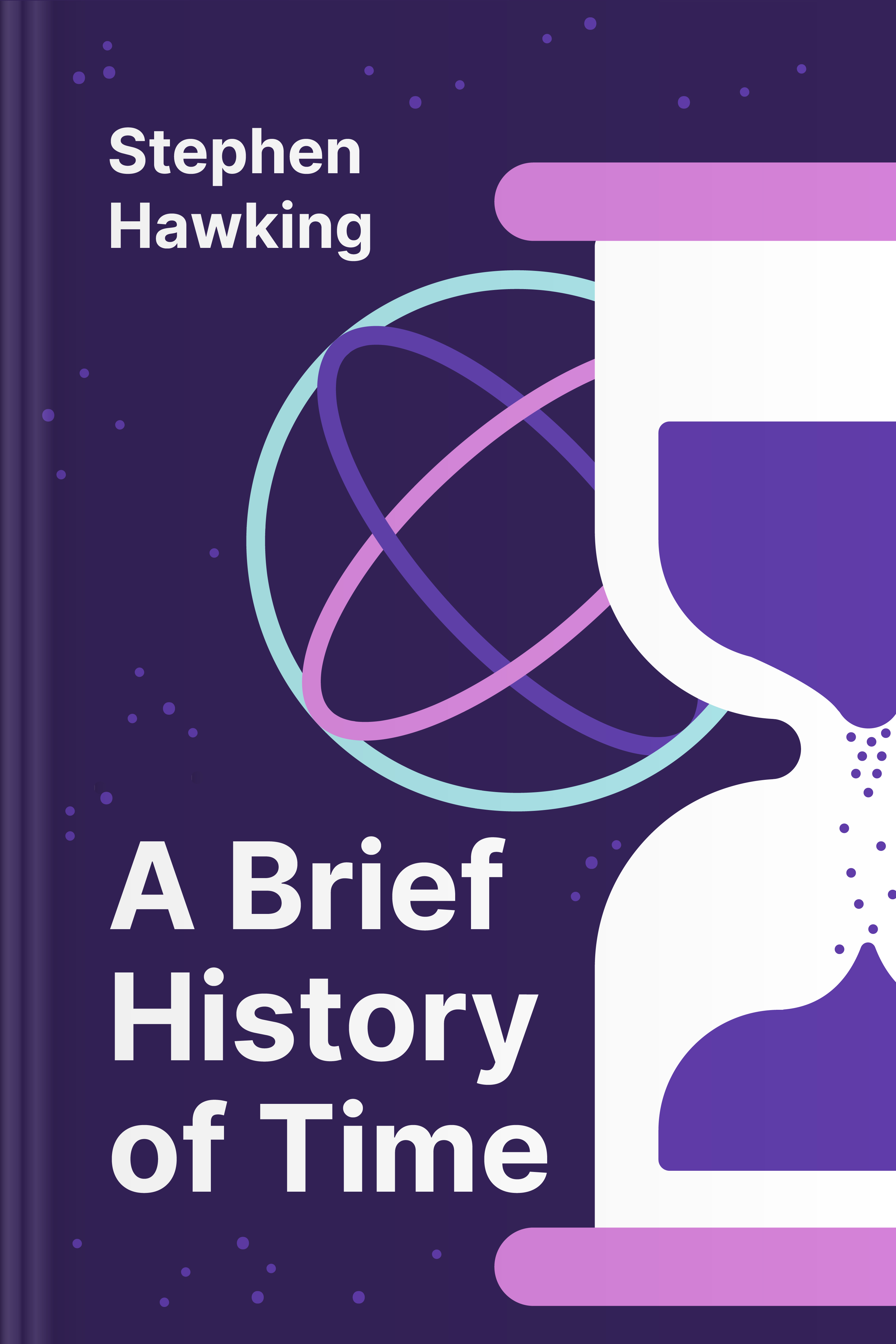
A Brief History of Time
Start ListeningDownload Try free on iPhoneScan to start in 5 seconds
Categories:
If You're Curious About These Questions...
You should listen to this audiobook
- Have you ever wondered why the very fabric of space and time isn't flat, but actually bends and curves around the stars?
- Did you know that black holes might not be the permanent cosmic traps we once thought, but could actually hold the secret to how the universe 'breathes'?
- Are you curious about how the smallest, most unpredictable particles in the quantum world actually shape the massive history of everything we see?
Listen to A Brief History of Time — Free Audiobook
Loading player...
Key Takeaways from A Brief History of Time
- Discover how astronomer Edwin Hubble's observation of receding galaxies proved the universe is expanding, laying the foundational evidence for the Big Bang model.
- Understand the central challenge of modern physics by exploring why the rules of general relativity and quantum mechanics contradict each other in extreme conditions.
- Learn why ordinary matter cannot surpass the speed of light, as an object's increasing energy directly increases its mass and makes it harder to accelerate.
- Explore how massive objects like planets and stars warp the space-time continuum, creating invisible indentations that literally bend the path of traveling light.
- Find out how gravity affects the flow of time, proving that time is dynamic and actually causes clocks to run slightly faster at higher altitudes.
Learning Tools
Reinforce what you learned from A Brief History of Time
Mind Map
A Brief History of Time
Scientific Theories+
Motion & Relativity+
Space-Time & Gravity+
The Quantum World+
Black Holes+
The Arrow of Time+
Forces & Origins+
Unified Theory Quest+
Quiz — Test Your Understanding
Question 1 of 10
According to the book, what discovery by Edwin Hubble in 1929 provided strong evidence for the Big Bang model?
Question 2 of 10
The text mentions a practical, modern technology that must account for the time-slowing effects of gravity described by Einstein's theory of relativity. What is it?
Question 3 of 10
What is the primary cause of the 'redshift' observed in the light from most distant galaxies?
Question 4 of 10
According to Heisenberg's uncertainty principle as explained in the book, why is it impossible to know a particle's exact position and speed at the same time?
Question 5 of 10
What is the significance of the slight imbalance between matter and antimatter in the early universe?
Question 6 of 10
What was Stephen Hawking's revolutionary insight regarding black holes, often called 'Hawking radiation'?
Question 7 of 10
The book describes three 'arrows of time.' The 'thermodynamic arrow' is linked to the second law of thermodynamics. What does this law state?
Question 8 of 10
String theories require the existence of extra dimensions beyond the four we experience (three of space, one of time). How might these extra dimensions theoretically allow for shortcuts across the universe?
Question 9 of 10
The text discusses why our universe's dimensional structure is crucial for life. What is one reason given for why complex life would be unlikely in a two-dimensional universe?
Question 10 of 10
What is the final, overarching message of the book summary regarding the nature of the universe and our understanding of it?
A Brief History of Time — Full Chapter Overview
- 1Recommendation
- 2Theories based on past observations can help predict the future.
- 3In the 1600s, Isaac Newton transformed how we understand moving objects.
- 4The constant speed of light shows that speed can’t always be measured relative to something else.
- 5Relativity shows that time itself is not fixed.
- 6Because particles can’t be measured exactly, scientists use quantum states to make predictions.
- 7Gravity comes from massive objects curving the universe.
- 8When a very massive star dies, it collapses into a singularity known as a black hole.
- 9Black holes release radiation, which can eventually cause them to evaporate.
- 10While we can’t know for certain, strong evidence suggests that time only moves forward.
- 11Besides gravity, the universe has three other fundamental forces.
- 12Scientists believe the universe began with the Big Bang, but they still don’t know exactly how it happened.
- 13Physicists have not yet unified general relativity with quantum physics.
- 14Final summary
A Brief History of Time Summary & Overview
This narration explores big questions in a calm, supportive way: How did the universe begin? Why does space bend? Why is the quantum world so hard to predict? And what happens at the edge of a black hole?
Along the way, it introduces the thinkers and experiments that shaped modern physics—Hubble’s expanding universe, Einstein’s curved spacetime, Heisenberg’s uncertainty, and Hawking’s insight that black holes can slowly radiate away. The tone stays friendly and human, treating science as an invitation rather than a test.
Who Should Listen to A Brief History of Time?
- Curious listeners who want an approachable, story-like introduction to cosmology, relativity, quantum ideas, and black holes.
- Anyone who feels intimidated by physics and would appreciate a warm, guided tour that values wonder over perfection.
- Listeners who enjoy big-picture thinking—how time, space, matter, and uncertainty might fit together.
Books Similar to A Brief History of Time
Readers who enjoyed this also liked these titles.