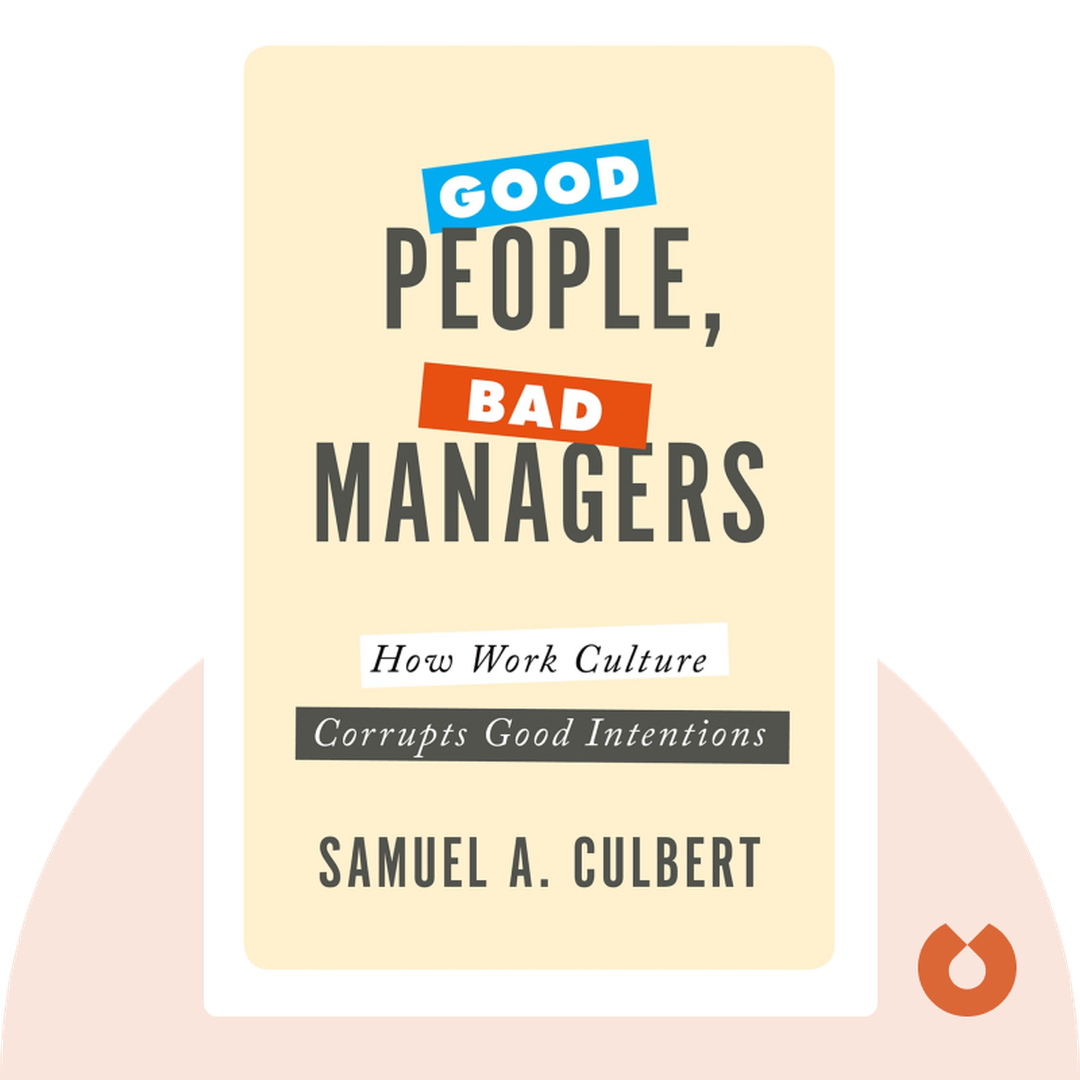
Good People, Bad Managers
Start ListeningDownload Try free on iPhoneScan to start in 5 seconds
Categories:
If You're Curious About These Questions...
You should listen to this audiobook
- Have you ever wondered why even the most well-intentioned people often transform into "bad" managers the moment they step into a leadership role?
- Did you know that the standard management practices we take for granted might actually be sabotaging your team's productivity and mental health?
- What if the key to a thriving workplace isn't about finding better people, but uncovering the hidden culture of self-preservation that holds every manager back?
Listen to Good People, Bad Managers — Free Audiobook
Loading player...
Key Takeaways from Good People, Bad Managers
- Discover why bad management is the accepted norm in the workplace and how simply leaving productive employees alone is often the most effective managerial strategy.
- Understand the danger of the managerial 'Boy Scout mentality,' where leaders focus on performing generic good deeds instead of addressing the actual needs of their team.
- Learn how to shift from a self-focused leadership style to an 'other-focused' approach that asks employees what they need rather than dictating demands.
- Recognize how traditional business education and a culture of corporate conformity stifle honest communication and crucial skills like personal introspection.
- Break free from the toxic cycle of double-dealing and secrecy by understanding why managers are taught to be deceitful and how you can cultivate a more authentic workplace.
Learning Tools
Reinforce what you learned from Good People, Bad Managers
Mind Map
Good People, Bad Managers
The Reality of Bad Management+
Root Causes of Poor Management+
Solutions for Better Management+
Quiz — Test Your Understanding
Question 1 of 7
What does the book suggest is a surprisingly effective action a manager can take to help employees?
Question 2 of 7
According to the author, what is the flaw in the 'Boy-Scout mentality' among managers?
Question 3 of 7
How do business schools contribute to the prevalence of poor management, according to the text?
Question 4 of 7
What is 'borrowed authority' in the context of bad managerial habits?
Question 5 of 7
Why is it difficult to break the cycle of bad management from the bottom up?
Question 6 of 7
What alternative does the author propose to replace traditional performance reviews?
Question 7 of 7
How can using the first-person pronoun (e.g., 'Let me tell you how I see it...') improve management?
Good People, Bad Managers — Full Chapter Overview
- 1Recommendation
- 2Although most managers have good intentions, poor management has become the norm in many workplaces.
- 3Effective management requires overseeing others, but managers often focus too much on their own success.
- 4Business education and workplace culture teach managers harmful habits.
- 5Managers often focus on protecting their own positions through double-dealing, posturing and secrecy.
- 6Breaking the cycle of bad management is difficult and requires leadership from the top.
- 7Leaders and managers can improve management by doing away with performance reviews.
- 8Adopting a new mind-set, seeking feedback and prioritizing honesty can lead to better management.
- 9Final summary
Good People, Bad Managers Summary & Overview
Good People, Bad Managers (2017) argues that the culture of the modern American workplace is perpetuating bad management without our being aware of it. The current management culture of self-preservation leads to behavior that actively harms well-being, productivity and motivation. Culbert explores why so many good people are trapped in the cycle of bad management, and makes a case for cultural change in our workplaces.
Who Should Listen to Good People, Bad Managers?
- Managers looking to improve their business
- People who are interested in how work culture functions
- Those who want to challenge conventional management approaches
Books Similar to Good People, Bad Managers
Readers who enjoyed this also liked these titles.