If You're Curious About These Questions...
You should listen to this audiobook
- Did you know that a surprisingly simple and low-cost engineering solution could be the key to reversing global warming?
- Have you ever wondered why, according to the data, walking home drunk is actually more dangerous than driving?
- What’s the secret to solving massive global crises by identifying the hidden incentives that drive human behavior in the most unexpected places?
Listen to SuperFreakonomics — Free Audiobook
Loading player...
Key Takeaways from SuperFreakonomics
- Understand why well-intentioned incentives often backfire, such as how trash fees inadvertently increased Germany's rat population, and how data can predict these human reactions.
- Learn to think like an economist by using cold, hard data to separate actual trends from media hype, as demonstrated by the exaggerated 'Summer of the Shark'.
- Discover how approaching intractable problems from a completely new angle leads to groundbreaking solutions, just as the invention of the car solved the 1900s horse manure crisis.
- Master fundamental economic principles like supply, demand, and price discrimination by examining the surprising data behind why 19th-century sex workers earned significantly more than modern ones.
- Find out how data analysis and algorithms track unexpected behavioral patterns, revealing that terrorists are typically well-educated and middle-class rather than driven by poverty.
Learning Tools
Reinforce what you learned from SuperFreakonomics
Mind Map
SuperFreakonomics
The Power of Data & Economics+
Hidden Economics of Human Behavior+
Simple Solutions to Complex Problems+
Re-evaluating Global Warming+
Quiz — Test Your Understanding
Question 1 of 9
What unintended consequence occurred when Germany introduced volume-based trash pickup fees to reduce waste?
Question 2 of 9
How did objective statistical analysis change the perception of the 2001 'Summer of the Shark' in the US?
Question 3 of 9
According to the book, why did sex workers in the 1900s earn significantly higher wages compared to modern sex workers?
Question 4 of 9
What surprising discovery did economist Alan Krueger make when analyzing data about terrorists in Lebanon?
Question 5 of 9
In Ian Horsley's banking algorithm designed to track potential terrorists, what is considered a 'negative indicator' (a characteristic a terrorist wouldn't normally display)?
Question 6 of 9
How did economist John List prove that society is not as fundamentally altruistic as the original Dictator Game suggested?
Question 7 of 9
When analyzing car crash data in the 1950s, how did Robert Strange McNamara solve the problem of fatal head injuries?
Question 8 of 9
Which persistent myth about global warming is challenged by the data presented in the book?
Question 9 of 9
What counterintuitive, cost-effective solution to global warming is proposed by researchers, inspired by the 1991 eruption of Mount Pinatubo?
SuperFreakonomics — Full Chapter Overview
- 1Recommendation
- 2Statistics can reveal brilliant insights about our world today.
- 3Think like an economist and you’ll unlock society’s hidden secrets today.
- 4Prostitution statistics reveal several economic principles at play today.
- 5Economic thinking can help us catch terrorists before they strike.
- 6In truth, people are neither wholly altruistic nor completely apathetic.
- 7Often, the trickiest problems end up having the simplest solutions indeed.
- 8Confusion surrounding global warming makes it difficult to tackle effectively.
- 9Statistics suggest we can combat global warming with more pollution, not less, actually.
SuperFreakonomics Summary & Overview
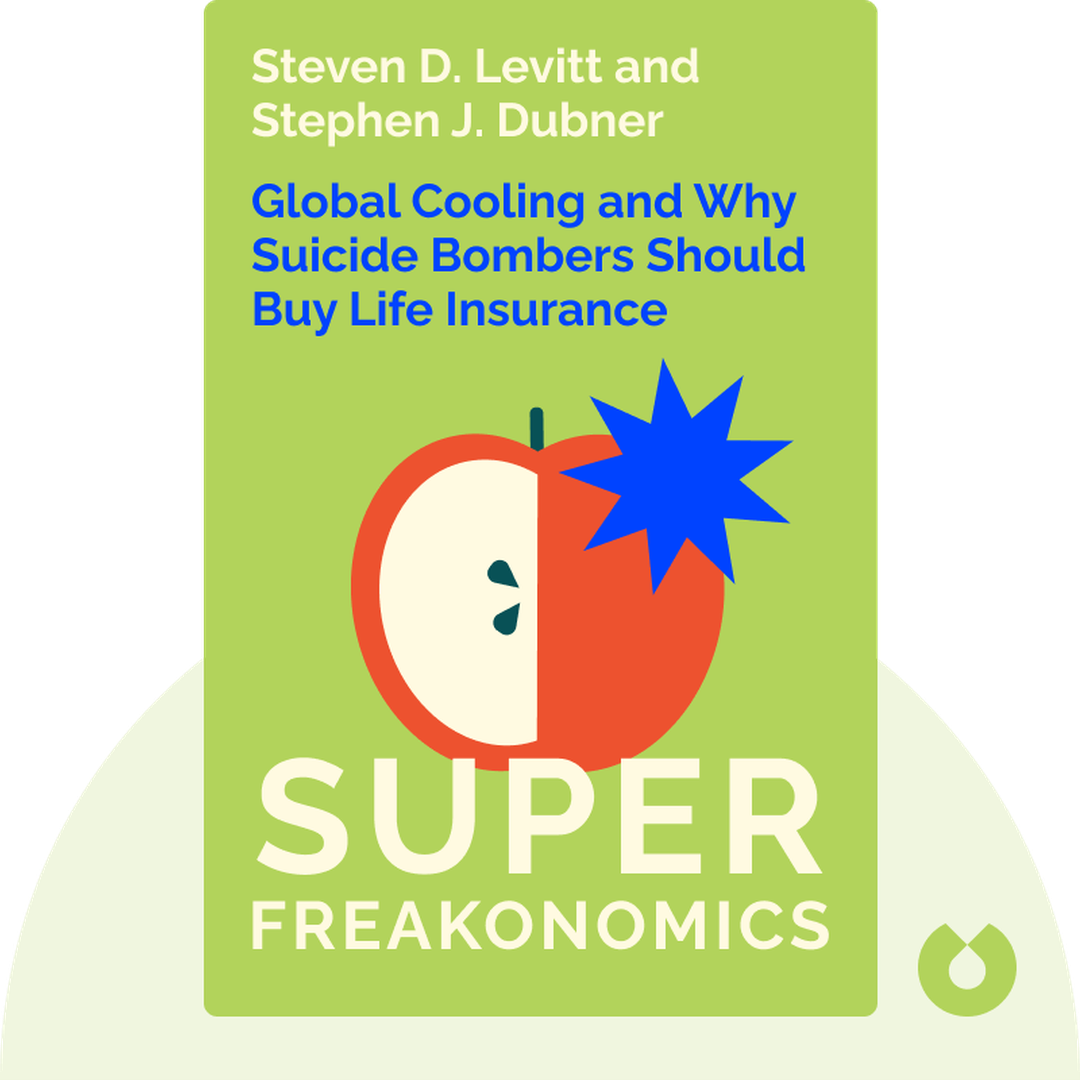
SuperFreakonomics (2009) explains why thinking like an economist can help us understand our modern world. These blinks illustrate key economic principles and the importance of collecting data with colorful stories from human history, and offers surprising solutions for the global problems that we face today.
Who Should Listen to SuperFreakonomics?
- Anyone interested in entertaining, statistical facts about human behavior
- Math buffs who believe in the power of statistics
- Anyone curious about a very cheap way to stop global warming
Books Similar to SuperFreakonomics
Readers who enjoyed this also liked these titles.