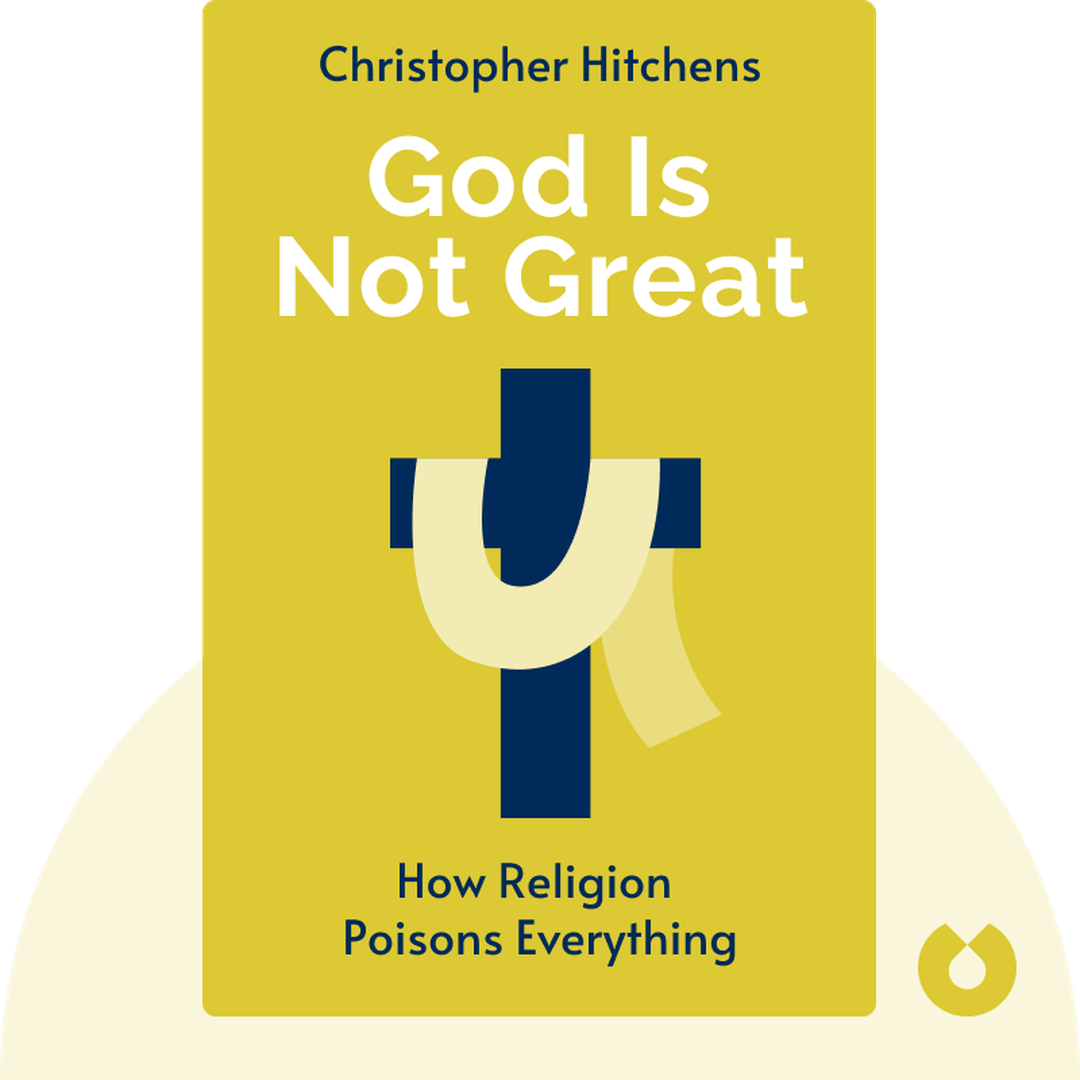
If You're Curious About These Questions...
You should listen to this audiobook
- Have you ever wondered how primitive superstitions from the dawn of humanity evolved into the complex global religions we see today?
- Are you curious why scientific theory and religious belief are fundamentally irreconcilable, no matter how hard we try to bridge the gap?
- Did you know that the very beliefs meant to provide comfort might actually pose a hidden danger to modern society and human progress?
Listen to God Is Not Great — Free Audiobook
Loading player...
Key Takeaways from God Is Not Great
- Understand why religious texts are actually man-made creations, featuring cherry-picked narratives and historical inaccuracies rather than divine inspiration.
- Discover how supposed religious miracles are often primitive misunderstandings of natural phenomena or irrelevant tricks that fail to withstand scientific scrutiny.
- Recognize why religions are not the true guardians of morality, as their foundational texts frequently promote abhorrent practices and punish inescapable human biology with the threat of damnation.
- Explore how religious belief mirrors totalitarian dictatorships by demanding blind obedience, constant surveillance, and the willing subjugation of its followers.
- Learn how blind faith leads society to accept the irrational and harmful treatment of children, excusing physical alterations and psychological indoctrination through the fear of hell.
Learning Tools
Reinforce what you learned from God Is Not Great
Mind Map
God Is Not Great
Man-Made Origins+
Totalitarianism and Intolerance+
Conflict with Science and Reason+
Quiz — Test Your Understanding
Question 1 of 9
Why does the author cite the Gospel of Judas in the discussion of religious texts?
Question 2 of 9
According to the text, what is the primary reason the religious stories in the Bible contain historical inaccuracies?
Question 3 of 9
What does the author suggest the modern tendency to see the face of God in a piece of toast illustrates?
Question 4 of 9
How does the author view religious commandments regarding human sexuality?
Question 5 of 9
What parallel does the author draw between religious belief and the totalitarian regime of North Korea?
Question 6 of 9
Why does the author classify the teaching of hell and eternal damnation to children as highly immoral?
Question 7 of 9
According to the text, what is the root cause of religious intolerance toward other faiths and systems of knowledge?
Question 8 of 9
Which of the following is cited in the text as a tragic, real-world consequence of religion standing in the way of scientific progress?
Question 9 of 9
How does the author explain the ongoing survival and influence of religion despite widespread scientific advancements?
God Is Not Great — Full Chapter Overview
- 1Recommendation
- 2Miracles aren’t as miraculous as they first seem.
- 3Rather than guarding morality, religions often teach immoral ideas.
- 4Religious belief is totalitarian, much like a dictatorship.
- 5Religions’ treatment of children shows how blind faith can lead to irrational and bizarre behavior.
- 6Religions cannot be truly tolerant – they feel compelled to interfere in others’ lives.
- 7Despite religious persecution, freethinkers have always helped drive the progress of knowledge.
- 8Religion and science are fundamentally at odds.
- 9As long as religion exists, it will try to impose itself on society – and must be opposed.
- 10Final summary
God Is Not Great Summary & Overview
God is Not Great traces the development of religious belief from the earliest, most primitive ages of humankind through to today. It attempts to explain the dangerous implications of religious thought and the reasons why faith still exists today. It also helps explain why scientific theory and religious belief can never be reconciled.
Who Should Listen to God Is Not Great?
- Those who want to know how religions developed
- Anyone who wants to understand the fight between religious and scientific thinking
- Those who wish to see the negative aspects of religious belief
Books Similar to God Is Not Great
Readers who enjoyed this also liked these titles.