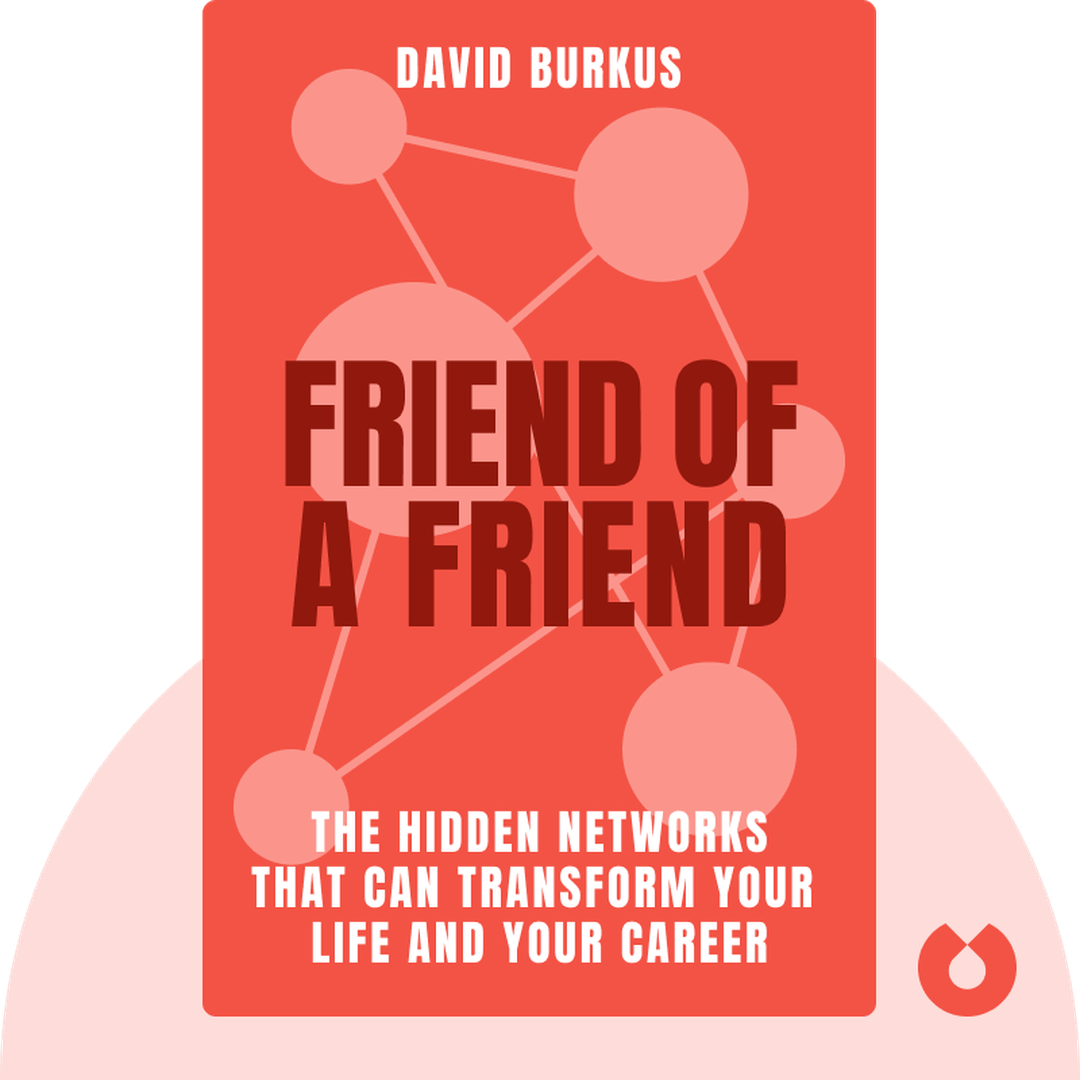
If You're Curious About These Questions...
You should listen to this audiobook
- Did you know that your 'dormant ties'—people you haven't spoken to in years—might actually be the secret weapon for your next big career breakthrough?
- Have you ever wondered why traditional networking events often fail, and what the world’s most successful people do differently to build their influence?
- What if the key to groundbreaking innovation isn't about who you know, but how you bridge the 'hidden gaps' between different social circles?
Listen to Friend of a Friend — Free Audiobook
Loading player...
Key Takeaways from Friend of a Friend
- Discover why reaching out to 'weak social ties' instead of close friends is the most effective strategy for finding new job opportunities and generating innovative business models.
- Learn how stepping outside your usual cliques to mingle with completely unfamiliar social clusters can lead to better ideas, higher salaries, and faster career advancement.
- Understand the critical role of team reshuffling, and why collaborating with new people generates significantly more high-profile innovation than sticking with established, stale groups.
- Uncover the 'Matthew effect' in professional networking, revealing how gathering a few initial connections creates a powerful snowball effect that naturally attracts even more valuable contacts.
- Master the art of expanding your professional circle by learning techniques to identify and connect with the right people, proving that your network is already much larger than you think.
Learning Tools
Reinforce what you learned from Friend of a Friend
Mind Map
Friend of a Friend
Power of Weak Ties+
Bridging Unfamiliar Groups+
Teamwork & Reshuffling+
Network Growth+
Super Connectors+
Overcoming Homophily+
Effective Networking+
Friendship and Business+
Quiz — Test Your Understanding
Question 1 of 8
Why are 'weak social ties' often more effective than 'strong social ties' when searching for a new job?
Question 2 of 8
According to Brian Uzzi's research on scientific innovation, which type of team is most likely to publish in high-profile periodicals?
Question 3 of 8
How does the 'Matthew effect' apply to the concept of networking?
Question 4 of 8
What strategy did Tim Ferriss use to become a 'Super Connector' and make his book a bestseller?
Question 5 of 8
What did the founders of Gimlet Media realize about their hiring process that hindered diversity?
Question 6 of 8
According to the Columbia University study by Paul Ingram and Michael Morris, why are traditional social mixers often ineffective for networking?
Question 7 of 8
What alternative method does behavioral scientist Jon Levy use to successfully help professionals bond and network?
Question 8 of 8
Based on Jessica Methot's research on workplace relationships, what is a noted trade-off of having close friends at work?
Friend of a Friend — Full Chapter Overview
- 1Recommendation
- 2Connecting with people you don’t know well leads to stronger networking and innovation.
- 3Building ties with unfamiliar groups sparks innovation and supports better careers.
- 4Innovation increasingly comes from teamwork, especially when teams are reshuffled.
- 5Building connections is like a rolling snowball: once you have some, you’ll gather more and more.
- 6Super Connectors can make your own network seem small, but you can become one too.
- 7People tend to cluster in similar groups, which can make diversity hard to achieve.
- 8Social mixers aren’t the best way to network, since people bond more easily through activities.
- 9In networking, friendships and business relationships can reinforce each other.
- 10Final summary
Friend of a Friend Summary & Overview
Friend of a Friend (2018) shows how networks around us can be put to use and taken advantage of. Networking is, of course, a crucial skill for professional success – but networks themselves go even deeper and aren’t just about making new contacts. Innovation, career development and business success all have their part to play, too.
Who Should Listen to Friend of a Friend?
- Students of business and management
- Ambitious professionals
- Frustrated workers stuck in dead-end jobs
Books Similar to Friend of a Friend
Readers who enjoyed this also liked these titles.