If You're Curious About These Questions...
You should listen to this audiobook
- Did you know that your daily food choices might be the most powerful tool we have to combat chronic disease, economic inequality, and climate change all at once?
- Have you ever wondered why our current food system is often at odds with our health, and what specific shifts could finally bridge that gap?
- What if the secret to reversing environmental collapse and saving trillions in healthcare costs was hidden within a revolutionary approach to how we treat our soil?
Listen to Food Fix — Free Audiobook
Loading player...
Key Takeaways from Food Fix
- Understand why the gravest problems facing humanity, including chronic disease, global inequality, and climate change, can all be traced back to our consumption of ultra-processed foods.
- Discover the terrifying economic impact of the 'industrial diet' and see how the trillions of dollars spent on diet-related chronic diseases could otherwise be used to eradicate global poverty.
- Learn how intensive farming and big agribusiness are destroying vital, carbon-storing soils and creating toxic oceanic 'dead zones' through dangerous fertilizer runoff.
- Realize how bad food exacerbates social inequality by causing malnutrition that stunts intellectual development and traps vulnerable populations in endless cycles of poverty.
- Find out how to navigate and reverse this crisis by learning exactly which foods to avoid, how governments should intervene, and why sustainable farming practices hold the key to our survival.
Learning Tools
Reinforce what you learned from Food Fix
Mind Map
Food Fix
The Global Food Crisis+
The Economic Toll+
Dietary Solutions+
Policy & Government Action+
Regenerative Agriculture+
Quiz — Test Your Understanding
Question 1 of 8
According to the book, what is the single focal point linking major global crises such as chronic disease, inequality, and climate change?
Question 2 of 8
What is a major reason why the economic cost of the 'industrial diet' is so high in the United States?
Question 3 of 8
How does intensive farming contribute directly to global warming, aside from its use of fossil fuels?
Question 4 of 8
Why did the 'Green Revolution' fail to end world hunger despite producing enough food to feed the globe?
Question 5 of 8
What is the author's stance on incorporating meat into a sustainable diet?
Question 6 of 8
How did the Chilean government successfully combat the junk food industry's influence on public health?
Question 7 of 8
What is the primary benefit of the 'no-till' farming method mentioned in the text?
Question 8 of 8
How does Reginaldo Haslett-Marroquin's 'Main Street Project' utilize agroforestry to create a sustainable farm?
Food Fix — Full Chapter Overview
- 1Recommendation
- 2The biggest problems we face as a species can be traced to one thing: our food.
- 3The economic cost of unhealthy food is alarming.
- 4Big agribusiness is creating an environmental disaster.
- 5The systems that once helped end mass hunger are now breaking down.
- 6Food that’s healthy for you is also healthy for the planet.
- 7Food lobbyists are powerful, but government action against harmful corporations can work.
- 8Regenerative agriculture is essential for a healthy planet and healthy people.
- 9Innovative farming methods are emerging around the world.
- 10Final summary
Food Fix Summary & Overview
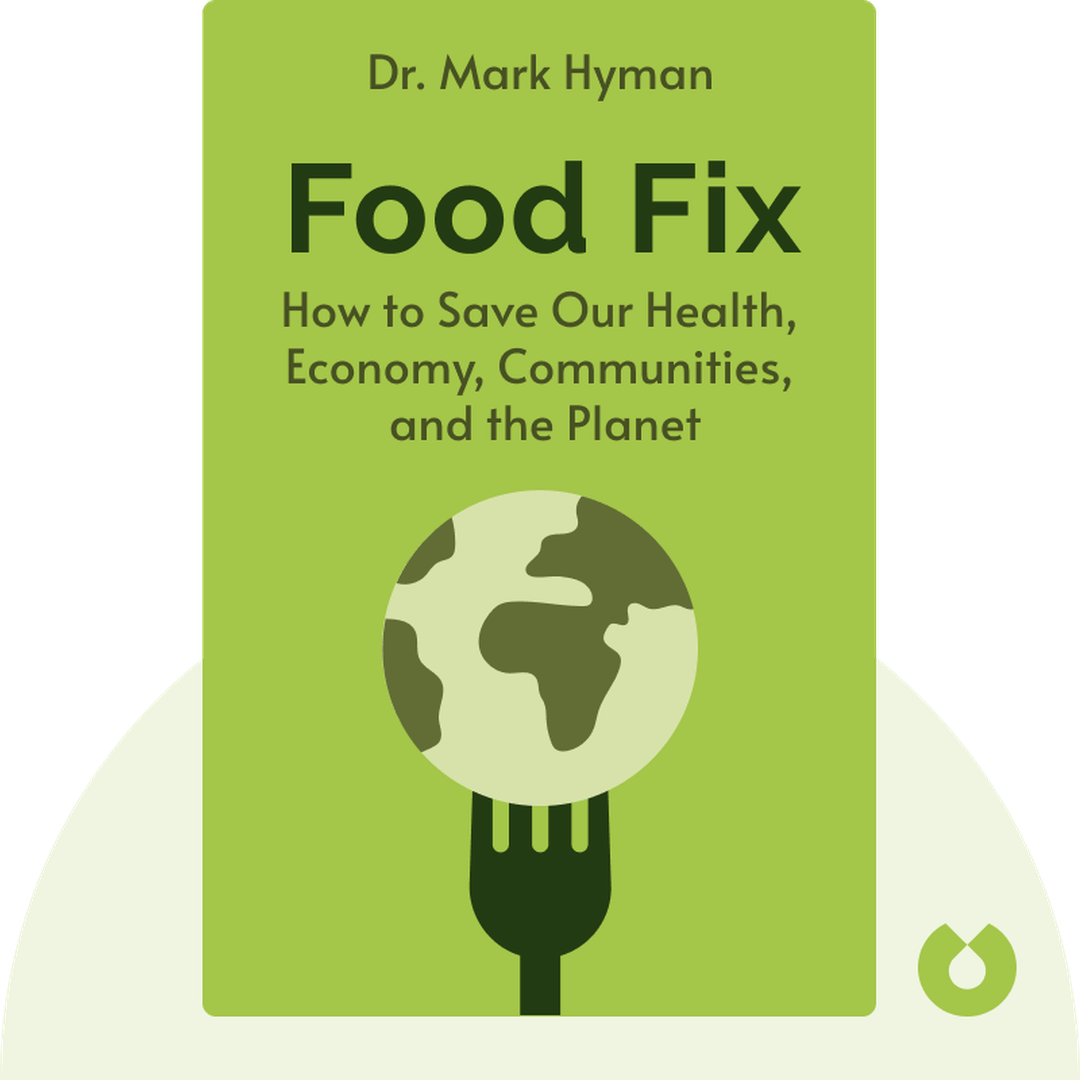
Food Fix (2020) shows us how the world's gravest problems, like chronic disease, inequality, and climate collapse, can all be traced back to our food and the way we produce it. Here, American physician Mark Hyman describes what we should do next, setting out the path to healthy eating and regenerative farming.
Who Should Listen to Food Fix?
- Anyone interested in eating and living well
- Environmentalists and climate activists
- Farmers looking to transition to sustainable agriculture
Books Similar to Food Fix
Readers who enjoyed this also liked these titles.