If You're Curious About These Questions...
You should listen to this audiobook
- Have you ever wondered what top-tier magicians, high-stakes advertisers, and even psychopaths have in common when it comes to the art of influence?
- Did you know there’s a biological 'shortcut' in the human brain that allows expert persuaders to flip your perspective in a matter of seconds?
- What if you could decode the secret psychological triggers used by master manipulators to ensure you never get talked into something you don't want again?
Listen to Flipnosis — Free Audiobook
Loading player...
Key Takeaways from Flipnosis
- Understand why persuasion is an essential societal tool that happens up to 400 times a day to prevent human interactions from devolving into violent coercion.
- Discover how to use primal 'key stimuli,' such as a simple physical gesture of submission, to naturally defuse conflict and pacify aggressive behavior.
- Learn how to bypass deception by intentionally increasing a person's cognitive load, making it mentally harder for them to lie and easier to tell the truth.
- Master the psychological trigger of 'social proof' to subconsciously influence decisions by tapping into the innate human urge to belong to a popular group.
- Uncover how professional persuaders exploit the 'fundamental attribution error' by framing information to control narratives and completely alter your perception of reality.
Learning Tools
Reinforce what you learned from Flipnosis
Mind Map
Flipnosis
The Reality of Persuasion+
Biological & Instinctual Triggers+
The Three A's of Mental Blind Spots+
Professional Framing+
Group Conformity & Radicalization+
SPICE Formula for Split-Second Persuasion+
Defense & Ethics+
Quiz — Test Your Understanding
Question 1 of 7
According to the text, why is persuasion considered an essential part of society rather than just a common occurrence?
Question 2 of 7
How does Marco, the Job Centre employee, successfully pacify angry and frustrated job seekers without using security measures?
Question 3 of 7
According to the con man Keith Barrett, what is the effect of deliberately increasing a person's cognitive load (the "Attention" principle)?
Question 4 of 7
Why did changing an infomercial prompt from "Operators are waiting" to "If operators are busy, please call again" drastically increase the number of callers?
Question 5 of 7
The scenario comparing John crashing his car while rushing home with an anniversary present versus a brick of cocaine illustrates which psychological concept?
Question 6 of 7
What did Solomon Asch’s famous line-length experiment demonstrate about human behavior?
Question 7 of 7
In the SPICE formula for split-second persuasion, what does the principle of "Incongruity" rely on?
Flipnosis — Full Chapter Overview
- 1Recommendation
- 2Our Instinct for Persuasion
- 3How to Capture Someone’s Mind
- 4Persuasion Experts Are All Around Us
- 5The Persuasive Force of the Crowd
- 6The Formula for Instant Persuasion
- 7Final Summary
Flipnosis Summary & Overview
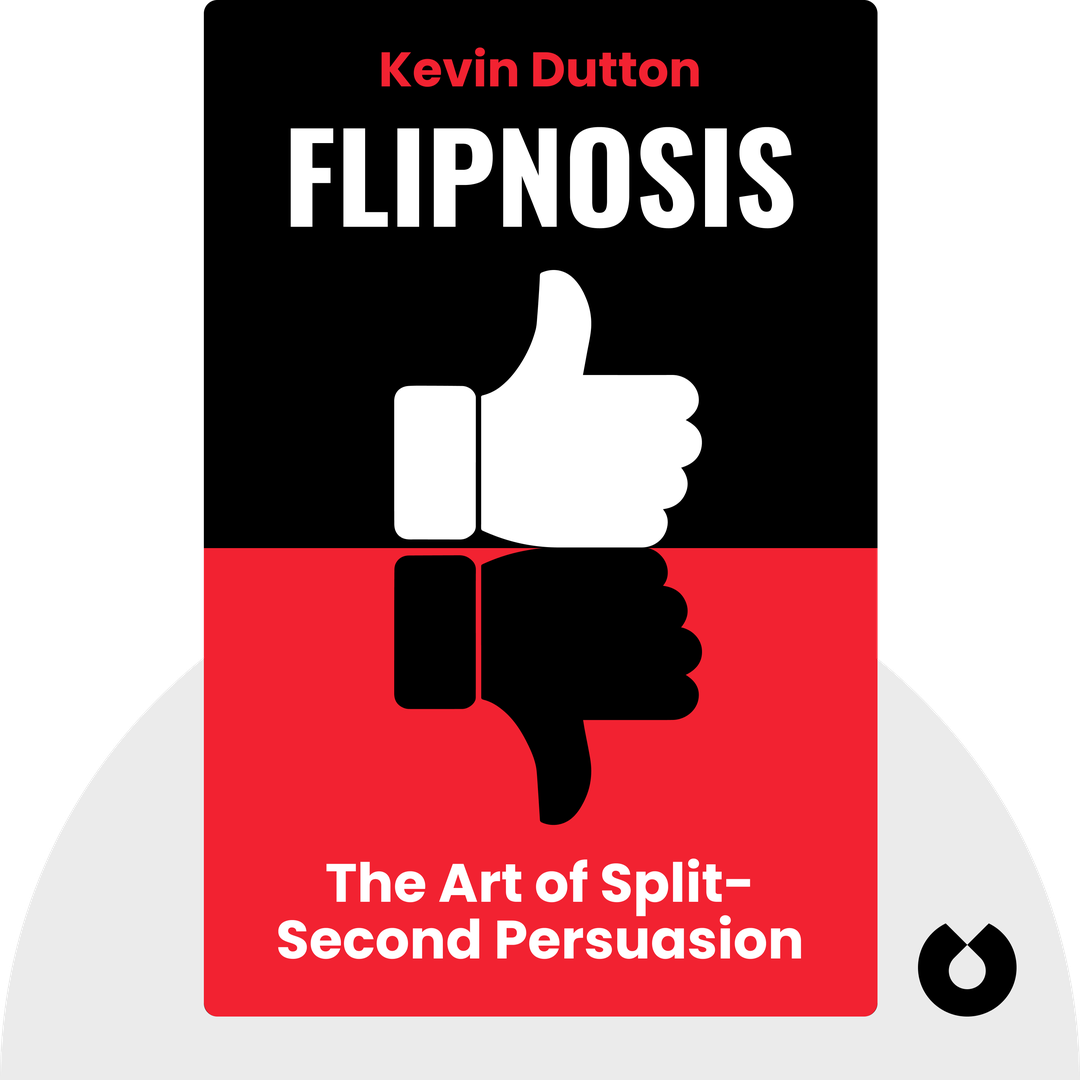
Flipnosis (2010) looks at the role of persuasion in our lives, and the social and biological underpinnings that allow some people to quickly and successfully encourage and convince those around them. By examining the science and looking at real-world master persuaders – from magicians and advertisers to criminals and psychopaths – you too can tap into the art of persuasion.
Who Should Listen to Flipnosis?
- Would-be social engineers, looking for a few tricks to improve their influence
- Free-thinkers who want to make sure that their choices are, in fact, their own
- Anyone who has been sold something they didn’t want, and were left wondering: What just happened?
Books Similar to Flipnosis
Readers who enjoyed this also liked these titles.