If You're Curious About These Questions...
You should listen to this audiobook
- Have you ever wondered why executive salaries are often so disproportionately high, and whether those massive paychecks actually translate into better performance?
- What’s the secret to aligning leadership compensation with long-term company value so that 'fair pay' truly leads to 'fair play'?
- What if you could implement a pay scale that rewards top-tier talent while maintaining trust and transparency across your entire organization?
Listen to Fair Pay Fair Play — Free Audiobook
Loading player...
Key Takeaways from Fair Pay Fair Play
- Understand why executive compensation must be tied to both individual performance and specific industry standards to fairly account for external market forces.
- Discover the importance of sticking to pre-arranged pay agreements and long-term business strategies instead of making arbitrary compensation adjustments during economic crises.
- Learn how the psychological trap of 'illusory superiority' leads companies to over-reward executives during strong economies while blaming external factors for poor leadership.
- Recognize the danger of applying a one-size-fits-all pay model, specifically the mistake of rewarding public company executives using short-term private equity structures.
- Find out why cash is a surprisingly poor motivator for retaining top talent, and discover how professional growth, company vision, and legacy drive true executive success.
Learning Tools
Reinforce what you learned from Fair Pay Fair Play
Mind Map
Fair Pay Fair Play
Performance & Industry Standards+
Strategy & Pre-arranged Plans+
Flaws in Current Models+
The Myth of Cash Retention+
Tools for Calibration+
Quiz — Test Your Understanding
Question 1 of 5
Why is it crucial to consider industry standards and peers when setting a CEO's compensation?
Question 2 of 5
How do arbitrary decisions and reactions to short-term economic events generally affect executive compensation?
Question 3 of 5
According to the text, what was a major mistake companies made regarding executive compensation in the 1990s and 2000s?
Question 4 of 5
Why is it generally a bad idea for companies to offer massive financial packages simply to prevent executives from leaving during a crisis?
Question 5 of 5
What is the primary purpose of an 'alignment report' in the context of executive pay?
Fair Pay Fair Play — Full Chapter Overview
- 1Recommendation
- 2Executive pay plans should reflect CEO performance and industry benchmarks.
- 3For fair compensation, use pre-arranged agreements and focus on overall business strategy.
- 4Executive pay plans often shield CEOs from mistakes or short-term risks.
- 5Companies often overpay executives to retain them, but cash is a weak motivator.
- 6A few tools can help you calibrate executive pay and keep it fair.
- 7Final summary
Fair Pay Fair Play Summary & Overview
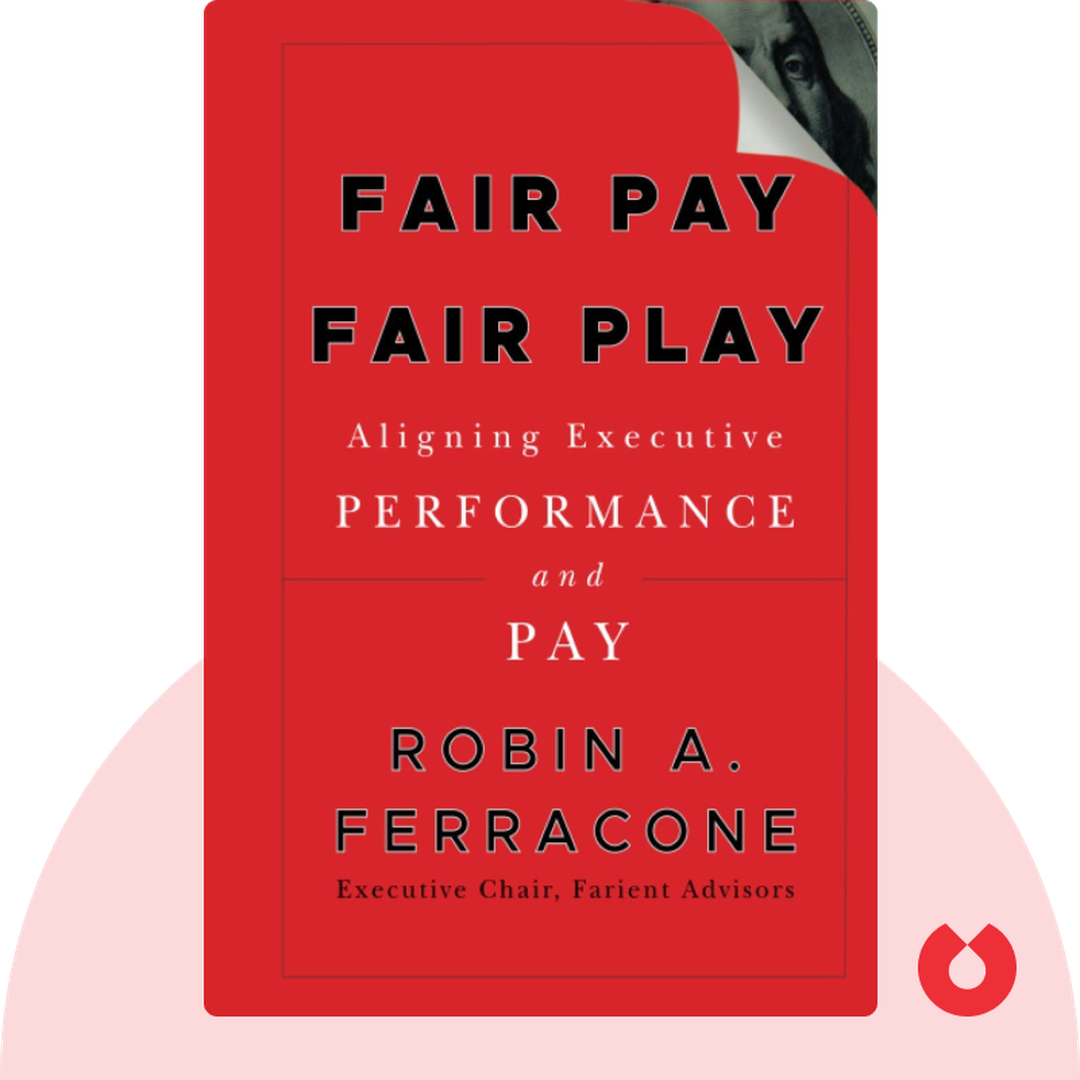
Fair Pay Fair Play (2010) sets out the basic principles of fair executive compensation. These blinks explain what goes into making compensation reasonable, why executives are often paid disproportionately higher salaries than other employees and which concrete strategies you can employ to set a fair pay scale for your company.
Who Should Listen to Fair Pay Fair Play?
- Human relations (HR) professionals
- Entrepreneurs and CEOs
- Anyone interested in the rules of executive compensation
Books Similar to Fair Pay Fair Play
Readers who enjoyed this also liked these titles.