If You're Curious About These Questions...
You should listen to this audiobook
- Did you know that in the world of 3D printing, an intricate, complex design costs exactly the same to produce as a simple plastic block?
- Have you ever wondered how the ability to 'print' living biological cells could soon revolutionize the way we treat disease and even source our food?
- What if you could bypass global supply chains entirely and manufacture customized products on demand, right from your own desk?
Listen to Fabricated — Free Audiobook
Loading player...
Key Takeaways from Fabricated
- Discover how 3D printing will evolve beyond a niche hobby to revolutionize everyday life, from cooking meals to treating serious illnesses.
- Understand the fundamental process of 3D fabrication, which constructs complex physical objects by meticulously stacking materials one flat layer at a time based on an electronic blueprint.
- Learn how sophisticated 3D design software utilizes XYZ coordinate systems to let you freely view, scale, and adjust intricate digital models without redesigning them from scratch.
- Find out why 3D printing offers the perfect middle ground between rigid mass production and expensive artisanal craftsmanship by enabling infinite, easily modifiable reproductions.
- Explore how decentralized cloud manufacturing makes innovation safe and affordable by allowing anyone to upload a design file and easily order everything from a single custom prototype to a large batch.
Learning Tools
Reinforce what you learned from Fabricated
Mind Map
Fabricated
Mechanics of 3D Printing+
Manufacturing Revolution+
The Ladder of Life+
Environmental Impact+
Quiz — Test Your Understanding
Question 1 of 6
How does a 3D printer physically construct an object?
Question 2 of 6
What is a primary advantage of 3D design software over traditional two-dimensional blueprints?
Question 3 of 6
How does 3D printing serve as a 'middle ground' between mass production and artisanal craftsmanship?
Question 4 of 6
According to the text, what is 'cloud manufacturing'?
Question 5 of 6
What does the 'ladder of life' represent in the context of 3D printing?
Question 6 of 6
Which of the following is an environmental DISADVANTAGE of 3D printing mentioned in the text?
Fabricated — Full Chapter Overview
- 1Recommendation
- 2Using a computer and design file, a 3D printer can create almost any object, layer by layer.
- 3Design software builds a three-dimensional environment to help you create your object.
- 43D printing has significant advantages over mass production and artisanal craftsmanship.
- 53D printing makes innovation safer and more affordable, and could transform manufacturing.
- 6We are already starting to print life-saving objects like body parts and food.
- 7When it comes to the environment, 3D printing has both benefits and drawbacks.
- 8Final summary
Fabricated Summary & Overview
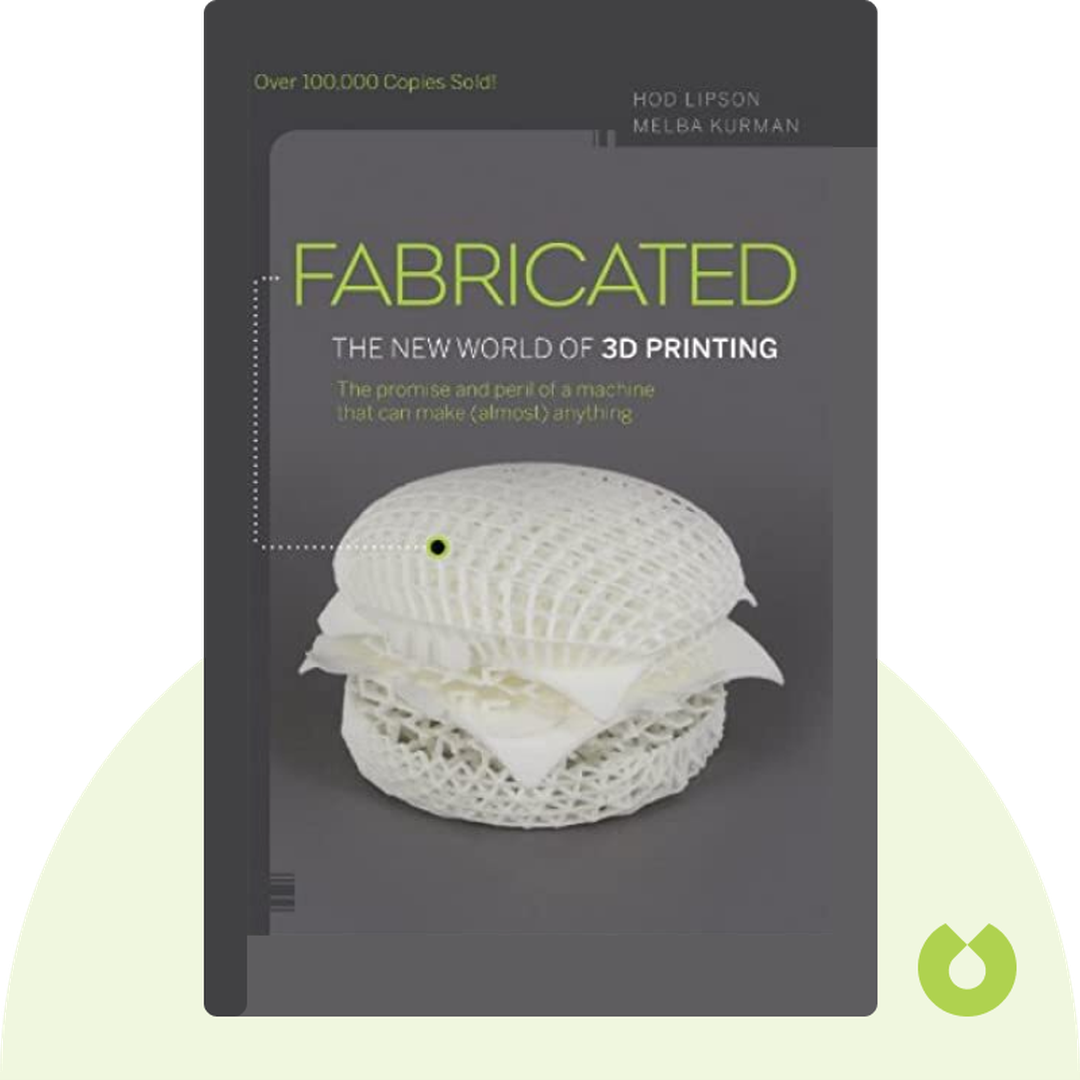
Fabricated (2013) offers a detailed view of the nuts and bolts of additive manufacturing – or, as it is more commonly known, 3D printing. In addition to exploring some of the technology’s more far-out possibilities, these blinks also provide insight into its more personal implications.
Who Should Listen to Fabricated?
- Designers and engineers
- Inventors
- Tech geeks
Books Similar to Fabricated
Readers who enjoyed this also liked these titles.