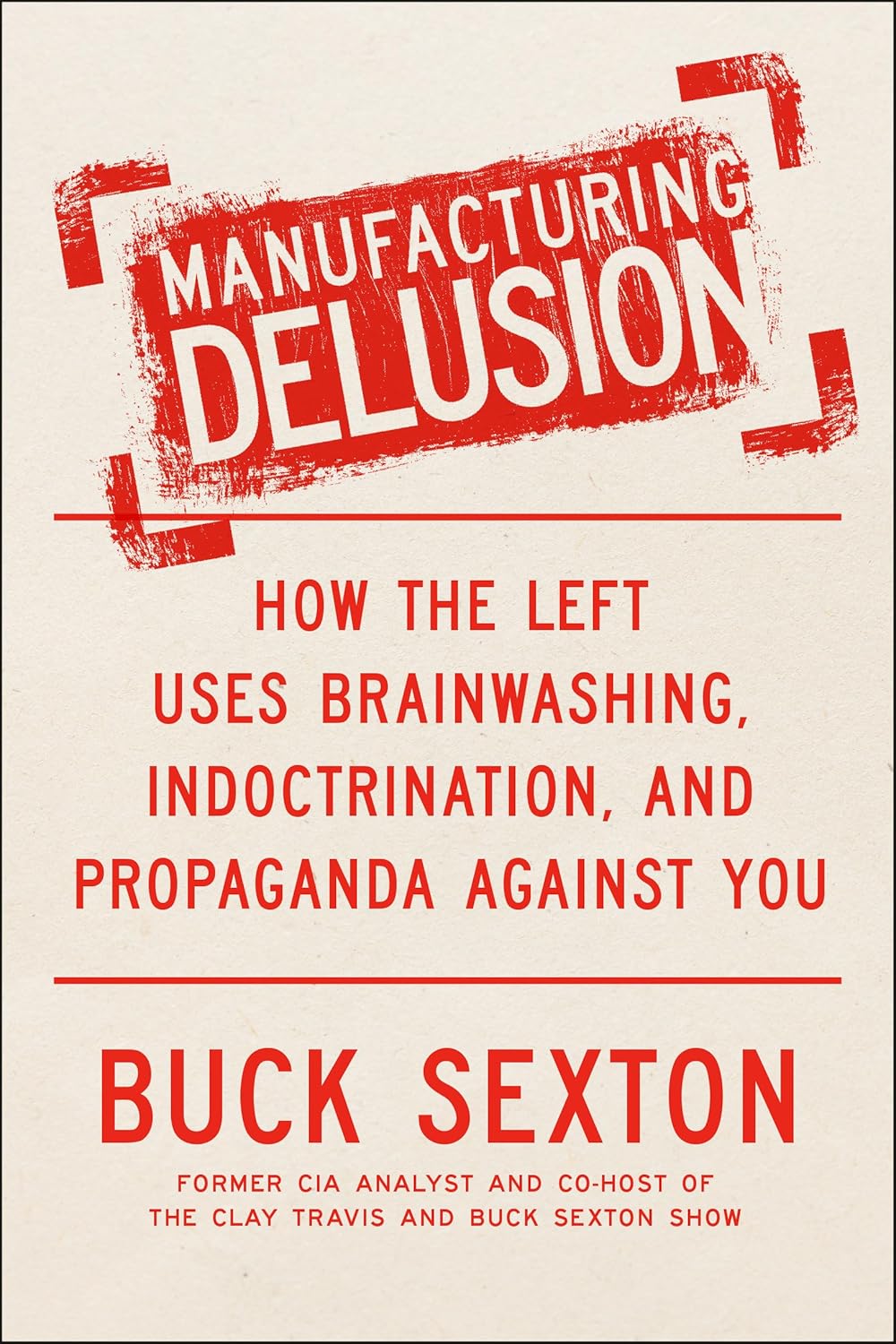
Manufacturing Delusion audiobook cover - From CIA counterterrorism tours to pandemic-era Manhattan, Buck Sexton argues mass delusion is “manufactured,” not accidental—built through repeatable tactics that condition fear, weaponize institutions, and rewrite identity, with AI poised to supercharge the entire playbook.

Manufacturing Delusion

From CIA counterterrorism tours to pandemic-era Manhattan, Buck Sexton argues mass delusion is “manufactured,” not accidental—built through repeatable tactics that condition fear, weaponize institutions, and rewrite identity, with AI poised to supercharge the entire playbook.

Buck Sexton

4.5 / 5(408 ratings)

If You're Curious About These Questions...

You should listen to this audiobook

Listen to Manufacturing Delusion — Free Audiobook

Loading player...

Key Takeaways from Manufacturing Delusion

Learning Tools

Reinforce what you learned from Manufacturing Delusion

Mind Map

Manufacturing Delusion
Genesis of Mass Delusion+
Psychological Breaking+
Indoctrination & Rebuilding+
Coercion by Fear & Law+
Disconnection & Control+
Manipulation & The AI Future+

Quiz — Test Your Understanding

Question 1 of 10
According to the book's introduction, what is the central thesis of "Manufacturing Delusion"?
  • A. Western societies are now more susceptible to violent extremism than developing nations.
  • B. Mass delusion is humanity's greatest threat, capable of inverting truth and morality to make citizens oppress themselves.
  • C. The CIA's bureaucratic failures are the primary cause of global instability and psychic epidemics.
  • D. Psychic outbreaks are a recent phenomenon caused exclusively by social media and the internet.
Question 2 of 10
In the chapter on "Conditioning," how did Sexton argue the politically approved mass gatherings of summer 2020 affected the public?
  • A. They broke the conditioning by showing that the fear of the virus was exaggerated.
  • B. They proved that outdoor activities were always safe, leading to a logical loosening of all restrictions.
  • C. They deepened the conditioning by teaching that reality is whatever authorities label "safe," and disobedience is a moral crime.
  • D. They had no effect on conditioning, as most people ignored the contradiction.
Question 3 of 10
What is the ultimate purpose of "menticide," or the "killing of the mind," as described by Sexton?
  • A. To persuade an individual through logical debate and evidence.
  • B. To temporarily confuse a person so they can be easily controlled in the short term.
  • C. To physically eliminate political opponents without a trial.
  • D. To force participation in a lie, weakening inner resistance until truth feels unreachable.
Question 4 of 10
According to Sexton, how do modern DEI rituals mirror the "brainwashing" template identified by Robert Jay Lifton?
  • A. They use physical torture and sleep deprivation to force compliance.
  • B. They focus on celebrating individual achievement and merit.
  • C. They use a confession/reeducation model that imposes guilt and then offers absolution through ideological compliance.
  • D. They encourage open debate and dissent to arrive at a stronger, more inclusive ideology.
Question 5 of 10
How does Sexton use Nazi Germany to illustrate the concept of "weaponized law"?
  • A. By showing that the Nazis immediately abolished all existing legal structures.
  • B. By highlighting how the regime retained the appearance of law while gradually reshaping it to legalize evil and create "desk perpetrators."
  • C. By arguing that Nazi law was ineffective and widely ignored by the German population.
  • D. By focusing on the international war crime tribunals that prosecuted Nazi leaders after the war.
Question 6 of 10
Which modern issue does Sexton identify as a primary example of "forced phobia"?
  • A. Fear of economic collapse due to national debt.
  • B. Anxiety over technological unemployment from automation.
  • C. Climate catastrophism, which he argues is an engineered phobia used to justify extreme policies.
  • D. Public health concerns about processed foods and obesity.
Question 7 of 10
In the chapter on "Isolation," what is the consequence of "atomization," a concept from Hannah Arendt?
  • A. It makes people more resilient and independent, strengthening their critical thinking.
  • B. It leads to the spontaneous formation of strong, healthy communities based on mutual trust.
  • C. It creates lonely people without stable social bonds who are prime material for mass movements.
  • D. It forces governments to provide better social services to combat loneliness.
Question 8 of 10
What concept does Sexton use to explain how "identity construction" works at a crowd level?
  • A. Mass formation, where crowds believe narratives because they create a social bond, not because they are true.
  • B. Collective intelligence, where the wisdom of the crowd leads to more accurate conclusions.
  • C. Stockholm syndrome, where individuals in a crowd begin to identify with charismatic leaders.
  • D. Dissociative identity, where the crowd collectively forgets its past and creates a new history.
Question 9 of 10
What propaganda technique, which Sexton links to modern Russian methods, involves high-volume, nonstop repetition, and an indifference to truth or consistency?
  • A. The Socratic method
  • B. The "firehose of falsehood"
  • C. The "big lie"
  • D. Gaslighting
Question 10 of 10
What is Sexton's ultimate warning regarding the future of mass delusion, especially concerning AI?
  • A. AI will solve the problem of propaganda by fact-checking all information in real-time.
  • B. The greatest danger is from brain-computer interfaces being hacked by foreign adversaries.
  • C. AI will amplify all tactics of delusion, potentially creating a future where evidence itself is unstable and perception is manipulated neurologically.
  • D. The main threat of AI is economic, as it will create mass unemployment and social unrest.

Manufacturing Delusion — Full Chapter Overview

Manufacturing Delusion Summary & Overview

Manufacturing Delusion is Buck Sexton’s field-driven argument that the greatest civilizational threat isn’t just violence or disease, but the psychological takeover of populations—mass hysteria that makes ordinary people defend obvious falsehoods and punish dissent.

Using experiences from northern Nigeria, Iraq, Afghanistan, New York City, and the U.S. culture wars, Sexton traces a practical “mind-control playbook” used by totalitarians, insurgents, and modern institutions. He organizes the phenomenon into eight tactics—conditioning, menticide, brainwashing, weaponized law, forced phobia, isolation, identity construction, and propaganda—showing how they reinforce each other until lies become sacred and reality becomes negotiable.

The conclusion warns that AI, deepfakes, and brain-computer interfaces may accelerate reality manipulation, making early detection of these tactics more urgent than ever.

Who Should Listen to Manufacturing Delusion?

  • Listeners interested in propaganda, mass psychology, and how societies slide into ideological extremism.
  • People who want a “pattern-recognition” framework for modern culture wars, media narratives, and institutional pressure campaigns.
  • Readers drawn to political-psychology explanations grounded in history (Soviet, Nazi, Maoist China, cults) and the author’s national-security perspective.

About the Author: Buck Sexton

Buck Sexton is cohost of The Clay Travis and Buck Sexton Show and host of the podcast Buck Brief. He previously served as a CIA officer in the Counterterrorism Center and the Office of Iraq Analysis, deploying to Iraq and Afghanistan, and later worked in the NYPD Intelligence Division on counterterrorism and counter-radicalization.

🎧
Listen in the AppOffline playback & background play
Get App