If You're Curious About These Questions...
You should listen to this audiobook
- Have you ever wondered why the pain of a 'broken heart' feels just as intense and real as a physical injury?
- Did you know that your brain has a 'default' setting that automatically switches on the moment you stop working—and it’s entirely focused on other people?
- What if the secret to building high-performing teams isn't found in logic or strategy, but in an evolutionary drive as vital as our need for food and shelter?
Listen to Social — Free Audiobook
Loading player...
Key Takeaways from Social
- Discover why human identity is defined more by our innate, hardwired sociality than by an isolated sense of self.
- Learn how the brain's 'default network' automatically switches to social thinking during downtime, turning us into experts in human interaction by age ten.
- Understand why social rejection hurts so much by exploring the neurological link that processes social and physical pain in the exact same region of the brain.
- Recognize how our fundamental drive for social connection stems from an evolutionary survival mechanism designed to ensure helpless infants receive essential care.
- Find out how the brain develops the ability to 'mentalize'—or intuitively read the intentions and feelings of others—allowing us to collaborate and thrive in society.
Learning Tools
Reinforce what you learned from Social
Mind Map
Social
Default Network & Hardwiring+
Social Pain & Connection+
Mentalizing (Theory of Mind)+
The Social Self+
Self-Control & Cohesion+
Well-being & Workplace+
Quiz — Test Your Understanding
Question 1 of 7
What does the brain's 'default network' primarily do when a person is not engaged in a specific task?
Question 2 of 7
According to the Cyberball video game study, how does the human brain react to social exclusion?
Question 3 of 7
What does the 'Sally-Anne task' experiment demonstrate about human cognitive development?
Question 4 of 7
How does the author describe the concept of the 'self' in relation to our social world?
Question 5 of 7
How does Jeremy Bentham's 'Panopticon' thought experiment relate to social behavior?
Question 6 of 7
What did Ian Larkin's study on a software vendor's 'gold star' incentive scheme reveal about employee motivation?
Question 7 of 7
Based on Adam Grant's study with university alumni callers, what is an actionable and highly effective way to motivate a team at work?
Social — Full Chapter Overview
- 1Recommendation
- 2Our brains are hardwired with a passion for social thinking.
- 3Human brains are wired to foster social bonds, which is why social pain cuts so deeply.
- 4Understanding other people’s thoughts and feelings enables our social lives to flourish.
- 5Our sense of self helps us join and adjust to social groups.
- 6Our ability to exercise self-control benefits more than ourselves – it also strengthens social harmony.
- 7Social influences can raise our daily happiness and boost productivity at work.
Social Summary & Overview
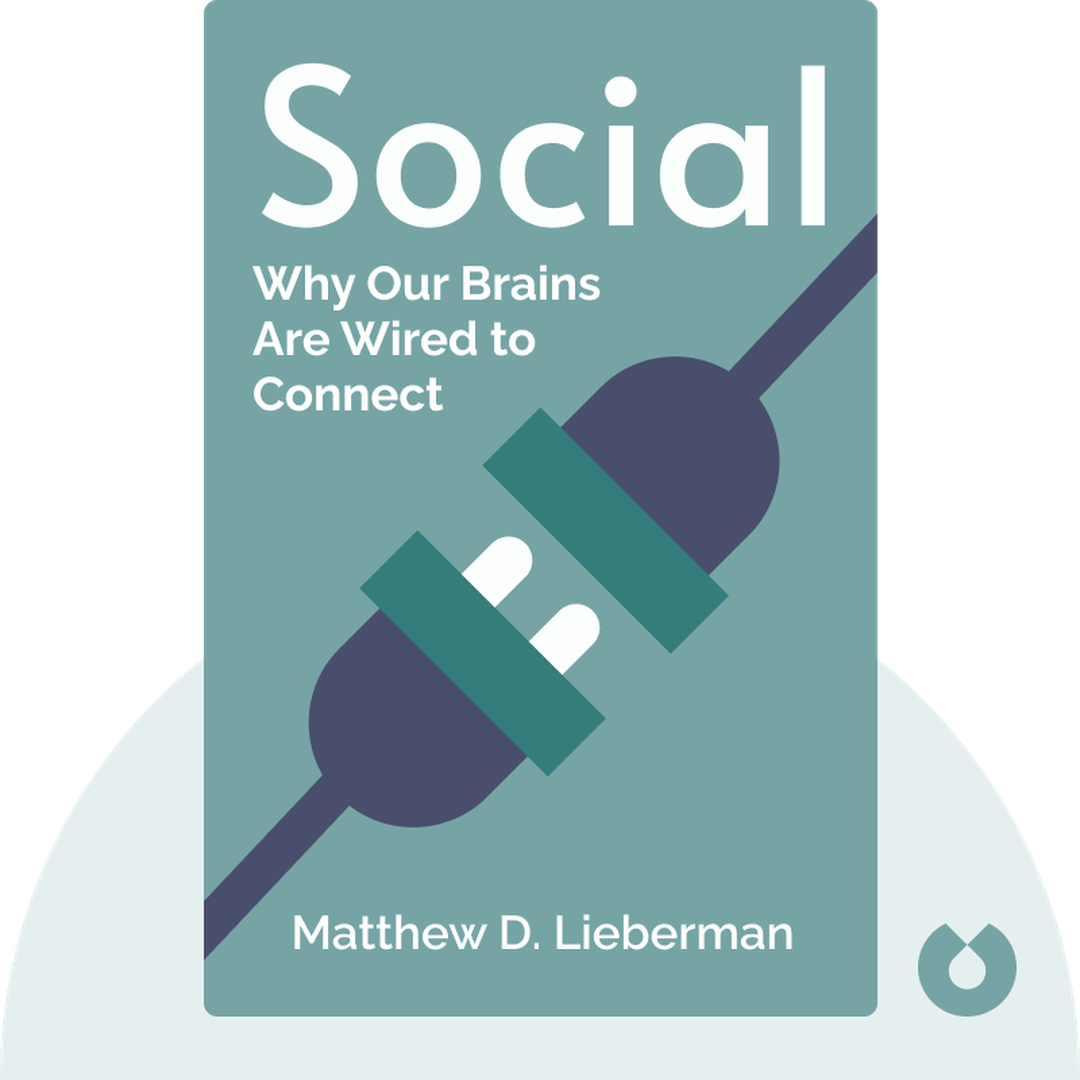
Social (2013) is a whistlestop tour led by noted psychologist Matthew Lieberman through the latest neuroscientific research into our social lives. Foregrounding the deeply human need for connection, these blinks examine how evolution has molded the ways in which we navigate complex social situations. Packed full of original research conducted in the Lieberman’s UCLA lab, Social shows that getting along with others is a primary driver in all our lives.
Who Should Listen to Social?
- People working in teams
- Anyone who’s wondered why a “broken heart” is so painful
- Amateur psychologists
Books Similar to Social
Readers who enjoyed this also liked these titles.