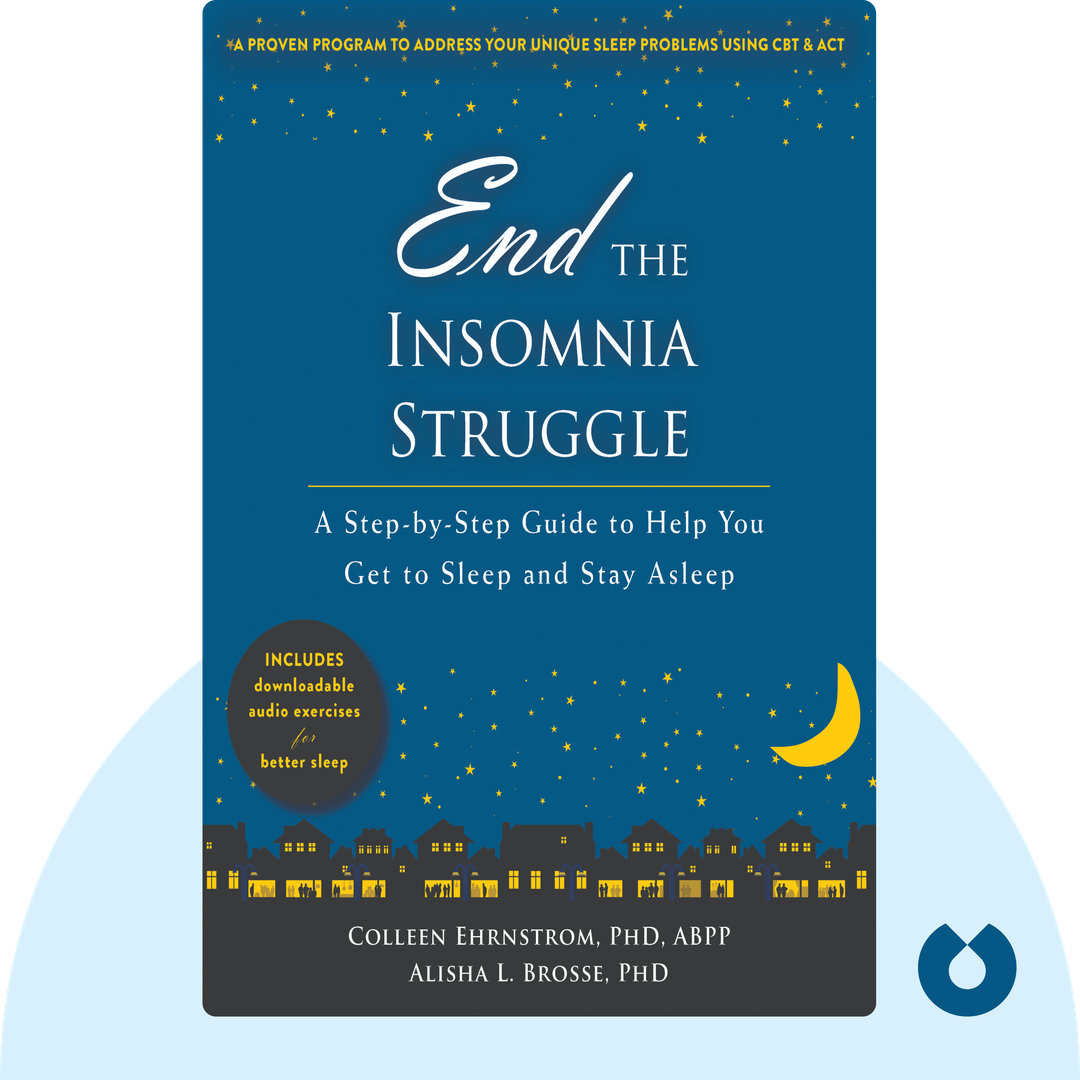
End the Insomnia Struggle
Start ListeningDownload Try free on iPhoneScan to start in 5 seconds
Categories:
If You're Curious About These Questions...
You should listen to this audiobook
- Did you know that the very strategies you use to 'fix' your sleep might be the secret reason you’re still lying awake at 3:00 a.m.?
- Have you ever wondered why standard sleep hygiene tips often fail for chronic insomniacs, and what the science says actually works?
- What if you could decode the hidden patterns in your sleeplessness to finally reclaim the deep, restorative rest your body craves?
Listen to End the Insomnia Struggle — Free Audiobook
Loading player...
Key Takeaways from End the Insomnia Struggle
- Understand how your sleep drive and internal body clock collaborate to regulate your rest, and why environmental cues are vital for keeping them in sync.
- Discover why there is no one-size-fits-all cure for insomnia and how maintaining a daily sleep log can help you tailor strategies to your unique needs.
- Learn the core principles of Stimulus Control Therapy by reserving your bed strictly for sleep, eliminating counterproductive associations like stress or screen time.
- Master the 20-minute rule by getting out of bed to do a relaxing, screen-free activity whenever you struggle to doze off, returning only when you are truly tired.
- Find out why you must commit to a consistent daily wake-up time, regardless of how poorly you slept, to keep your biological sleep mechanisms functioning properly.
Learning Tools
Reinforce what you learned from End the Insomnia Struggle
Mind Map
End the Insomnia Struggle
Biological Foundations of Sleep+
Tracking & Personalization+
Behavioral Strategies (SCT)+
Cognitive Strategies+
Quiz — Test Your Understanding
Question 1 of 7
According to the text, what are the two distinct biological processes that must work in close collaboration to maintain healthy sleep patterns?
Question 2 of 7
Why does the book recommend keeping a sleep log?
Question 3 of 7
Under the rules of Stimulus Control Therapy (SCT), what should you do if you wake up at night and cannot fall back asleep within 20 minutes?
Question 4 of 7
How should you manage your morning wake-up time if you suffer from insomnia?
Question 5 of 7
How do distorted and unhelpful thoughts physically prevent you from falling asleep?
Question 6 of 7
What is the primary mechanism of the Designated Worry Time (DWT) strategy?
Question 7 of 7
What actionable advice does the book give regarding taking naps during the day?
End the Insomnia Struggle — Full Chapter Overview
- 1Recommendation
- 2Healthy sleep patterns depend on teamwork between two distinct biological processes.
- 3There’s no single treatment for insomnia, but tracking your sleep can help.
- 4Use your bed only for sleep, and get up if you can’t doze off.
- 5Return to bed only when you feel sleepy, and follow your set sleep schedule.
- 6Your thoughts can work against you in insomnia, but a creative approach can help.
- 7Keep worries from disrupting your sleep by postponing them until later.
- 8Final summary
End the Insomnia Struggle Summary & Overview
End the Insomnia Struggle (2016) is a guide to getting a good night’s sleep. These blinks are full of practical advice on how to handle sleeplessness. They explain, among other things, how to track your sleep problems, understand the science of insomnia and apply a variety of strategies that’ll help you get the rest you need.
Who Should Listen to End the Insomnia Struggle?
- Sleepless souls
- Psychologists and physicians
- Students of human cognition
Books Similar to End the Insomnia Struggle
Readers who enjoyed this also liked these titles.