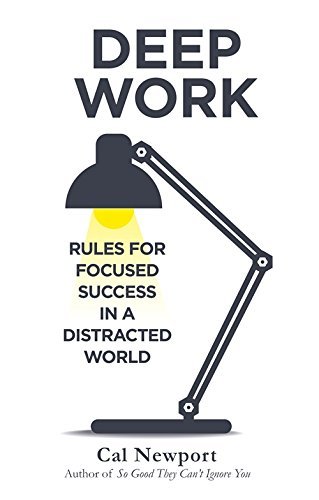
Deep Work: Rules for Focused Success in a Distracted World audiobook cover - In a world where inboxes and feeds fracture every thought, “Deep Work” argues that distraction-free concentration is now the rarest—and most valuable—skill, then shows how to train it, protect it, and use it to produce elite results and a richer life.

Deep Work: Rules for Focused Success in a Distracted World

In a world where inboxes and feeds fracture every thought, “Deep Work” argues that distraction-free concentration is now the rarest—and most valuable—skill, then shows how to train it, protect it, and use it to produce elite results and a richer life.

Cal Newport

4.3 / 5(4 ratings)
Start ListeningDownloadQR code that opens AudiobookHub on the App StoreTry free on iPhoneScan to start in 5 seconds

If You're Curious About These Questions...

You should listen to this audiobook

Listen to Deep Work: Rules for Focused Success in a Distracted World — Free Audiobook

Loading player...

Key Takeaways from Deep Work: Rules for Focused Success in a Distracted World

Learning Tools

Reinforce what you learned from Deep Work: Rules for Focused Success in a Distracted World

Mind Map

Deep Work: Rules for Focused Success in a Distracted World
Part 1: The Idea (Why Deep Work Matters)+
Part 2: The Rules (How to Cultivate Deep Work)+

Quiz — Test Your Understanding

Question 1 of 10
According to the book's opening, what is the primary distinction between 'deep work' and 'shallow work'?
  • A. Deep work is performed in isolation, while shallow work is collaborative.
  • B. Deep work creates new, hard-to-replicate value, while shallow work is logistical and low-cognitive.
  • C. Deep work is for creative professions, while shallow work is for administrative roles.
  • D. Deep work takes a long time to complete, while shallow work can be done quickly.
Question 2 of 10
What is the central argument of the 'Deep Work Hypothesis'?
  • A. The ability to perform deep work is becoming increasingly rare and, at the same time, increasingly valuable.
  • B. Deep work is a skill that only a few people are born with and cannot be learned.
  • C. The modern economy has made deep work obsolete in favor of rapid communication.
  • D. Performing more than four hours of deep work per day leads to burnout and is unproductive.
Question 3 of 10
The book states that two core abilities are needed to thrive in the new economy. What are they?
  • A. Managing large teams and networking effectively on social media.
  • B. Responding to communications instantly and being constantly available online.
  • C. Quickly mastering hard things and producing at an elite level.
  • D. Automating routine tasks and owning capital.
Question 4 of 10
What is the primary reason the book gives for why modern workplaces, which should value deep work, often actively discourage it?
  • A. Open offices are cheaper to build and maintain.
  • B. Employees are naturally resistant to focused work and prefer distraction.
  • C. Deep work is difficult to measure, so organizations drift towards 'busyness as a proxy for productivity'.
  • D. Constant communication has been proven to lead to faster innovation cycles.
Question 5 of 10
Which of the four 'depth philosophies' involves building a fixed, repeatable schedule for deep work, such as working deeply for a set time every morning?
  • A. The Monastic philosophy
  • B. The Bimodal philosophy
  • C. The Journalistic philosophy
  • D. The Rhythmic philosophy
Question 6 of 10
What is the main purpose of Rule Two, 'Embrace Boredom'?
  • A. To find more enjoyable hobbies for your leisure time.
  • B. To increase your capacity for concentration by resisting the impulse to seek distraction.
  • C. To use periods of boredom to do low-effort shallow work.
  • D. To schedule long, unstructured 'boredom breaks' to reset your brain.
Question 7 of 10
The book proposes a 'craftsman approach' to technology. What does this approach entail?
  • A. Using any tool that provides even a small, hypothetical benefit.
  • B. Adopting a tool only if its positive impact on your core goals substantially outweighs its negative impact.
  • C. Rejecting all modern network tools in favor of analog methods.
  • D. Only using tools that you can personally build or modify, like a true craftsman.
Question 8 of 10
In Rule Four, 'Drain the Shallows', what is the primary benefit of 'scheduling every minute of your day'?
  • A. To create a rigid, unchangeable plan that eliminates all spontaneity.
  • B. To prove to your boss that you are working constantly.
  • C. To force intentionality about how to use your time, instead of defaulting to reactive busyness.
  • D. To ensure every task is given an equal amount of time.
Question 9 of 10
What is the primary benefit of having a strict 'shutdown ritual' at the end of the workday?
  • A. It ensures you have a final check of your email so nothing is missed overnight.
  • B. It signals to colleagues that you are done for the day and should not be contacted.
  • C. It helps restore your attention and allows for insights to emerge during downtime.
  • D. It impresses management by showing you have a disciplined work process.
Question 10 of 10
How does the book suggest you should evaluate whether a task is deep or shallow?
  • A. By how long the task takes to complete.
  • B. By asking how long it would take to train a smart recent graduate to do the task.
  • C. By whether the task is done alone or with other people.
  • D. By how much you enjoy doing the task.

Deep Work: Rules for Focused Success in a Distracted World — Full Chapter Overview

Deep Work: Rules for Focused Success in a Distracted World Summary & Overview

Deep Work is a practical guide to thriving in the attention-splintered information economy by reclaiming the ability to focus without distraction. Cal Newport defines deep work as demanding, cognitively intense effort that creates new value and improves skill—work that is hard to replicate and increasingly rewarded. He contrasts it with shallow work: logistical tasks done amid distraction that feel busy but rarely move the needle.

The book is split into two parts. Part 1 defends the “Deep Work Hypothesis”: deep work is becoming rarer at the same time it’s becoming more valuable, and it is also a major source of meaning and satisfaction. Part 2 turns the idea into a system: four rules that help readers schedule depth, train focus, reduce distraction (especially from network tools), and aggressively limit shallow obligations so deep work can become the core of a professional life.

Who Should Listen to Deep Work: Rules for Focused Success in a Distracted World?

  • Knowledge workers who feel busy all day but struggle to produce high-quality output (writers, engineers, analysts, academics, marketers).
  • Students and career switchers who need to learn difficult skills quickly and want a repeatable focus system.
  • Managers and entrepreneurs who want higher-leverage work, fewer meetings, and a healthier boundary between work and downtime.

About the Author: Cal Newport

Cal Newport is a computer science professor and author known for writing about productivity, attention, and building a meaningful career. He advocates systems that prioritize focused work and minimize digital distraction.

🎧
Listen in the AppOffline playback & background play
Get App