If You're Curious About These Questions...
You should listen to this audiobook
- Have you ever wondered why most high-tech products fail just as they start to gain momentum, while others become global household names?
- What if the secret to conquering a massive market wasn't about reaching everyone at once, but actually ignoring almost everyone to focus on one tiny niche?
- Are you curious about the invisible 'chasm' that separates visionary early adopters from the mainstream customers who actually drive long-term profit?
Listen to Crossing the Chasm — Free Audiobook
Loading player...
Key Takeaways from Crossing the Chasm
- Understand the vital difference between continuous and disruptive innovations, and discover why high-tech products fail when they ignore the behavioral changes required from consumers.
- Discover the five distinct customer groups in the technology adoption life cycle—Innovators, Early Adopters, Early Majority, Late Majority, and Laggards—and how to navigate their unique marketing demands.
- Learn how to leverage tech-savvy Innovators to test your product's viability, while targeting visionary Early Adopters who are willing to take risks and invest heavily to achieve grand business goals.
- Find out why the Early Majority, or pragmatists, hold the key to explosive mainstream profit, and how you can win their trust using industry-specific events and trusted publications.
- Master the use of niche marketing to successfully maneuver your startup across the perilous 'chasm' and into the mainstream market before your funding runs dry.
Learning Tools
Reinforce what you learned from Crossing the Chasm
Mind Map
Crossing the Chasm
Technology Adoption Life Cycle+
The Chasm+
The Whole Product+
The Beachhead Strategy+
Choosing the First Niche+
Product Positioning+
Distribution & Pricing+
Consumer vs. B2B Markets+
Post-Chasm Organization+
Quiz — Test Your Understanding
Question 1 of 8
Which two customer groups make up the 'early market' in the Technology Adoption Life Cycle?
Question 2 of 8
What is the fundamental cause of the 'chasm' that exists between the early market and the mainstream market?
Question 3 of 8
What does the text mean by a 'whole product'?
Question 4 of 8
Why is it crucial for a company to focus exclusively on a single target niche when attempting to cross the chasm?
Question 5 of 8
When positioning a product for pragmatists, how should a newcomer demonstrate market leadership if they don't yet have direct competitors?
Question 6 of 8
Which distribution channel is generally considered optimal for actively creating demand and successfully crossing the chasm?
Question 7 of 8
Why is it generally more difficult to cross the chasm in consumer markets compared to business markets?
Question 8 of 8
What major organizational shift must occur to ensure success after a company successfully emerges from the chasm?
Crossing the Chasm — Full Chapter Overview
- 1Recommendation
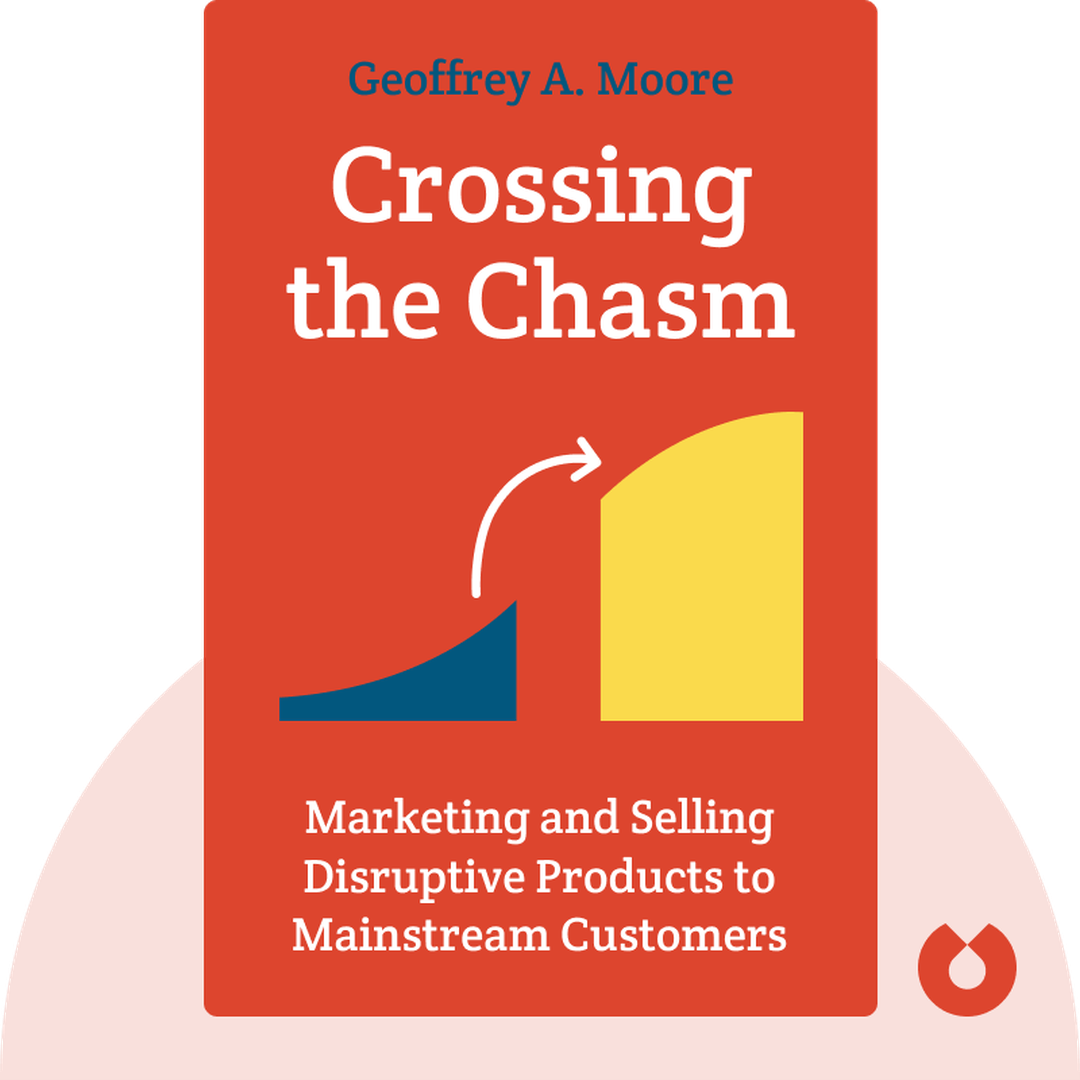
- 2A chasm between visionaries and pragmatists is where products stall and companies fail.
- 3To win in the mainstream market, you must fully meet customers’ needs with a whole product.
- 4Crossing the chasm is like launching an invasion: first, secure a niche beachhead.
- 5Select your first niche by identifying the most attractive customer segment.
- 6Position your product effectively in customers’ minds with a strong claim of market leadership.
- 7Choose a distribution channel pragmatists trust, then motivate it to sell.
- 8Crossing the chasm is even tougher in consumer markets than in business markets.
- 9To handle post-chasm challenges, a company must secure profitability and realign its organization.
- 10Final summary
Crossing the Chasm Summary & Overview
Crossing the Chasm (1991) examines the market dynamics faced by innovative new products, particularly the daunting chasm that lies between early to mainstream markets.
The book provides tangible advice on how to make this difficult transition and offers real-world examples of companies that have struggled in the chasm.
Who Should Listen to Crossing the Chasm?
- Anyone working within the high tech industry
- Anyone trying to enter a market with an innovative product
- Anyone interested in how high tech products are adopted
Books Similar to Crossing the Chasm
Readers who enjoyed this also liked these titles.