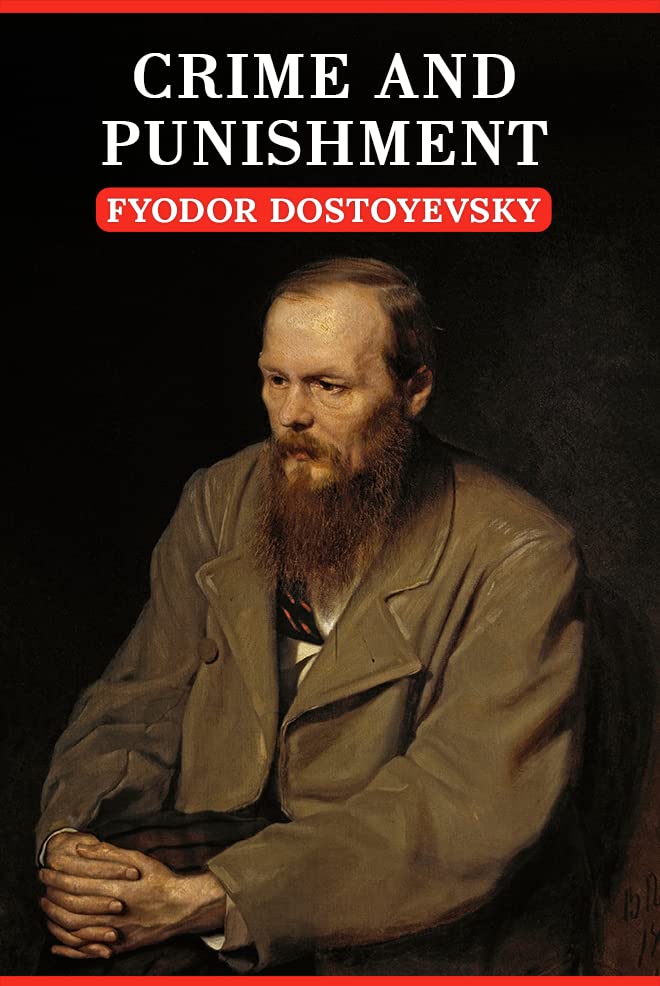
If You're Curious About These Questions...
You should listen to this audiobook
- What drives someone to commit a heinous crime, and can they ever truly be redeemed?
- Are you curious about the darker corners of the human psyche, and what they reveal about our own morality?
- What if you could peer into the mind of a murderer, and uncover the twisted logic that led them down a path of destruction?
Listen to Crime and Punishment — Free Audiobook
Loading player...
Key Takeaways from Crime and Punishment
- Discover why this story is considered a psychological 'whydunit' that explores the deep motivations and spiritual consequences behind a crime rather than just the act itself.
- Understand how severe isolation, deep poverty, and an oppressive city environment can detach a person from reality and plunge them into dangerous, abstract theories.
- Explore the dual nature of the human psyche through Raskolnikov's character, whose very name means 'schism,' revealing a constant internal battle between cold ruthlessness and profound empathy.
- Examine the dangerous philosophical belief that cowardice is humanity's greatest obstacle, which can drive individuals to commit horrific acts just to prove they are capable of taking a 'new step'.
- Learn how subconscious horror and empathy manifest through vivid, agonizing dreams, illustrating the severe psychological toll that builds up before a terrible deed is even committed.
Learning Tools
Reinforce what you learned from Crime and Punishment
Mind Map
Crime and Punishment
Context & Character+
Philosophical Motives+
The Crime+
The Psychological Punishment+
Forces of Salvation+
Confession & Redemption+
Quiz — Test Your Understanding
Question 1 of 7
In Russian, the word 'raskolnik' means 'schism.' How does this reflect Rodion Raskolnikov's character in the text?
Question 2 of 7
What is the psychological significance of Raskolnikov's dream about the horse being beaten to death?
Question 3 of 7
According to the text, how does the murder of Lizaveta differ fundamentally from the murder of Alyona?
Question 4 of 7
In the immediate aftermath of the murders, what does Raskolnikov realize will be his true 'punishment'?
Question 5 of 7
How does Dostoevsky's portrayal of the 'extraordinary man' theory differ from Friedrich Nietzsche's concept of the Übermensch?
Question 6 of 7
Which biblical story does Raskolnikov demand that Sonia read to him, and what does it symbolize for them?
Question 7 of 7
Why does the environment of Siberia play a crucial role in Raskolnikov's eventual redemption?
Crime and Punishment — Full Chapter Overview
- 1Recommendation
- 2Prior to the Crime
- 3The Crime Itself
- 4The Punishment Begins
- 5A Possible Way Out
- 6The Exceptional Man
- 7The Sex Worker
- 8The Confession
- 9Final summary
Crime and Punishment Summary & Overview
Crime and Punishment (1866) is considered one of the greatest masterpieces of Russian literature. It follows a young man called Rodion Raskolnikov – first as he plots to kill an elderly pawnbroker, then as he commits the deed, and finally as he confronts the many consequences of his actions. Emotionally poignant as well as philosophically and psychologically complex, the novel has left a visible mark on generations of writers, thinkers, and artists ever since its publication.
Who Should Listen to Crime and Punishment?
- Fans of Russian literature
- Lovers of melodrama, mental anguish, and moral quandaries
- Philosophy buffs
Books Similar to Crime and Punishment
Readers who enjoyed this also liked these titles.