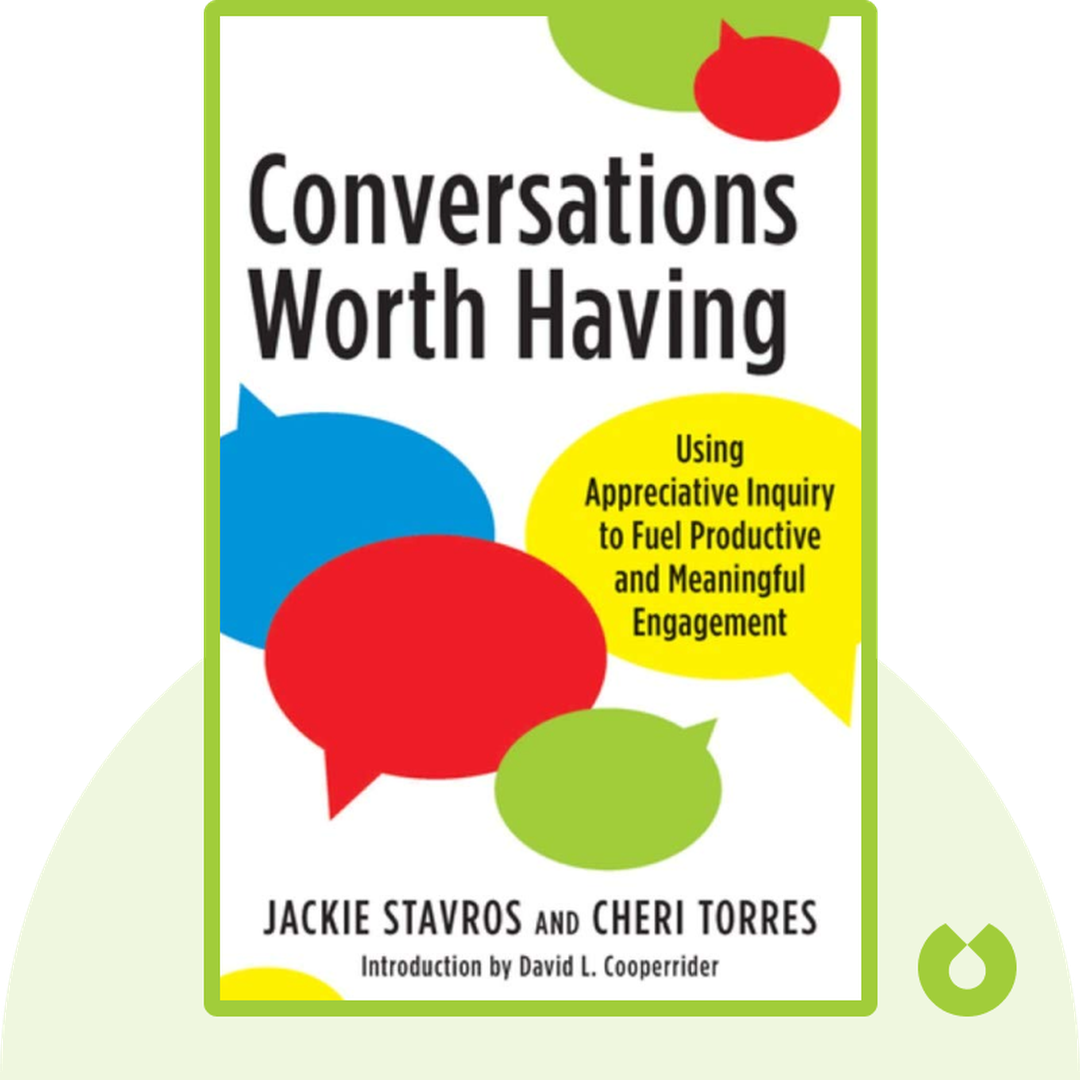
Conversations Worth Having
Start ListeningDownload Try free on iPhoneScan to start in 5 seconds
Categories:
If You're Curious About These Questions...
You should listen to this audiobook
- Did you know that the simple way you frame a single question can either shut down a conversation or spark a wave of innovation and productivity?
- What if you could turn every challenging interaction into an opportunity for growth using a scientifically backed approach called Appreciative Inquiry?
- Are you curious about the secret to shifting a negative environment into a positive one, whether you’re leading a team at work or talking to your children at home?
Listen to Conversations Worth Having — Free Audiobook
Loading player...
Key Takeaways from Conversations Worth Having
- Learn how to use Appreciative Inquiry to transform negative, depreciative interactions into productive conversations that fuel growth and build strong connections.
- Discover how to identify and manage the unseen influences—like stress, biases, and beliefs—that lurk beneath the surface and unconsciously dictate your conversations.
- Master a simple three-step technique—pause, breathe, and get curious—to stop negative momentum and deliberately take charge of your interactions.
- Understand how to ask generative questions that add value to any situation by revealing hidden information, inspiring new possibilities, and creating shared understanding.
- Find out how to apply positive framing to shift the focus of difficult discussions away from defensive excuses and toward shared goals and collaborative solutions.
Learning Tools
Reinforce what you learned from Conversations Worth Having
Mind Map
Conversations Worth Having
Appreciative Inquiry (AI) Basics+
Tuning In (Unseen Influences)+
Two Key Practices+
Five Fundamental Principles+
Life Applications+
Actionable Audit+
Quiz — Test Your Understanding
Question 1 of 7
According to the text, what is the recommended three-step technique to handle the 'unseen influences' that often lead to depreciative conversations?
Question 2 of 7
How does a 'depreciative' conversation typically affect a situation, as described in the text?
Question 3 of 7
What is the primary function of a 'generative question' in Appreciative Inquiry?
Question 4 of 7
When using 'positive framing' to address a problem, what is the three-step process called 'flipping' meant to achieve?
Question 5 of 7
Which principle of Appreciative Inquiry explains why two teachers might interpret the exact same student's behavior completely differently based on their own upbringing?
Question 6 of 7
What does the 'simultaneity principle' suggest about our interactions?
Question 7 of 7
According to the final summary's actionable advice, what ratio of positive to negative conversations indicates a healthy balance?
Conversations Worth Having — Full Chapter Overview
- 1Recommendation
- 2Tune in to the kind of conversation you’re having.
- 3Use Appreciative Inquiry with generative questions and positive framing.
- 4Five fundamental principles shape all our conversations.
- 5Apply Appreciative Inquiry in every area of your life.
- 6Final summary
Conversations Worth Having Summary & Overview
Conversations Worth Having (2018) looks at the power of conversation in our lives and what we can do to communicate more productively at work, in our relationships, and in the community. Drawing on real-life stories and scientifically based theories, it illustrates how we can improve organizations and lives using the principle of Appreciative Inquiry – effective conversation through positive perspective and asking the right questions.
Who Should Listen to Conversations Worth Having?
- Leaders who want to engage with their teams for the best results
- Parents and teachers who want to see their children flourish
- Anyone looking to improve the tone and direction of their conversations
Books Similar to Conversations Worth Having
Readers who enjoyed this also liked these titles.