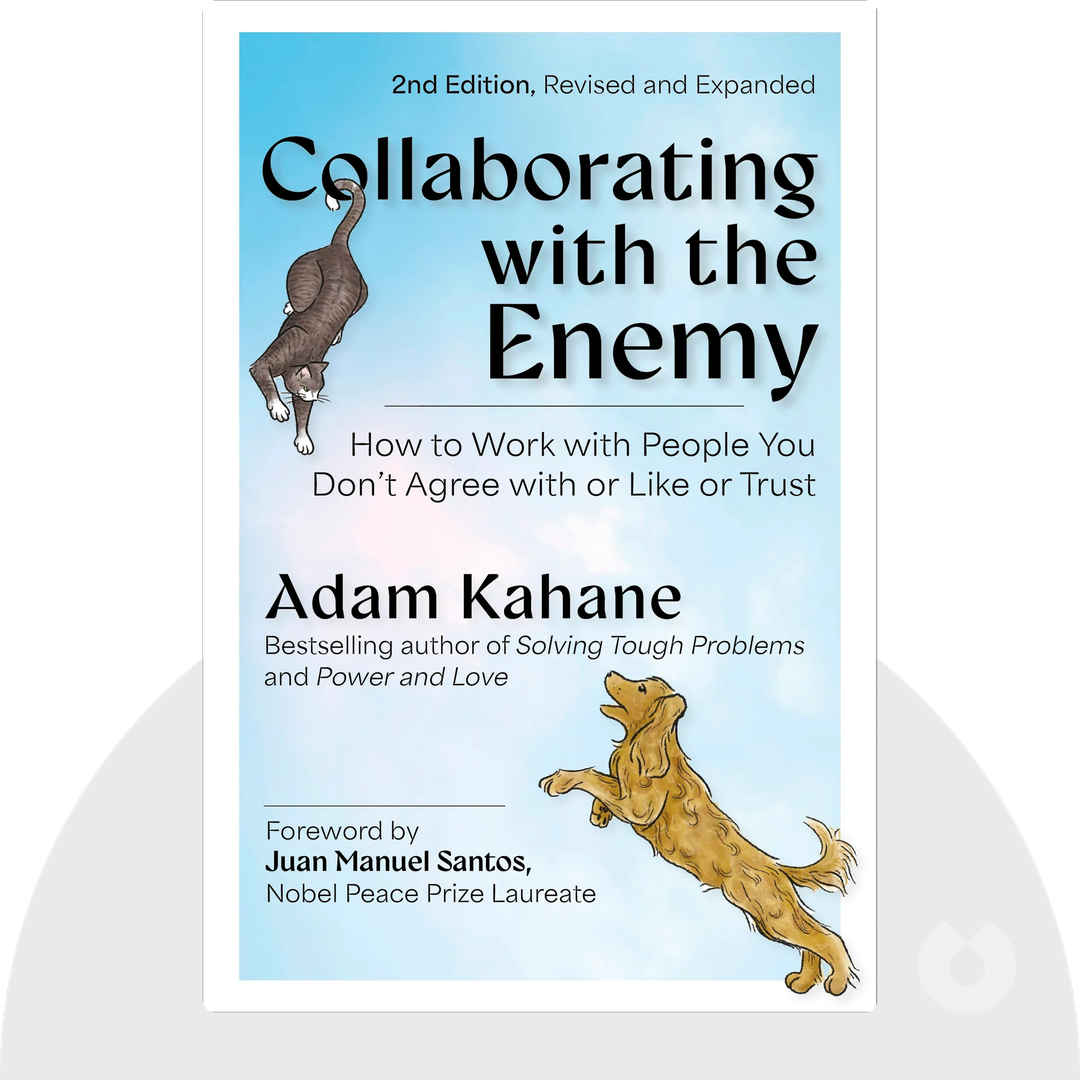
Collaborating with the Enemy
Start ListeningDownload Try free on iPhoneScan to start in 5 seconds
Categories:
If You're Curious About These Questions...
You should listen to this audiobook
- What's the secret to turning your biggest adversaries into collaborative partners?
- Are you curious about how to uncover breakthrough solutions in the most unlikely of places?
- What if you could transform conflict into a catalyst for innovation and growth?
Listen to Collaborating with the Enemy — Free Audiobook
Loading player...
Key Takeaways from Collaborating with the Enemy
- Discover how 'stretch collaboration' flips the conventional model by embracing discord, mistakes, and chaos as essential tools for progress rather than signs of failure.
- Understand why demonizing your 'enemies' prevents real progress, and learn to replace hierarchical power struggles with co-creation and experimentation.
- Master the four distinct problem-solving strategies—adapting, forcing, exiting, and collaborating—and find out exactly when to apply each based on your specific situation.
- Realize why controlled, harmonious collaboration is a myth in today's complex world, and learn to use opposing viewpoints to evolve your own ideas.
- Learn to navigate complex challenges without needing a single shared vision, focusing instead on changing yourself rather than trying to change your opponent.
Learning Tools
Reinforce what you learned from Collaborating with the Enemy
Mind Map
Collaborating with the Enemy
Redefining Collaboration+
Embracing Conflict+
The Art of Stepping Back+
Building Bridges+
Collaborative Problem Solving+
Quiz — Test Your Understanding
Question 1 of 6
According to the text, what is a central premise of collaborating with people you do not like or trust?
Question 2 of 6
How does the book suggest you should reframe your mindset when facing opponents in a conflict?
Question 3 of 6
When Jamal, a product team leader, noticed rising tensions between the design and engineering departments, what counterintuitive approach did he take?
Question 4 of 6
What is the primary purpose of 'stepping back' during a heated conflict, as described in the text?
Question 5 of 6
Why does the text recommend using 'I' statements, such as 'I see this differently,' instead of saying 'You are wrong'?
Question 6 of 6
Which technique borrowed from improv theater is recommended to foster creativity and demonstrate respect during collaborative problem-solving?
Collaborating with the Enemy — Full Chapter Overview
- 1Recommendation
- 2The surprising wisdom of collaboration
- 3Seeing conflict as an opportunity
- 4The skill of stepping back
- 5Creating bridges
- 6Solving problems collaboratively
- 7Final summary
Collaborating with the Enemy Summary & Overview
Collaborating with the Enemy (2017) offers a fresh perspective on tackling complex challenges in an increasingly polarized world. It introduces practical strategies for turning conflicts into opportunities, offering guidance on working effectively with those we may see as adversaries to uncover breakthrough solutions and drive meaningful innovation.
Who Should Listen to Collaborating with the Enemy?
- Leaders managing conflicts within diverse or polarized teams
- Community organizers and activists working on contentious local issues
- Professionals seeking creative solutions through unconventional partnerships
Books Similar to Collaborating with the Enemy
Readers who enjoyed this also liked these titles.