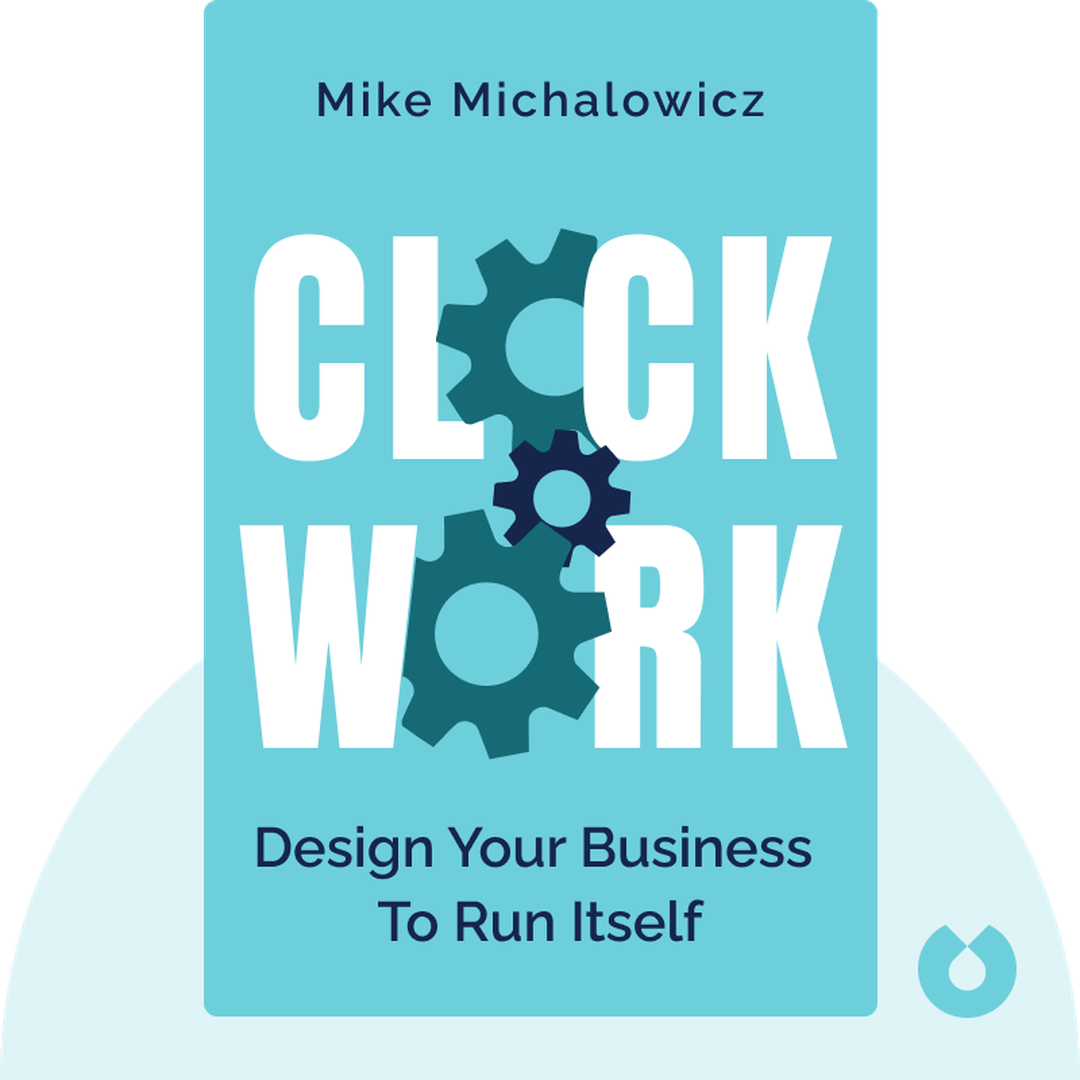
If You're Curious About These Questions...
You should listen to this audiobook
- Have you ever wondered if your business could survive—and even thrive—if you took a four-week vacation starting tomorrow?
- What if you could identify the single most important role in your company that allows every other system to run automatically?
- Are you curious about the specific mindset shift that separates exhausted "superhero" owners from those whose businesses run like clockwork?
Listen to Clockwork — Cinematic Audio Edition
Loading player...
Key Takeaways from Clockwork
- Discover how to build systems that allow your small business to thrive without you, freeing you from the daily grind to strategize and pursue new opportunities.
- Understand why relying on productivity hacks is a trap, and learn to aim for targeted organizational efficiency rather than just squeezing more work into less time.
- Learn the Four D’s of work—doing, deciding, delegating, and designing—and discover why shifting your focus to designing is crucial for your company's growth.
- Master the art of true delegation by handing over not just tasks, but the decisions around them, allowing you to step off the field and into the coach's box.
- Identify and protect your company’s 'Queen Bee Role,' the single most critical task that drives your progress, and ensure your entire team prioritizes its success.
Learning Tools
Reinforce what you learned from Clockwork
Mind Map
Clockwork
Escaping the Productivity Trap+
The Four D's of Work+
The Queen Bee Role (QBR)+
Standard Operating Procedures (SOPs)+
Team Building & Hiring+
Finding Your Niche+
Metrics & Tracking+
Managing the Transition+
Quiz — Test Your Understanding
Question 1 of 10
What does the author identify as the 'productivity trap'?
Question 2 of 10
According to the Four D's of work, what is the ultimate goal for a business owner who wants their company to grow?
Question 3 of 10
What is the ideal time and resource allocation for a business across the Four D's?
Question 4 of 10
How should a company handle its 'Queen Bee Role' (QBR)?
Question 5 of 10
When setting up Standard Operating Procedures (SOPs), the author recommends categorizing tasks using the ACDC model. What does ACDC stand for?
Question 6 of 10
What counterintuitive advice does the author give regarding hiring new employees?
Question 7 of 10
How does the author suggest you identify your ideal niche market?
Question 8 of 10
Which metric does the author suggest is the best indicator of how well your business is 'Delivering' on its promises?
Question 9 of 10
Why might a business owner experience pushback from their team or themselves when transitioning to 'clockwork' mode?
Question 10 of 10
What actionable advice does the author give regarding turning tasks over to new hires?
Clockwork — Full Chapter Overview
- 1Recommendation
- 2Avoid the productivity trap.
- 3Don’t just do the work—design it.
- 4Identify and safeguard your Queen Bee Role.
- 5Standard operating procedures help everyone reach their potential.
- 6Grow your business to generate revenue without you.
- 7Find your niche market and focus your strengths there.
- 8Metrics make running your business easier.
- 9Expect pushback as your business shifts to clockwork.
- 10Final summary
Clockwork Summary & Overview
Clockwork (2018) explains how entrepreneurs can grow their enterprises without sacrificing their sanity. The trick is implementing smart systems and standard operating procedures that allow your business to run like clockwork without your constant input, freeing you up to tackle the challenges or embrace the opportunities that come your way.
Who Should Listen to Clockwork?
- Anyone dreaming of starting a small business
- Solopreneurs who are ready to scale in an intelligent way
- Entrepreneurs who can’t exactly remember the last time they took a vacation
Books Similar to Clockwork
Readers who enjoyed this also liked these titles.