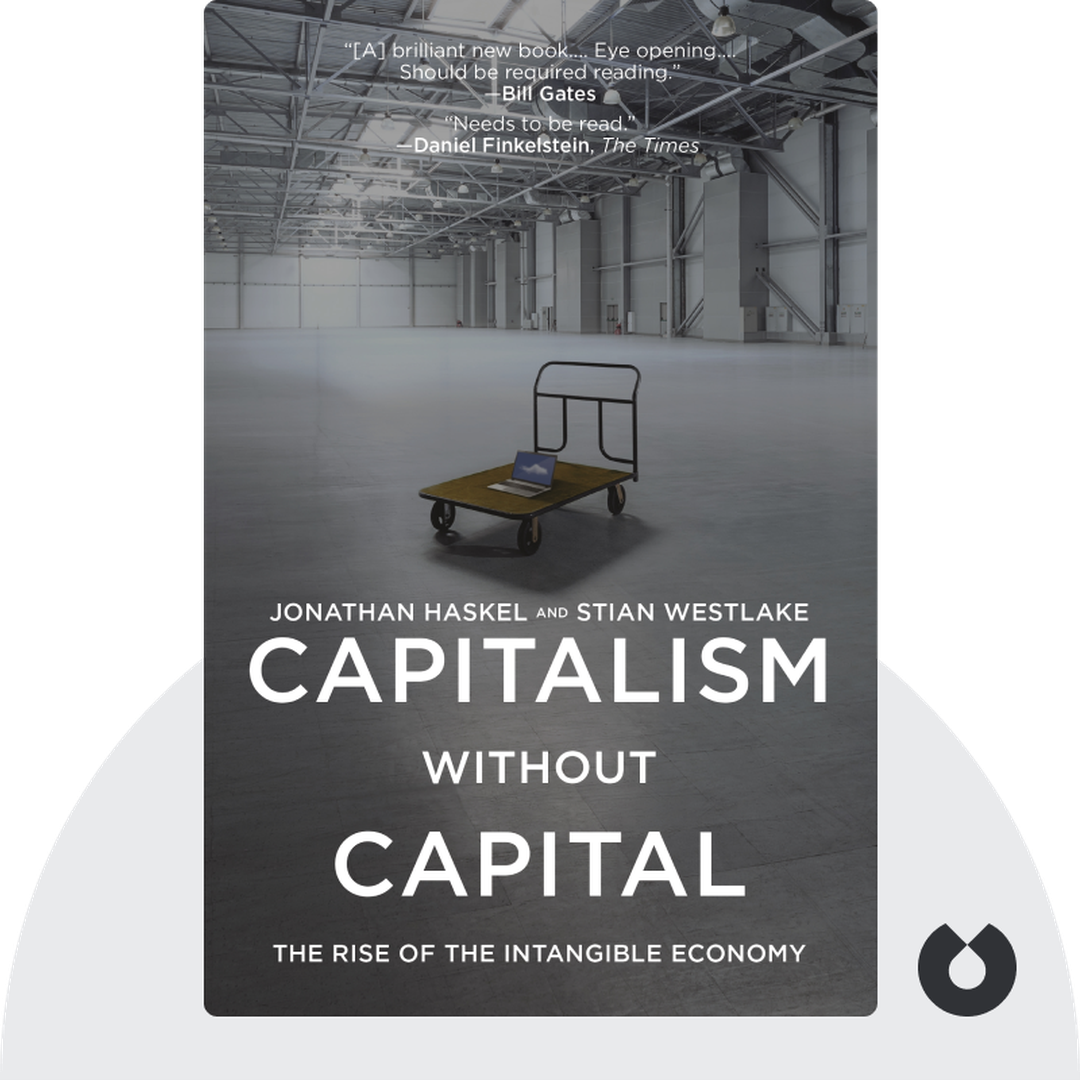
Capitalism Without Capital
Start ListeningDownload Try free on iPhoneScan to start in 5 seconds
Categories:
If You're Curious About These Questions...
You should listen to this audiobook
- Did you know that for the first time in history, the world’s leading economies are investing more in things they can't touch than in physical machinery and factories?
- Have you ever wondered why traditional business rules seem to fail when it comes to the meteoric rise of "asset-light" giants like Apple and Google?
- Are you curious about how the shift toward an "intangible economy" is fundamentally changing the way we measure wealth, competition, and success in the modern world?
Listen to Capitalism Without Capital — Free Audiobook
Loading player...
Key Takeaways from Capitalism Without Capital
- Understand how the foundation of the modern economy has shifted from physical goods to intangible assets like software, branding, and research.
- Discover why traditional economic metrics like GDP struggle to measure true value in a world where corporate worth is driven by nonphysical investments.
- Learn how the high scalability of intangible assets allows modern businesses to expand massively and rapidly without the limits of physical infrastructure.
- Explore why the monumental value of modern giants like Starbucks and Microsoft lies in invisible assets such as operating manuals, data, and supply-chain efficiency.
- Recognize that companies built on intangible capital behave fundamentally differently, scaling faster but posing new risks for investors and creating vulnerabilities to competitors.
Learning Tools
Reinforce what you learned from Capitalism Without Capital
Mind Map
Capitalism Without Capital
The Shift to Intangibles+
Core Characteristics+
Societal & Economic Impacts+
Policy & Future Solutions+
Quiz — Test Your Understanding
Question 1 of 9
According to the text, what is the fundamental shift currently occurring in modern economies?
Question 2 of 9
How did early calculations of Gross Domestic Product (GDP) historically treat intangible investments like research and design?
Question 3 of 9
Why are intangible assets like software or operating manuals considered highly 'scalable'?
Question 4 of 9
Why do banks often hesitate to lend money to intangible-heavy businesses?
Question 5 of 9
In the context of the intangible economy, what is a 'spillover' effect?
Question 6 of 9
What does the invention of the modern microwave oven illustrate about the intangible economy?
Question 7 of 9
How does the growth of the intangible economy contribute to wealth inequality?
Question 8 of 9
Why do the authors suggest governments should focus on nurturing adult education rather than just changing school curriculums (like teaching all children to code)?
Question 9 of 9
What solution do the authors propose to mitigate the risk of underinvestment in research and development (R&D) caused by the fear of spillovers?
Capitalism Without Capital — Full Chapter Overview
- 1Recommendation
- 2Our economy is shifting from physical assets to intangible ones.
- 3The move toward an intangible economy is now clear, even if it has only recently been measured.
- 4Intangible assets scale easily, so we should expect some businesses to grow very large, very quickly.
- 5Intangible investments are sunk costs, with consequences for financing and future financial crashes.
- 6Spillover effects, where companies benefit from other companies’ ideas, are becoming more common.
- 7In an intangible economy, ideas can combine to create valuable synergies and new ways of working.
- 8The growth of the intangible economy worsens economic inequality.
- 9The rise of the intangible economy calls for new thinking about education and finance.
- 10Public investment in research and development will bring growing benefits in an intangible economy.
- 11Final summary
Capitalism Without Capital Summary & Overview
Capitalism Without Capital (2017) is an account of the growing importance of the intangible economy. Today, for the first time, most developed economies are investing less in tangible, physical assets such as machinery and factories, than in intangible assets such as software, research and development capability. These intangibles are hugely valuable but do not exist in physical form. The blinks ahead explore the nature of this trend, as well as its effects on business, the economy and public policy.
Who Should Listen to Capitalism Without Capital?
- Anyone interested in business and investment
- Economists
- Those seeking to understand the sudden rise of behemoths like Apple and Google
Books Similar to Capitalism Without Capital
Readers who enjoyed this also liked these titles.