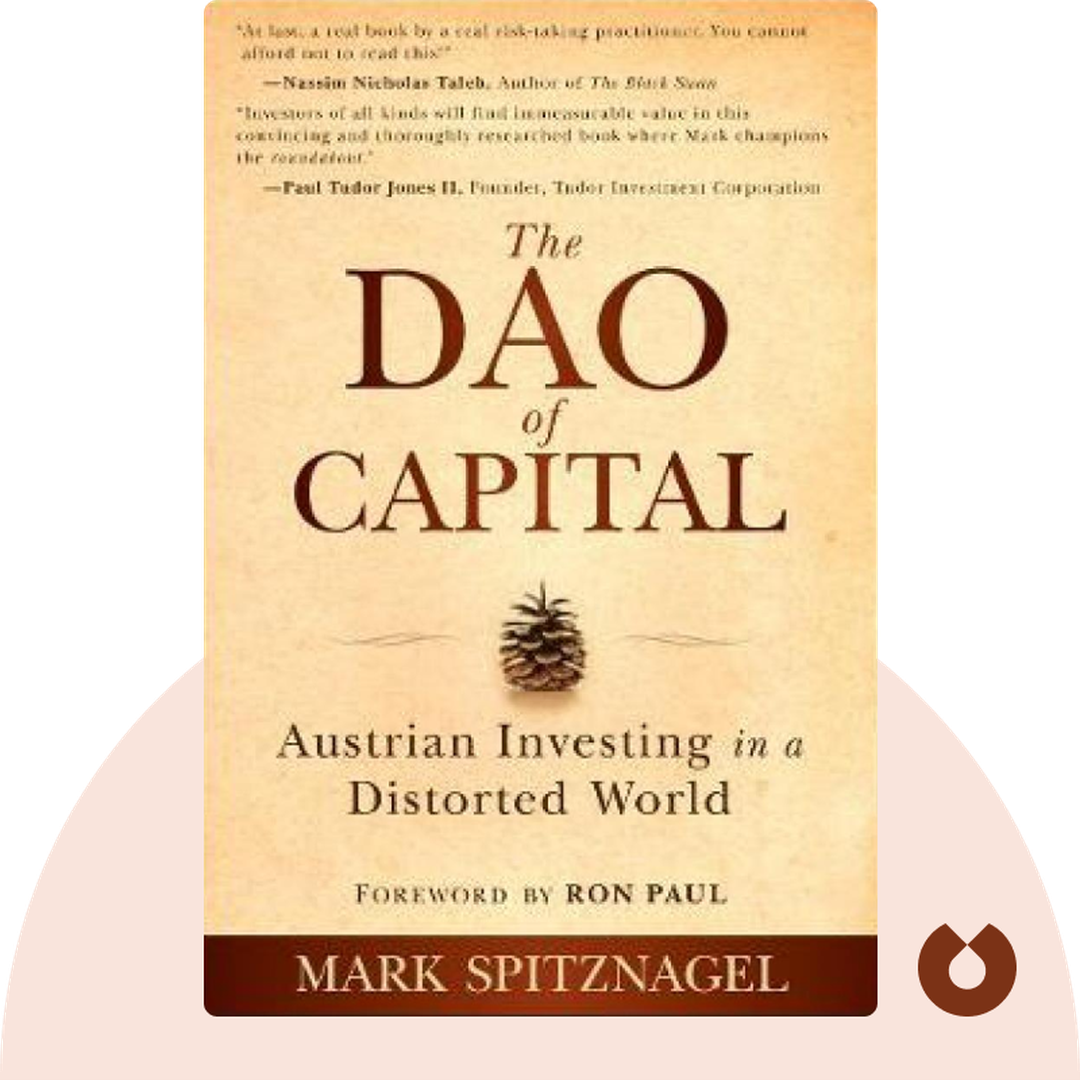
If You're Curious About These Questions...
You should listen to this audiobook
- What if the secret to long-term market dominance isn't chasing immediate profits, but mastering the ancient art of 'gaining by losing'?
- Did you know that a centuries-old philosophy from ancient China could be the most effective way to navigate the complexities of modern-day finance?
- Are you curious about how the 'roundabout' approach of Austrian economics can protect your capital while positioning you for explosive growth?
Listen to The Dao of Capital — Free Audiobook
Loading player...
Key Takeaways from The Dao of Capital
- Understand how applying the ancient Chinese philosophy of Daoism to markets can help you build long-term wealth by intentionally embracing short-term losses.
- Discover the Daoist principle of 'wei wuwei'—doing by not doing—and learn how to profit by patiently exploiting the urgency and impatience of other investors.
- Learn how taking a roundabout investment path, like Henry Ford sacrificing early profits to develop the assembly line, leads to massive future advantages.
- Explore what the slow, strategic growth of forest conifers teaches investors about avoiding direct competition and waiting for the perfect moment to capitalize on changing environments.
- Master the ancient military concept of 'shi' to secure a powerful positional advantage, allowing you to outmaneuver the market without relying on forceful, direct action.
Learning Tools
Reinforce what you learned from The Dao of Capital
Mind Map
The Dao of Capital
Core Philosophy+
Real-World Parables+
Nature's Blueprint+
Military Strategy+
Market Dynamics+
Psychological Barriers+
Implementation Strategy+
Quiz — Test Your Understanding
Question 1 of 8
What is the central paradox of Austrian investing according to Daoist philosophy?
Question 2 of 8
How do Robinson Crusoe and Henry Ford illustrate the concept of 'roundabout investing'?
Question 3 of 8
In the book's forest analogy, what do the conifers represent in the context of investing?
Question 4 of 8
What does the ancient Chinese military concept of 'shi' share with Austrian investing?
Question 5 of 8
Why does the Austrian School argue that the market cannot be studied as an empirical science?
Question 6 of 8
According to the text, what is the consequence of central banks printing money to counteract small market crashes?
Question 7 of 8
Why is the Austrian investing method considered so difficult for most people to implement?
Question 8 of 8
When looking for a company to invest in using the Austrian approach, what key characteristics should an investor seek?
The Dao of Capital — Full Chapter Overview
- 1Recommendation
- 2Austrian investing applies the Chinese philosophy of Daoism to modern markets.
- 3Robinson Crusoe and Henry Ford are classic examples showing Austrian investing can ultimately lead to success.
- 4Daoist principles can be found in nature, especially within the forest ecosystem.
- 5Daoist concepts informed the military strategies of ancient China and those of nineteenth century Prussia.
- 6The market is an ongoing process and cannot be deemed empirical.
- 7The market is naturally self-correcting, while outside intervention greatly weakens its balancing forces.
- 8Austrian investing is difficult to practice because it defies our natural human instinct for immediate gratification.
- 9You have to stay patient and seek out highly productive capital to benefit from Austrian investing.
The Dao of Capital Summary & Overview
The Dao of Capital takes the reader on a journey from ancient China to nineteenth and twentieth century Vienna, to modern, globalized markets. Using a multitude of examples, it outlines the approach of “roundabout investing” or “Austrian investing,” which is based on ancient Daoist wisdom of “gaining by losing.” See how strategic investing, rather than rapid and rushed investing, can lead you to great financial success.
Who Should Listen to The Dao of Capital?
- Anyone interested in economics
- Anyone interested in wise investing
- Anyone who wants to see how Daoist wisdom can be applied to markets
Books Similar to The Dao of Capital
Readers who enjoyed this also liked these titles.