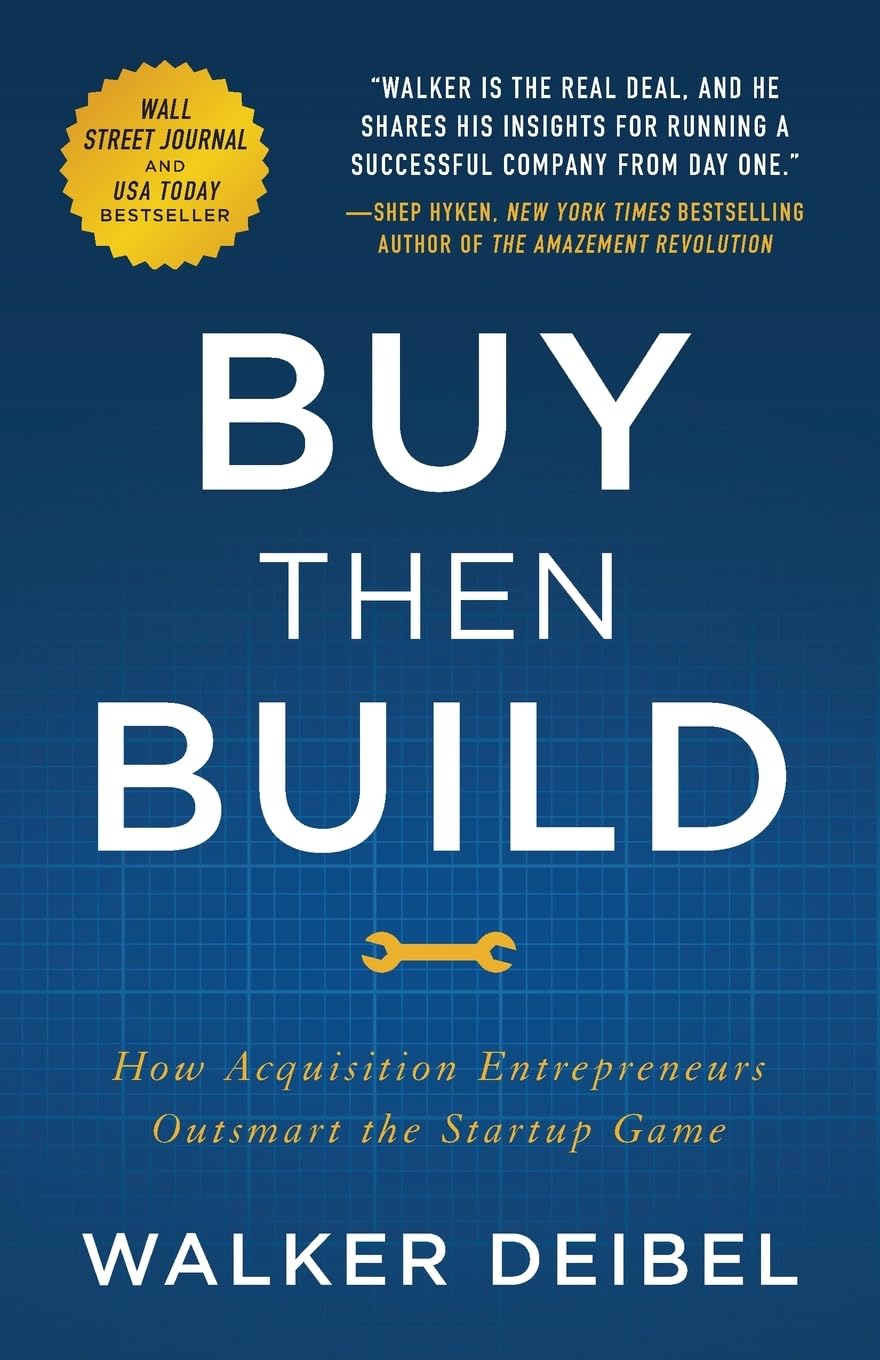
Buy Then Build: How Acquisition Entrepreneurs Outsmart the Startup Game audiobook cover - Most startups die in the “blank page” phase; this book argues you can skip it by buying a real, cash-flowing business, then applying entrepreneurial growth—using practical search, valuation, financing, and transition playbooks to become CEO faster with less risk.

Buy Then Build: How Acquisition Entrepreneurs Outsmart the Startup Game

Most startups die in the “blank page” phase; this book argues you can skip it by buying a real, cash-flowing business, then applying entrepreneurial growth—using practical search, valuation, financing, and transition playbooks to become CEO faster with less risk.

Walker Deibel

4.3 / 5(4 ratings)
Start ListeningDownloadQR code that opens AudiobookHub on the App StoreTry free on iPhoneScan to start in 5 seconds

If You're Curious About These Questions...

You should listen to this audiobook

Listen to Buy Then Build: How Acquisition Entrepreneurs Outsmart the Startup Game — Free Audiobook

Loading player...

Key Takeaways from Buy Then Build: How Acquisition Entrepreneurs Outsmart the Startup Game

Learning Tools

Reinforce what you learned from Buy Then Build: How Acquisition Entrepreneurs Outsmart the Startup Game

Mind Map

Buy Then Build: How Acquisition Entrepreneurs Outsmart the Startup Game
The Core Premise: Why Buy, Not Build?+
The Buyer's Mindset & Preparation+
The Search: Finding the Right Business+
The Deal: Analysis & Execution+
Conclusion: The New Entrepreneur Economy+

Quiz — Test Your Understanding

Question 1 of 8
According to the book, what is the fundamental flaw of the 'startup game' that acquisition entrepreneurship aims to solve?
  • A. Startups are unable to attract talented employees.
  • B. Startups require founders to have decades of industry experience.
  • C. Startups must burn through cash to find product-market fit, a phase that acquisition entrepreneurs bypass.
  • D. Startups cannot be financed with bank loans, only venture capital.
Question 2 of 8
What major demographic and economic trend does Walker Deibel call the '$10 Trillion Window' of opportunity?
  • A. The shift of global wealth towards emerging technology markets.
  • B. The total value of all businesses financed by the Small Business Administration (SBA).
  • C. The retirement of a massive cohort of baby boomer business owners, creating a large supply of companies for sale.
  • D. The projected growth of the venture capital industry over the next decade.
Question 3 of 8
The book emphasizes that 'wealth is built on cash flow'. How does using leverage, such as an SBA loan, amplify an acquisition entrepreneur's return on investment?
  • A. It allows a buyer to control a large, cash-flowing asset with a relatively small personal down payment.
  • B. It guarantees that the acquired business's cash flow will double in the first year.
  • C. It legally requires the seller to finance a portion of the deal at a zero-interest rate.
  • D. It transfers all the financial risk from the buyer to the lending bank.
Question 4 of 8
What is the primary purpose of Deibel's '3 As' (Attitude, Aptitude, Action) framework?
  • A. To evaluate the seller's motivation and negotiating style.
  • B. To create a scorecard for judging the quality of a business listing.
  • C. To conduct a self-assessment to determine how the buyer will create value before they even start searching for a business.
  • D. To serve as a checklist during the due diligence process to ensure all assets are accounted for.
Question 5 of 8
Why does the book insist that buyers should define the size of a target business by its SDE (Seller's Discretionary Earnings) rather than its revenue?
  • A. SDE is the only metric that matters for marketing and branding.
  • B. Revenue is a misleading figure, while SDE represents the actual cash flow available to the owner to pay themselves and service debt.
  • C. Banks will only lend against SDE and completely ignore a company's revenue history.
  • D. SDE is easier to calculate and does not require access to financial statements.
Question 6 of 8
What is Deibel's contrarian advice for generating high-quality deal flow?
  • A. Rely exclusively on public online listing sites, as they have the most transparent deals.
  • B. Hire a single buyer's agent and have them conduct the entire search.
  • C. Only approach business owners directly, bypassing brokers entirely.
  • D. Go 'upstream' by building relationships with multiple business brokers to get access to deals before they are widely marketed.
Question 7 of 8
What is the meaning of the valuation principle 'buy for the future, pay for the past'?
  • A. The price should be based on future projections, but you should verify them with past data.
  • B. The decision to buy is driven by future growth potential, but the price paid must be justified by proven historical cash flow.
  • C. You should pay whatever the seller is asking if the future prospects look good.
  • D. You should only buy businesses where the past performance is guaranteed to continue into the future.
Question 8 of 8
What is the recommended focus for a new owner during the first month of the 90-day transition period after closing a deal?
  • A. Implementing a new company-wide software system to improve efficiency.
  • B. Immediately firing underperforming employees to send a message.
  • C. Focusing on people: holding one-on-ones, listening, understanding the culture, and establishing trust.
  • D. Redesigning the company's marketing and sales strategy from the ground up.

Buy Then Build: How Acquisition Entrepreneurs Outsmart the Startup Game — Full Chapter Overview

Buy Then Build: How Acquisition Entrepreneurs Outsmart the Startup Game Summary & Overview

Buy Then Build reframes entrepreneurship as an acquisition-first discipline. Instead of starting from zero—no customers, no revenue, and high failure odds—Walker Deibel makes the case for buying an existing small business with proven cash flow, then using innovation and leadership to grow value. The book positions acquisition entrepreneurship as an unusually powerful wealth-building vehicle because the buyer can use bank leverage, step into an operating platform on day one, and capture upside through operational improvement, sales growth, and add-on acquisitions.

Deibel lays out a full roadmap: how to develop a CEO mindset, define a target company using Seller Discretionary Earnings (SDE) rather than revenue, source deals by getting “upstream” with brokers and intermediaries, evaluate a business through financial statements and valuation multiples, negotiate with sellers effectively, and execute the acquisition process from LOI through due diligence, closing, and the first 90-day transition. The goal is not theory—it’s a repeatable operating playbook for becoming an owner-operator.

Who Should Listen to Buy Then Build: How Acquisition Entrepreneurs Outsmart the Startup Game?

  • Aspiring entrepreneurs who want ownership and cash flow without the extreme risk and long runway of a startup
  • Professionals (operators, sales leaders, managers) considering buying a small business using bank financing
  • Small business owners and investors exploring acquisitions, search funds, or growth through add-on deals

About the Author: Walker Deibel

Walker Deibel is an entrepreneur and investor who has co-founded startups, acquired multiple companies, and participated in over 100 transactions. He holds an MBA from Washington University in St. Louis, is a Certified M&A Advisor, and later founded the Acquisition Lab to train acquisition entrepreneurs.

🎧
Listen in the AppOffline playback & background play
Get App