If You're Curious About These Questions...
You should listen to this audiobook
- Did you know that you can actually rewire your brain’s physical structure to default to happiness instead of stress?
- Have you ever wondered why your brain is naturally 'Velcro' for negative experiences but 'Teflon' for positive ones—and how you can reverse that?
- What if you could use the latest neurological breakthroughs to unlock the same states of deep peace and wisdom achieved by history’s greatest contemplatives?
Listen to Buddha’s Brain — Cinematic Audio Edition
Loading player...
Key Takeaways from Buddha’s Brain
- Understand how every thought physically reshapes your brain's neural pathways, empowering you to create long-lasting positive transformations.
- Discover how the core Buddhist principles of virtue, mindfulness, and wisdom perfectly align with your brain's natural functions of regulation, learning, and selection.
- Learn why your brain has an evolutionary sensitivity to negative experiences and how to actively counteract this by making joy a conscious daily choice.
- Master the concept of the 'two darts' to separate unavoidable initial pain from the optional suffering caused by your own reactive second darts.
- Recognize how your daily experiences form implicit memories, and find out how controlling your reactions can protect your nervous system from chronic stress.
Learning Tools
Reinforce what you learned from Buddha’s Brain
Mind Map
Buddha’s Brain
Mind-Brain Connection+
Evolution & Suffering+
Pathways to Happiness+
The Self and Ego+
Love & Empathy+
Actionable Practices+
Quiz — Test Your Understanding
Question 1 of 10
What principle explains how our mental processes can physically alter the structure of our brains over time?
Question 2 of 10
According to the book, why are human brains biologically biased toward preferentially storing negative memories over positive ones?
Question 3 of 10
In the context of experiencing pain or hardship, what does the 'second dart' represent?
Question 4 of 10
How does the practice of mindfulness physically promote well-being and a feeling of relaxation?
Question 5 of 10
What is the primary psychological benefit of practicing 'composure'?
Question 6 of 10
Why does having a strong sense of self or over-identifying with things (e.g., 'This is my laptop' or 'I am this belief') ultimately lead to suffering?
Question 7 of 10
What evolutionary factor is largely responsible for the tripling of the human brain's size over the past three million years?
Question 8 of 10
What is a likely consequence for a child who grows up with caregivers who show insufficient empathy?
Question 9 of 10
Studies on the brains of experienced meditators discovered a link between achieving a 'singleness of mind' and the presence of which of the following?
Question 10 of 10
When facing an interpersonal conflict, why does the author suggest using mental imagery, such as imagining yourself as a tree with the other person's words blowing past you like wind?
Buddha’s Brain — Full Chapter Overview
- 1Recommendation
- 2Our minds can reshape our brains and affect how we feel.
- 3Self-reflection can help us live happier, more fulfilling lives.
- 4Suffering is an evolutionary product that supports survival and still affects us today.
- 5Some physical discomfort is normal, but we often make it worse than necessary.
- 6Happiness depends on specific ways of thinking.
- 7Meditation brings deeper self-insight and, ultimately, greater wisdom.
- 8Meditation can help you develop a calmer, more relaxed sense of self.
- 9Our brains are wired for love.
- 10Greater empathy can make us more compassionate and loving.
- 11Final summary
Buddha’s Brain Summary & Overview
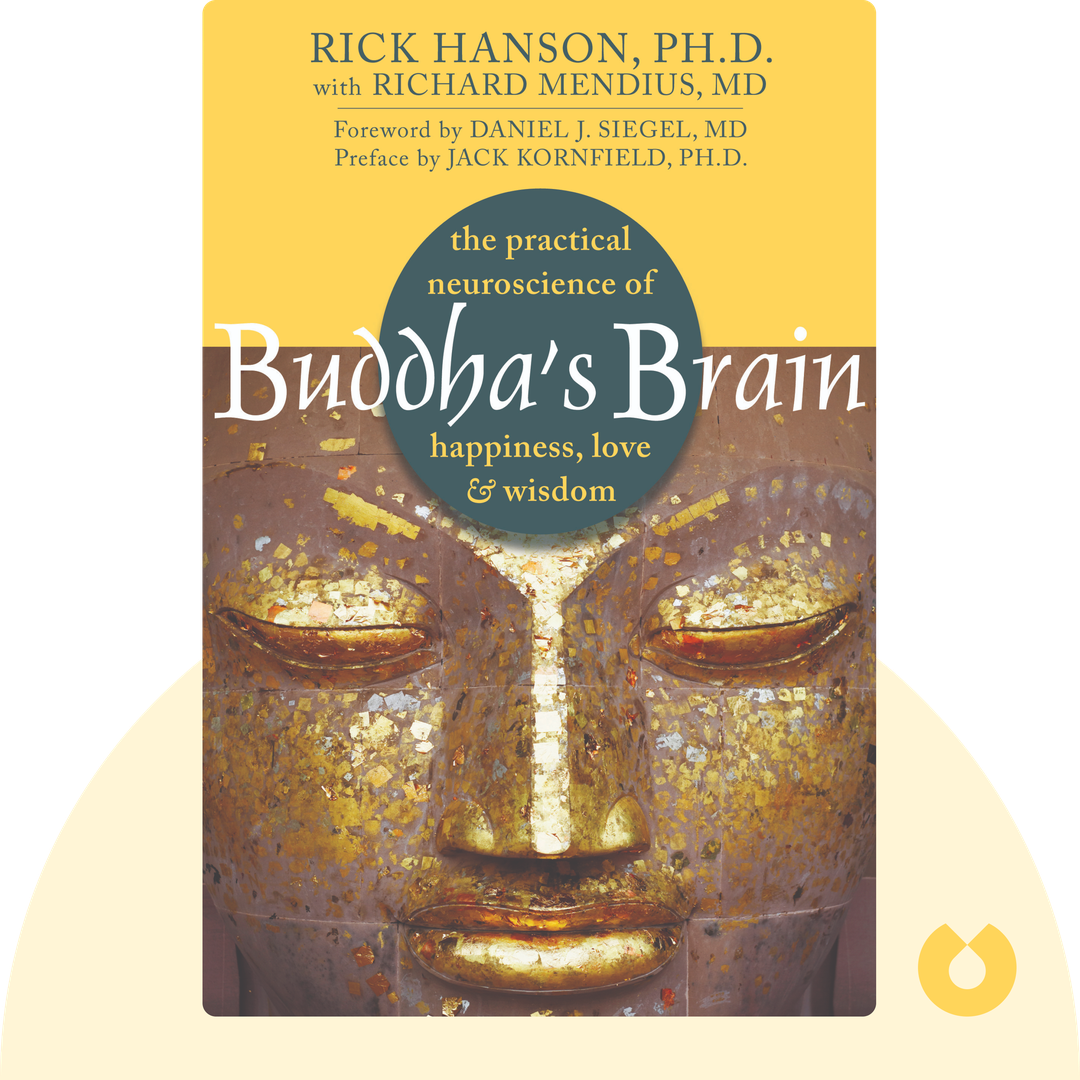
Buddha’s Brain is a practical guide to attaining more happiness, love and wisdom in life. It aims to empower readers by providing them with practical skills and tools to help unlock their brains’ potential and achieve greater peace of mind. Specific attention is paid to the contemplative technique “mindfulness” and the latest neurological findings that support it.
Who Should Listen to Buddha’s Brain?
- Psychology students who are interested in meditation but still want information grounded in scientific fact
- Anyone who wants to learn how to live a stress-free and happy life
- Anyone who wants to know both the theory behind meditation and its practical application in their everyday lives.
Books Similar to Buddha’s Brain
Readers who enjoyed this also liked these titles.