Theme Song
If You're Curious About These Questions...
You should listen to this audiobook
- Are you curious about the real reason why some people excel in their fields while others struggle to make progress?
- What if you could overcome the limitations of your natural ability and achieve greatness through a simple mindset shift?
- Did you know that the world's top performers in various fields have one surprising thing in common that sets them apart from everyone else?
Listen to Bounce — Cinematic Audio Edition
Loading player...
Key Takeaways from Bounce
- Discover why true talent is not an innate gift, but a measurable skill built through consistent, intentional, and often uncomfortable practice.
- Understand the critical difference between fixed and growth mindsets, and learn how to transform struggles from signs of inadequacy into valuable training information.
- Learn how to achieve genuine mastery by intentionally pushing beyond your current limits and focusing your time specifically on the tasks you cannot yet do.
- Recognize how supportive environments, consistent early exposure, and positive encouragement play a far greater role in shaping perceived 'natural talent' than genetics.
- Embrace a calmer approach to personal development that honors steady effort, proving that progress doesn't need to be instant or perfect to be entirely real.
Learning Tools
Reinforce what you learned from Bounce
Mind Map
Bounce
The Myth of Talent+
Purposeful Practice+
Neurological Adaptations+
Mindset and Motivation+
Self-Belief and Performance+
Choking Under Pressure+
Quiz — Test Your Understanding
Question 1 of 9
According to the book, what is the most accurate way to view 'talent'?
Question 2 of 9
What is the key difference between a 'growth mindset' and a 'fixed mindset'?
Question 3 of 9
The book suggests that impressive early achievement in individuals is often mistaken for 'natural talent'. What does it say is a more likely cause?
Question 4 of 9
What does the book say about the feeling of discomfort and making mistakes during 'purposeful practice'?
Question 5 of 9
How should failure be viewed on the path to excellence, according to the book?
Question 6 of 9
The book describes the phenomenon of 'choking' under pressure. What is its primary cause?
Question 7 of 9
What is the role of the subconscious in high performance, particularly under pressure?
Question 8 of 9
What defines the practice style of an expert, as described in the chapter on environment?
Question 9 of 9
What is the final, overarching message of the book about achieving mastery?
Bounce — Full Chapter Overview
- 1Recommendation
- 2To excel, 10,000 hours of practice will take you further than natural talent.
- 3To master new skills, keep challenging yourself and learn from your mistakes.
- 4Intensive practice reshapes your brain, making it work more effectively.
- 5If you think success depends on innate talent, you won’t strive for greatness.
- 6A powerful drive to succeed can be sparked by the smallest circumstances.
- 7If you don’t believe you can win, you won’t deliver your best performance.
- 8Under pressure, when we fear failure, our brains make us act cautiously and deliberately.
- 9Avoid choking under pressure by persuading yourself the event doesn’t matter.
- 10Final summary
Bounce Summary & Overview
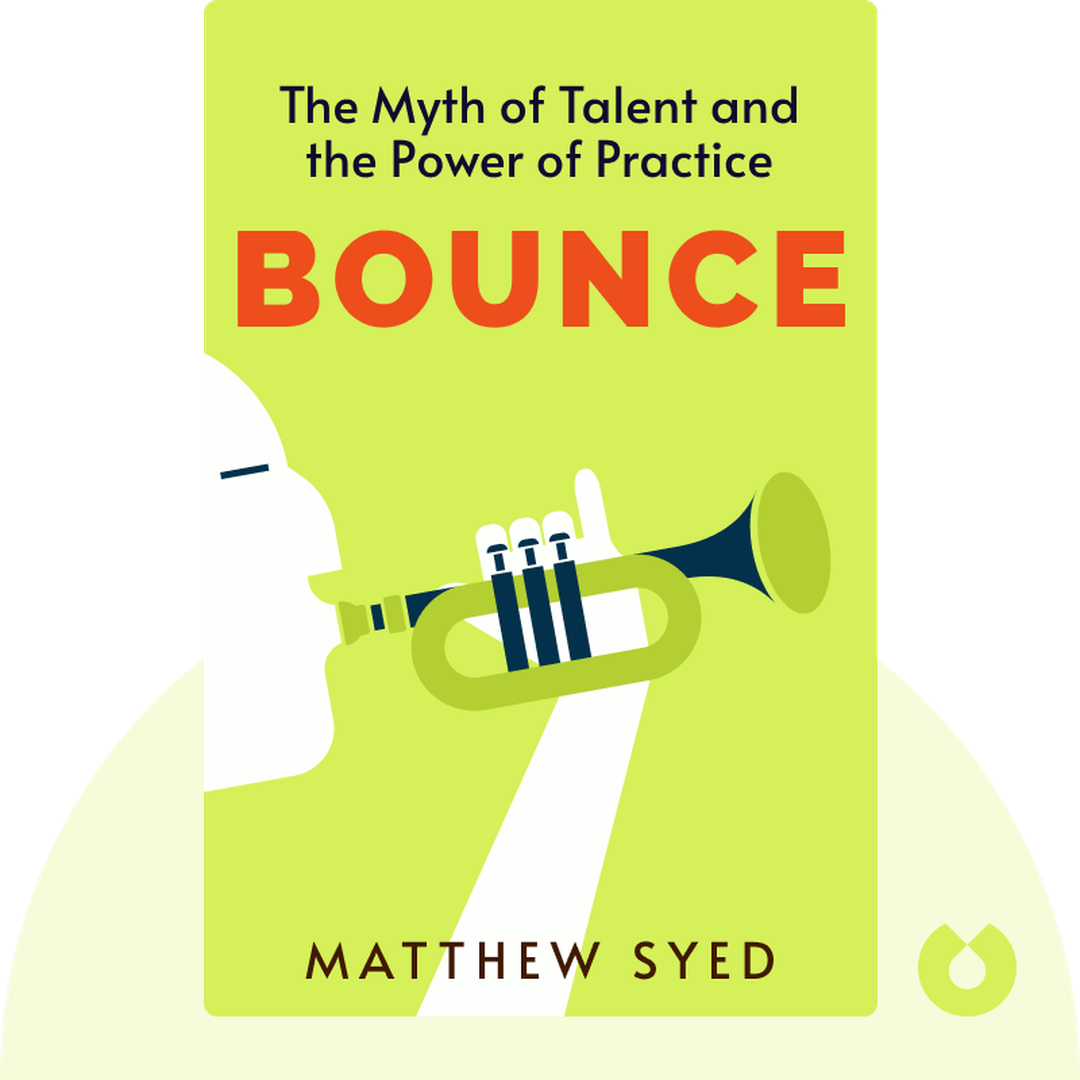
In Bounce (2011), Matthew Syed explores the origins of outstanding achievements in fields like sports, mathematics and music. He argues that it is intensive training, not natural ability that determines our success, and people who attribute great performances to natural gifts will probably miss their own chance to succeed due to lack of practice.
Who Should Listen to Bounce?
- Anyone who has big plans but is not sure that they have what it takes to succeed
- Anyone who’s interested in the secret of brilliant performances
- Anyone who wants to raise children who achieve their goals
- Anyone who wants to understand the underlying mechanisms of “choking” under pressure
Books Similar to Bounce
Readers who enjoyed this also liked these titles.