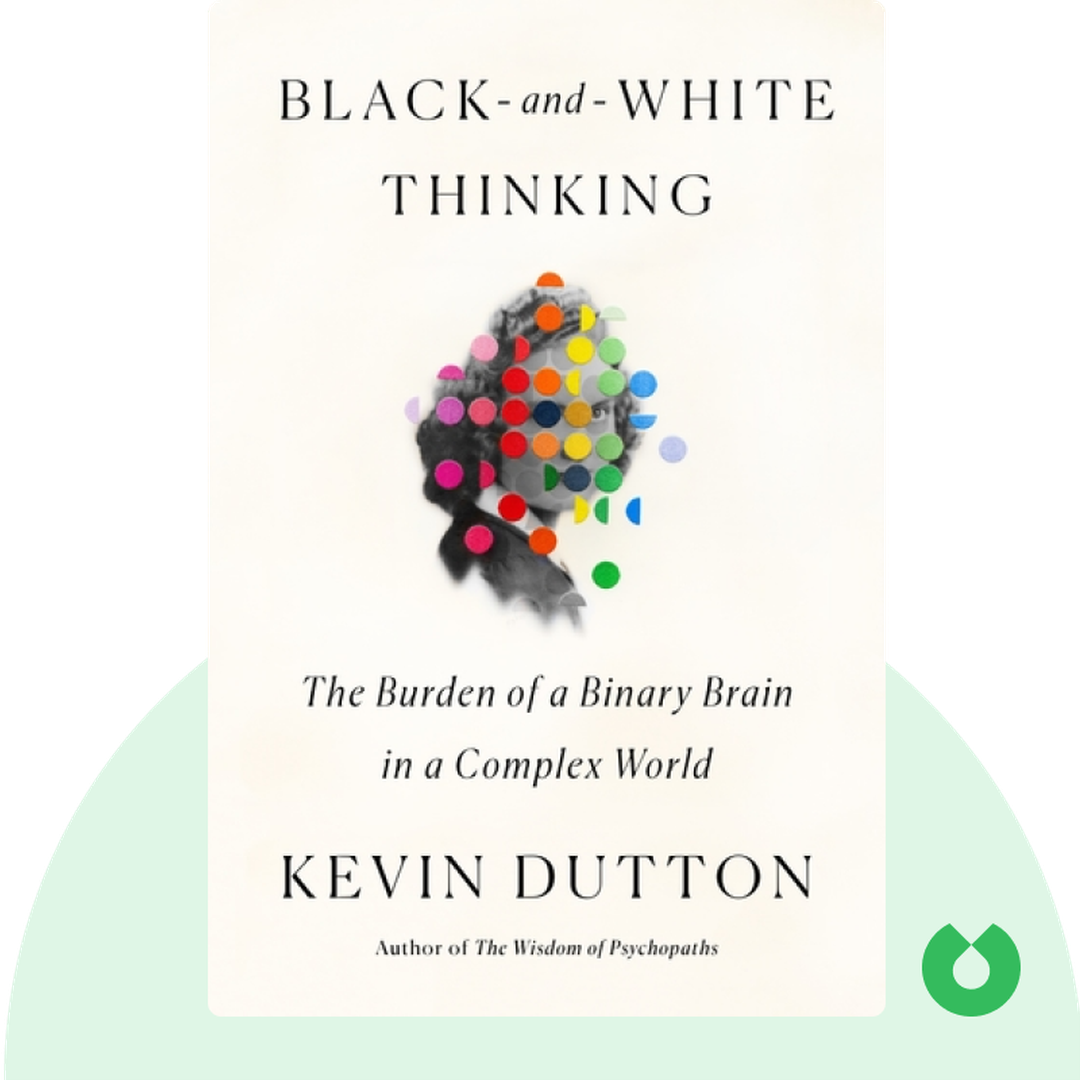
Black-and-White Thinking
Start ListeningDownload Try free on iPhoneScan to start in 5 seconds
Categories:
If You're Curious About These Questions...
You should listen to this audiobook
- How did evolutionary survival mechanisms, like the instinct to instantly categorize threats, wire our modern brains to struggle with nuanced, 'gray' issues?
- How does the everyday use of extreme language, like calling a minor inconvenience 'horrific', actually alter our brain's perception of reality and polarize our thinking?
- What is a 'supercategory', and how can simple affiliations like sports team loyalties be used to override deeply ingrained tribal biases like racial prejudice?
Listen to Black-and-White Thinking — Free Audiobook
Loading player...
Key Takeaways from Black-and-White Thinking
- Our brains evolved to rely on strict binary categories like us-versus-them and right-versus-wrong for ancient survival, but this black-and-white thinking frequently fails in a complex modern world.
- Categorizing the world too narrowly can lead to fragmented behaviors like hoarding, while categorizing too broadly frequently results in harmful stereotyping.
- Individuals with a high need for 'cognitive closure' crave absolute certainty and struggle with ambiguity, making them more susceptible to prejudiced views.
- Habitually using extreme language to describe mild situations actively trains the brain to perceive the surrounding world in a more polarized, less nuanced way.
- The most effective political and social persuasion often relies on 'supersuasion', a framing technique that manipulates our deeply wired evolutionary binaries to subtly control our choices.
Learning Tools
Reinforce what you learned from Black-and-White Thinking
Mind Map
Black-and-White Thinking
Evolutionary Origins+
The Challenge of Gray Areas+
Categorization Styles+
The Cognitive Spectrum+
Tribalism and Perception+
Language and Thought+
Framing and Persuasion+
Quiz — Test Your Understanding
Question 1 of 9
Why did evolution equip early humans with the 'us versus them' and 'right versus wrong' binaries?
Question 2 of 9
How does the Sorites paradox relate to real-world issues like abortion laws?
Question 3 of 9
According to the text, why do hoarders often struggle to throw things away?
Question 4 of 9
What did Else Frenkel-Brunswick’s study involving sketches of cats gradually turning into dogs reveal about highly prejudiced individuals?
Question 5 of 9
According to the book, is a high need for cognitive closure always a negative trait?
Question 6 of 9
What does the concept of 'tribal epistemology' explain?
Question 7 of 9
In the University of Delaware study involving football fans, what successfully overrode the participants' implicit racial biases?
Question 8 of 9
How did the use of extreme adjectives affect students in the author's language experiment?
Question 9 of 9
According to the author, what three evolutionary binaries form the foundation of 'supersuasion' frames?
Black-and-White Thinking — Full Chapter Overview
- 1Recommendation
- 2Evolution gave humans the ability to categorize.
- 3Gray areas are everywhere — and often hard to navigate.
- 4People can categorize things too narrowly or too broadly.
- 5People fall on a spectrum from cognitive closure to cognitive complexity.
- 6Tribalism warps our perception of reality.
- 7Extreme language encourages extreme thinking.
- 8Framing is a powerful tool for persuasion.
- 9Final summary
Black-and-White Thinking Summary & Overview
Black and White Thinking (2020) examines the human brain’s irresistible impulse to sort things into binary categories: black and white, good and evil, right and wrong. The instinct to categorize is strong – and we have evolution to thank for it. But while categorization helped us survive in ancient times – when every trip into the forest was life or death – it’s become an obstacle in the modern world. Today, life’s rarely black-and-white, but often shades of gray.
Who Should Listen to Black-and-White Thinking?
- Anyone fascinated by the human brain
- People who love to pick apart the intricacies of language
- Those who want to think more clearly in their daily lives
Books Similar to Black-and-White Thinking
Readers who enjoyed this also liked these titles.