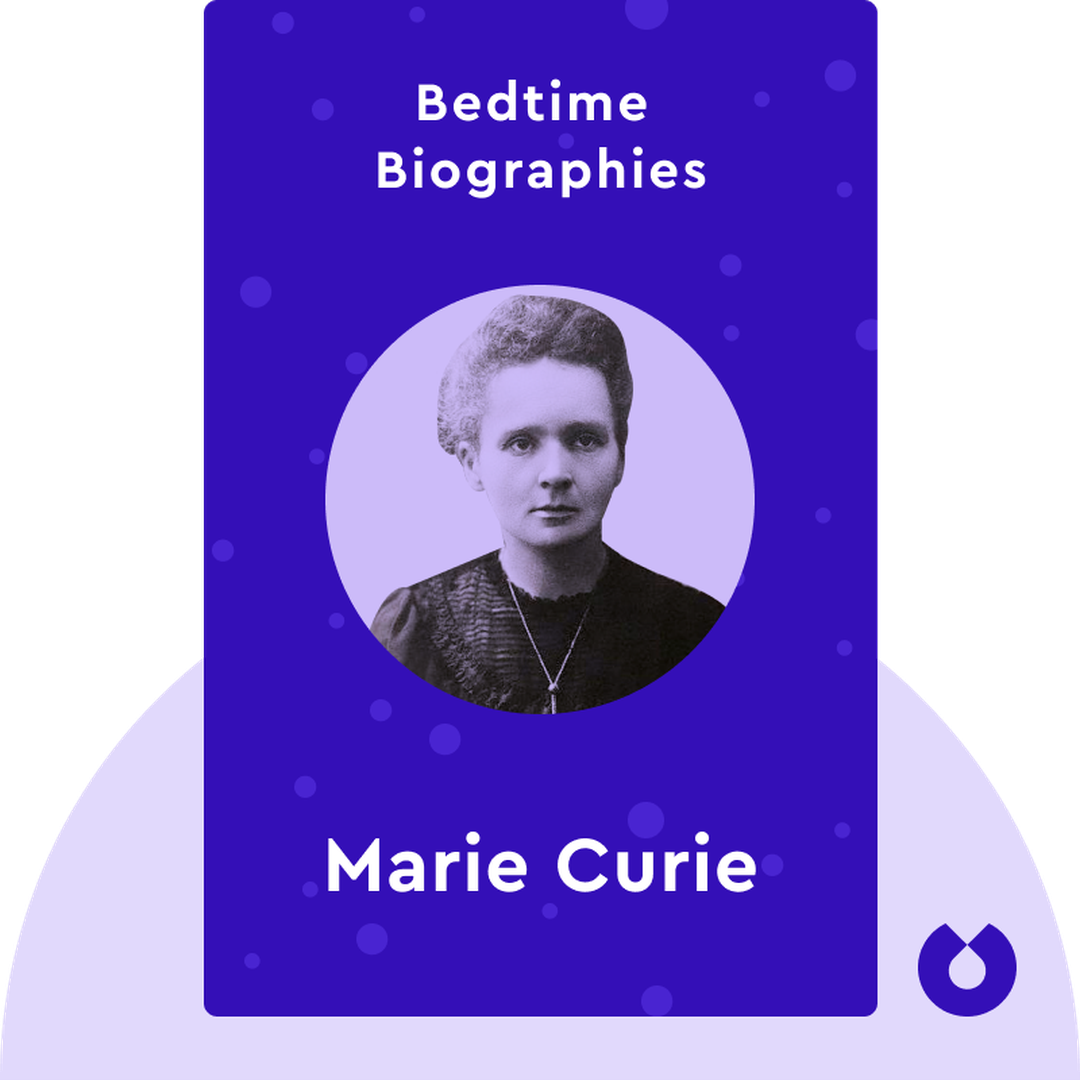
Bedtime Biography: Madame Curie
Start ListeningDownload Try free on iPhoneScan to start in 5 seconds
Categories:
If You're Curious About These Questions...
You should listen to this audiobook
- Did you know that Marie Curie is the only person to ever win Nobel Prizes in two different scientific fields, but what was the hidden personal cost of her groundbreaking discoveries?
- Have you ever wondered how a world-renowned scientist ended up on the front lines of World War I, transforming the face of medicine in the heat of battle?
- Are you curious about the private struggles and tireless spirit of the woman who defied every social barrier to change the world of science forever?
Listen to Bedtime Biography: Madame Curie — Free Audiobook
Loading player...
Key Takeaways from Bedtime Biography: Madame Curie
- Discover how Marie Curie's early fascination with science and relentless work ethic helped her overcome deep poverty and cultural suppression in Russian-occupied Poland.
- Learn the value of mutual support and delayed gratification through the strategic pact Marie made to fund her sister's medical degree before pursuing her own.
- Explore how Marie defied strict educational bans against women by attending Poland's illegal 'Floating University' and secretly teaching peasant children.
- Understand the extreme level of singular focus required for greatness by seeing how Marie sacrificed basic comforts, warmth, and proper meals in Paris to study without distraction.
- Find out how Marie's uncompromising dedication at the Sorbonne directly resulted in top academic honors, crucial scholarships, and the pivotal research assignment that introduced her to Pierre Curie.
Learning Tools
Reinforce what you learned from Bedtime Biography: Madame Curie
Mind Map
Bedtime Biography: Madame Curie
Early Life in Poland+
Education & Paris+
Scientific Discoveries+
Hardships & Triumphs+
Health & Legacy+
Quiz — Test Your Understanding
Question 1 of 9
What drove Maria and her sister Bronya to attend the 'Floating University' and make a pact to support each other financially?
Question 2 of 9
How did Marie initially fund her sister Bronya's medical education in Paris?
Question 3 of 9
According to the text, what was the primary reason Marie initially received no official credit for discovering that radioactivity is an atomic property?
Question 4 of 9
In the discovery of radioactivity, how did Marie Curie's approach differ from Henri Becquerel's initial discovery of 'uranium radiation'?
Question 5 of 9
How did Marie Curie apply her scientific knowledge to alleviate human suffering during the First World War?
Question 6 of 9
Why did Marie Curie's reputation suffer in France prior to her 1921 trip to the United States?
Question 7 of 9
What was the primary purpose and outcome of Marie Curie's trip to the United States organized by Missy Meloney?
Question 8 of 9
Why did Marie Curie expose herself to fatal levels of radiation throughout her life?
Question 9 of 9
Which of the following scientific milestones is Marie Curie NOT credited with in the provided text?
Bedtime Biography: Madame Curie — Full Chapter Overview
- 1Recommendation
- 2Chapter One
- 3Chapter Two
- 4Chapter Three
- 5Chapter Four
- 6The End
Bedtime Biography: Madame Curie Summary & Overview
Two Nobel Prizes, brilliant scientific breakthroughs, tragic losses, tireless work in the hospitals of the First World War: Marie Curie had an eventful life. In this Bedtime Biography, we will tell the story of Marie Curie, and introduce you to the woman behind the many myths.
Who Should Listen to Bedtime Biography: Madame Curie?
- Those interested in the history of science
- Fans of biographies
- Parents in search of female role models
Books Similar to Bedtime Biography: Madame Curie
Readers who enjoyed this also liked these titles.