If You're Curious About These Questions...
You should listen to this audiobook
- Did you know that a parrot can grasp complex concepts like categories, numbers, and even the abstract idea of 'zero' just like a human toddler?
- Have you ever wondered if a bird’s speech is merely mimicry, or if they are actually capable of expressing original thoughts and feelings?
- What if the secret to understanding human nature was hidden inside the mind of a single African Grey parrot?
Listen to Alex & Me — Free Audiobook
Loading player...
Key Takeaways from Alex & Me
- Discover how persistence and grit can help overcome deep-seated biases within the competitive scientific community to prove the true potential of animal intelligence.
- Understand the profound, transformative impact animals can have on human lives by providing emotional companionship and inspiring us to overcome daunting personal challenges.
- Learn how African Grey Parrots are capable of complex cognitive learning similar to kindergarten children, mastering intricate categories like shapes, colors, and numbers.
- Find out how animals can demonstrate distinct personalities and use learned vocal labels to express frustration, defuse tense situations, and respond to human emotions.
- Explore the fascinating scientific debate around animal intention by seeing how a parrot's deliberate requests strongly suggest a deeper level of cognitive understanding.
Learning Tools
Reinforce what you learned from Alex & Me
Mind Map
Alex & Me
Animal Intelligence & Learning+
Emotion & Intention+
Human-Animal Connection+
Scientific Challenges & Outsider Status+
Quiz — Test Your Understanding
Question 1 of 7
What specific training methodology did Dr. Pepperberg use to teach Alex new labels?
Question 2 of 7
Why do scientists like Dr. Pepperberg prefer to use the term 'labels' rather than 'words' or 'phrases' when discussing Alex's vocabulary?
Question 3 of 7
Which specific behavior strongly indicated to Dr. Pepperberg that Alex had clear intentions behind the labels he used?
Question 4 of 7
How did Alex demonstrate advanced creativity and the concept of 'lexical elision' when introduced to an apple?
Question 5 of 7
How did Alex prove that his understanding of numbers was based on abstract concepts rather than physical size?
Question 6 of 7
What surprising discovery did Dr. Pepperberg make when she analyzed Alex's vocal mechanisms using a heart X-ray machine?
Question 7 of 7
As a female scientist with unconventional ideas, Dr. Pepperberg avoided which common, yet harsh, methodology used by her peers to get animals to work for a reward?
Alex & Me — Full Chapter Overview
- 1Recommendation
- 2Animals can transform human lives and offer valuable insights.
- 3African Grey Parrots are exceptionally smart and quick learners.
- 4Alex reacted to emotional situations and showed signs of intent.
- 5Alex showed creativity and a sophisticated grasp of numbers.
- 6Humans and African Grey Parrots are more alike than you might think.
- 7Science can be fiercely competitive and resistant to new ideas and methods.
- 8Being an outsider is challenging, but it can bring unexpected insights.
- 9Final summary
Alex & Me Summary & Overview
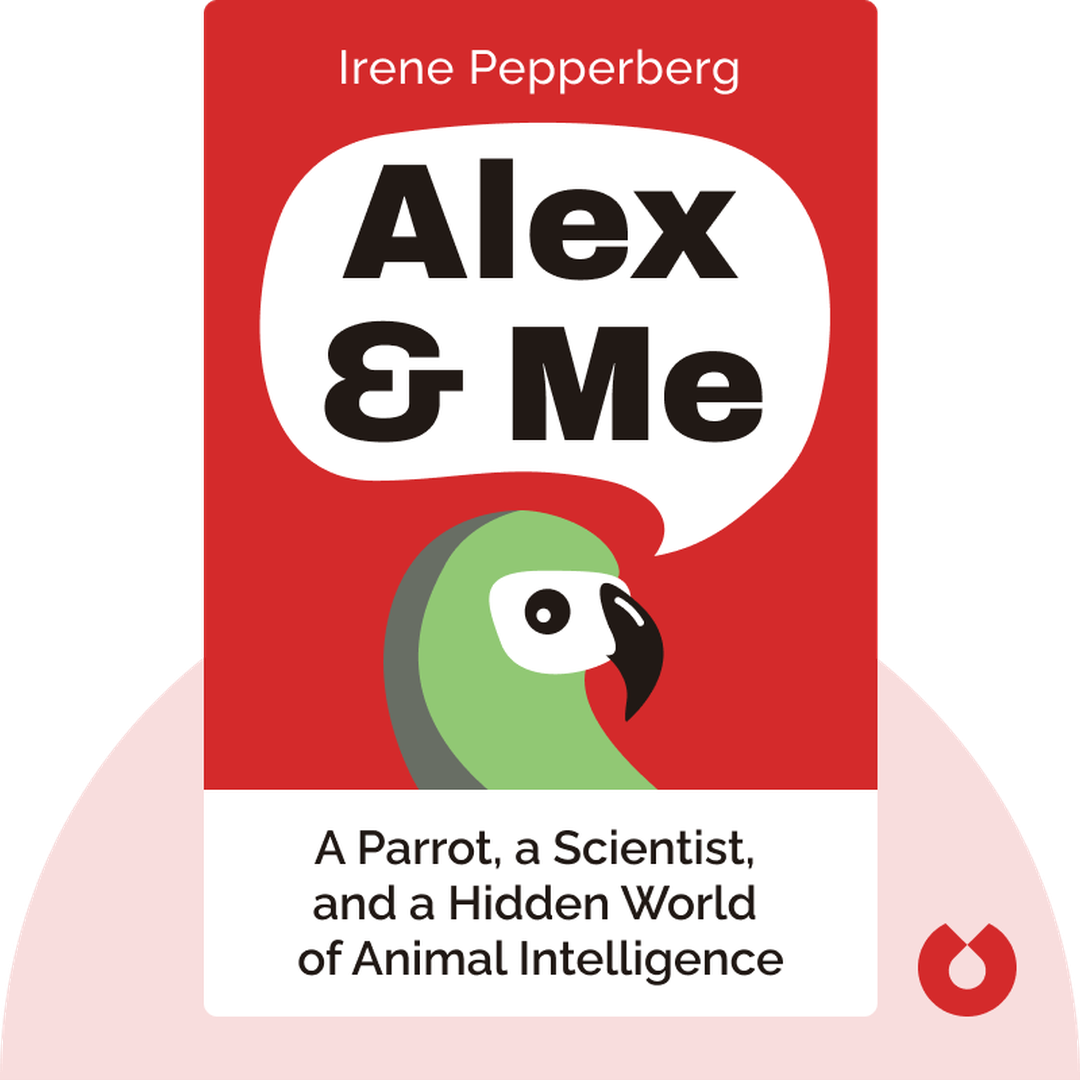
Alex & Me (2008) is the heartfelt memoir of Dr. Irene Pepperberg, who reveals the amazing story of how she, along with her parrot Alex, smashed scientific boundaries with their experiments and research on avian learning, speech and cognition. Their work has forever changed the way we think about animals, as well as how we understand human nature.
Who Should Listen to Alex & Me?
- Animal lovers
- Students of linguistics, neuroscience and speech
- Readers who like a good scientific breakthrough
Books Similar to Alex & Me
Readers who enjoyed this also liked these titles.