If You're Curious About These Questions...
You should listen to this audiobook
- Did you know that many AI systems used to predict human behavior—like who will succeed in a job—are often no more accurate than a simple coin flip?
- Have you ever wondered why AI is incredibly talented at generating content but remains dangerously unreliable when it comes to forecasting the future?
- Are you curious about how to spot the 'snake oil' in the tech industry before falling for the hype of AI that doesn't actually work?
Listen to AI Snake Oil — Free Audiobook
Loading player...
Key Takeaways from AI Snake Oil
- Discover why chatbots produce confident but false statements by merely predicting word sequences instead of actually understanding context.
- Uncover the hidden ethical costs behind generative AI, from the unauthorized use of copyrighted art to the exploitation of underpaid data-labeling workers.
- Understand how predictive AI fails to account for cause-and-effect relationships, relying solely on historical data that falls apart in new situations.
- Learn why relying on predictive AI often exacerbates societal inequality by permanently replicating historical biases against underrepresented populations.
- Recognize the dangers of automation bias and see why embracing inherent unpredictability yields better decisions than trusting easily manipulated predictive models.
Learning Tools
Reinforce what you learned from AI Snake Oil
Mind Map
AI Snake Oil
Core Premise+
Generative AI+
Predictive AI+
Content Moderation AI+
The Path Forward+
Quiz — Test Your Understanding
Question 1 of 7
According to the text, why are chatbots prone to producing plausible but inaccurate statements?
Question 2 of 7
What hidden labor issue is associated with the development of generative AI models?
Question 3 of 7
What is identified as a major limitation of predictive AI when it comes to decision-making?
Question 4 of 7
How do companies often react when fully automated predictive AI systems make poor decisions or fail?
Question 5 of 7
What is 'collateral censorship' in the context of content moderation AI?
Question 6 of 7
What approach does the book recommend for regulating artificial intelligence?
Question 7 of 7
To address the economic and employment impacts of AI automation, what policy does the text suggest might help incentivize retaining a human workforce?
AI Snake Oil — Full Chapter Overview
- 1Recommendation
- 2AI That Generates Content
- 3AI for Prediction
- 4AI for Content Moderation
- 5The Way Forward
- 6Final summary
AI Snake Oil Summary & Overview
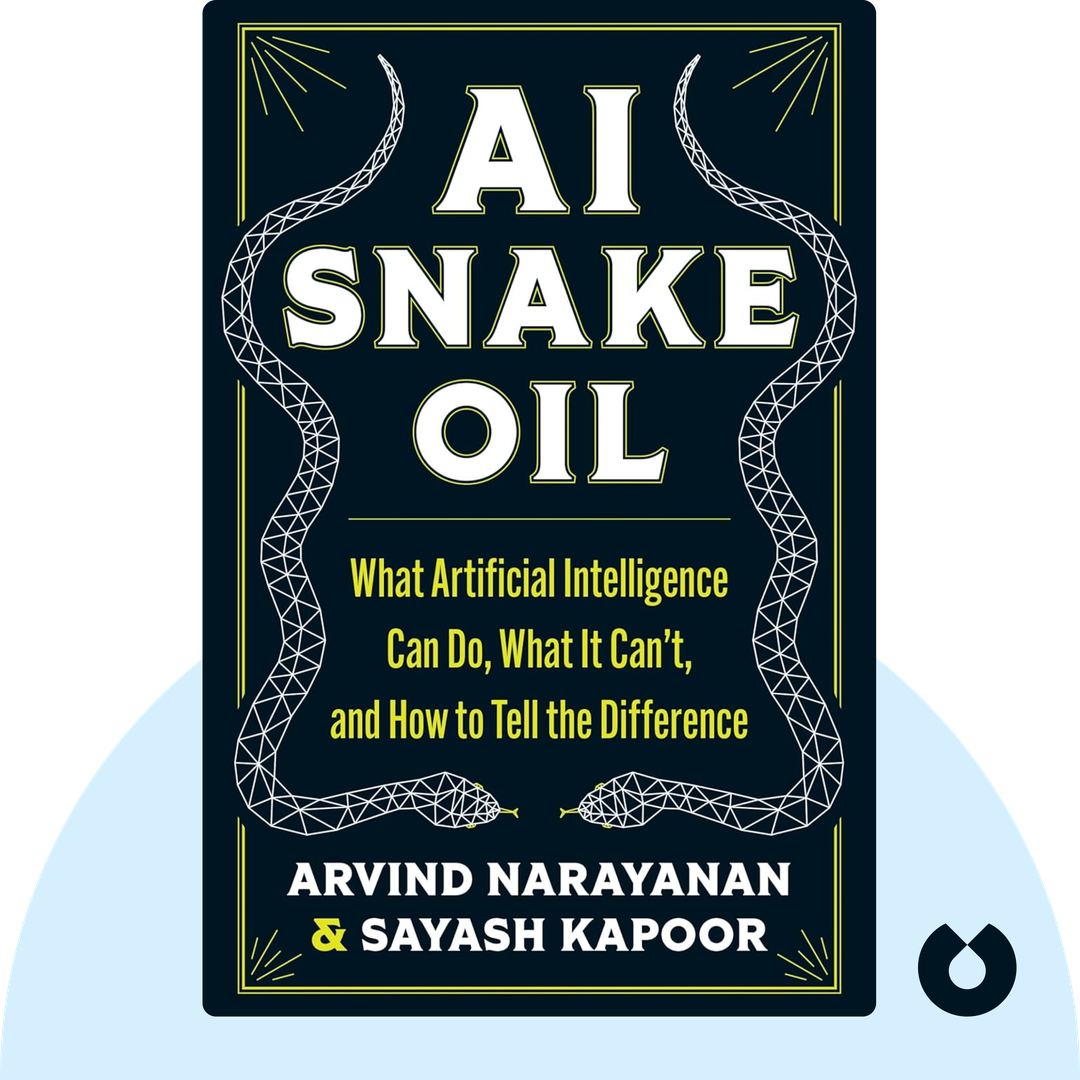
AI Snake Oil (2024) explores the myths and misconceptions surrounding artificial intelligence, particularly focusing on where AI fails to deliver on its promises. It critically examines the limitations of current technologies such as generative AI, predictive AI, and content moderation AI, emphasizing the need for a grounded understanding of what AI can and cannot achieve.
Who Should Listen to AI Snake Oil?
- Anyone keen to educate themselves about AI
- Policymakers and industry regulators
- Business and community leaders exploring AI adoption
Books Similar to AI Snake Oil
Readers who enjoyed this also liked these titles.