If You're Curious About These Questions...
You should listen to this audiobook
- Have you ever wondered what it’s actually like to trade modern comforts for 2,100 miles of unpredictable wilderness, bears, and blisters?
- Did you know that the Appalachian Trail is more than just a path, but a living museum of North America's geological history and vanishing ecology?
- Are you curious about how a grueling trek through the woods can test the limits of friendship and redefine your perspective on the natural world?
Listen to A Walk in the Woods — Cinematic Audio Edition
Loading player...
Key Takeaways from A Walk in the Woods
- Learn how embarking on the journey of a lifetime requires little more than willpower, effort, and the courage to take that first unexpected step.
- Discover the surprising origins of the 2,100-mile Appalachian Trail, a massive route entirely mapped, carved, and maintained by dedicated volunteers.
- Understand the counterintuitive practices of the US Forest Service, an agency tasked with protecting 191 million acres that actually prioritizes commercial logging, mining, and road-building.
- Prepare for the extreme physical demands and unpredictable dangers of the trail, where hikers must navigate black bear territory, sudden snowstorms, and treacherous 15-inch mountain paths.
- Explore the immense scale and biological diversity of America's wilderness, including the staggering 800-square-mile expanse of the Great Smoky Mountains National Park.
Learning Tools
Reinforce what you learned from A Walk in the Woods
Mind Map
A Walk in the Woods
The Appalachian Trail+
Flora, Fauna & Ecology+
The Hiking Experience & Dangers+
Key Locations & Milestones+
Cultural & Societal Observations+
Quiz — Test Your Understanding
Question 1 of 10
Unlike many historical routes, how did the Appalachian Trail come into existence?
Question 2 of 10
What counterintuitive activity does the US Forest Service spend most of its energy doing today?
Question 3 of 10
How does the US Park Service generally manage the Great Smoky Mountains National Park, according to the text?
Question 4 of 10
What caused the devastation of the Appalachian chestnut trees in the early 1900s?
Question 5 of 10
What realization does Bill Bryson come to about American habits when he visits Waynesboro, Virginia?
Question 6 of 10
Why is Harpers Ferry, West Virginia, considered a site of major historical significance?
Question 7 of 10
Which of the following best describes the current geological state of the Appalachian Mountains?
Question 8 of 10
According to the text, what makes hypothermia particularly insidious for hikers in places like the White Mountains?
Question 9 of 10
How did Bill Bryson and Stephen Katz's hike on the Appalachian Trail ultimately end?
Question 10 of 10
Based on the actionable advice provided, how should you react if a black bear attacks you?
A Walk in the Woods — Full Chapter Overview
- 1Recommendation
- 2The beautiful, demanding Appalachian Trail was built by twentieth-century volunteers.
- 3The US Forest Service has vast forests to manage, but its approach isn’t always ecological.
- 4Hiking the Appalachian Trail means facing all kinds of weather and terrain.
- 5The Great Smoky Mountains National Park is not only vast — its wildlife and natural beauty are remarkable.
- 6The Appalachian Trail is filled with extraordinary trees, but sadly they are highly vulnerable.
- 7Inactive Americans are fortunate to have Shenandoah National Park, despite its problems.
- 8The trail runs through Harpers Ferry, a historically important Civil War site.
- 9The Appalachian Mountains formed when continents collided, but they are now slowly shrinking.
- 10The White Mountains are an especially dangerous stretch of the Appalachian Trail.
- 11Maine’s densely forested Hundred Mile Wilderness truly lives up to its name.
- 12Final summary
A Walk in the Woods Summary & Overview
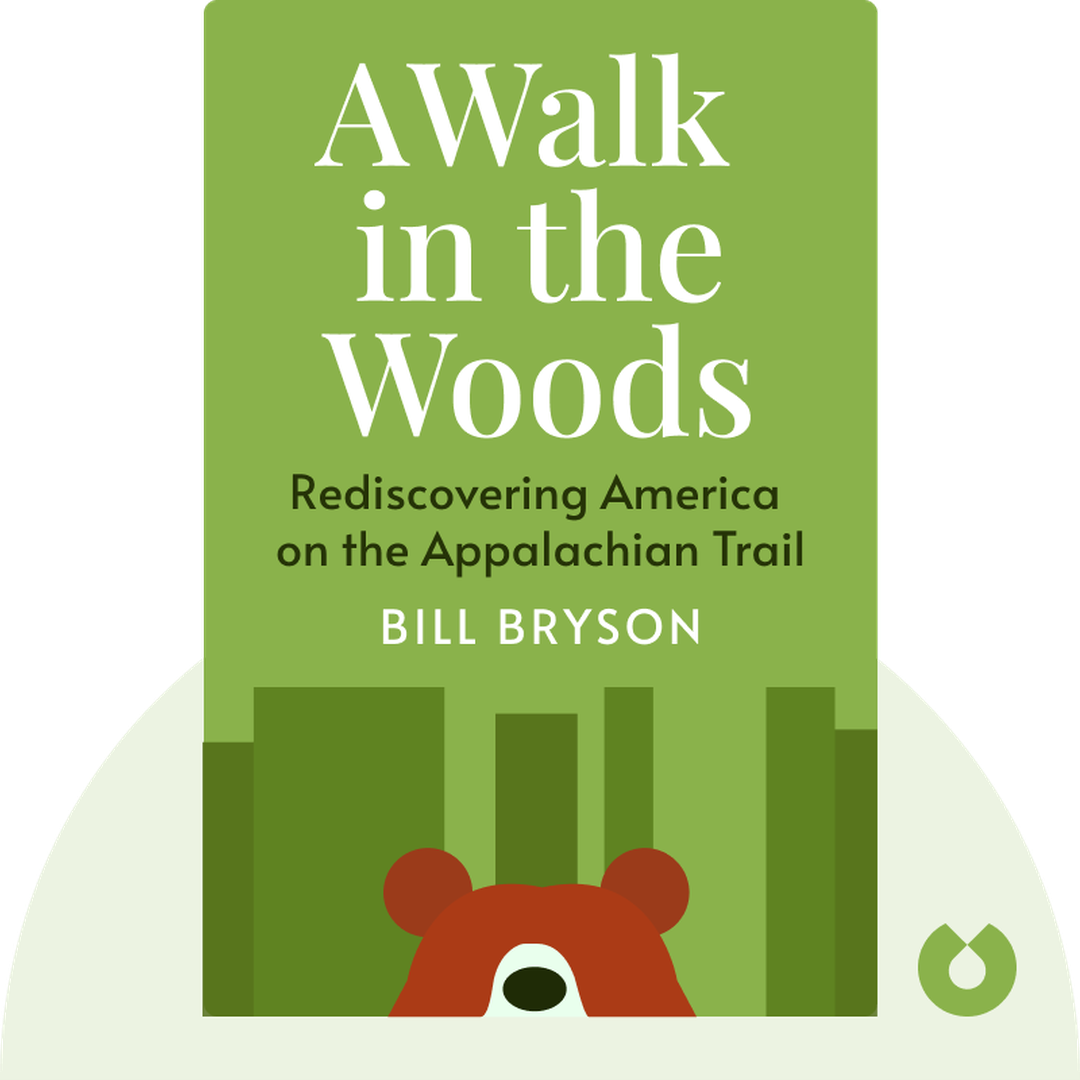
A Walk in the Woods (1997) is author Bill Bryson’s personal account of walking the Appalachian Trail – one of the longest hiking trails in the US – which stretches from Georgia in the South to Maine in the North. Partially a memoir recalling his attempt to follow its route, the book is also a tribute to the ecology, wildlife, geological history and natural environment of North America. What’s more, Bryson’s old school friend, Stephen Katz, also comes along for the ride.
Who Should Listen to A Walk in the Woods?
- Hikers and travelers
- Lovers of nature and the great outdoors
- Anyone who likes a good adventure story
Books Similar to A Walk in the Woods
Readers who enjoyed this also liked these titles.